








null
France talks a lot about reindustrialization. It finances gigafactories, supports relocations, deploys France 2030 and multiplies sectoral plans. It’s necessary. But a blind spot remains: what do we do with companies that already exist, that operate, that employ, that produce, but that risk disappearing for lack of a buyer?
In the next ten years, nearly 500,000 business leaders SMEs and TPE will reach retirement age. More than 3 million jobs are affected. At the current rate, only 130,000 VSE-SMEs would actually be transferred in the next five years. Between 20 and 30% of cessations of activity linked to retirement would occur in the absence of a successor.
This is not just a heritage problem. It is an industrial, territorial and strategic subject.
When a viable SME closes for lack of a buyer, France not only loses a line in a commercial register. It loses jobs, know-how, customer relationships, certifications, suppliers, subcontractors, sometimes an entire link in a local value chain. A precision mechanics workshop, a craft production company or an industrial subcontractor cannot be recreated in two years by decree or by grant.
This is the whole French paradox: we invest in new productive tools, but we sometimes let those we already have disappear. Reindustrializing a country without addressing transmission is like wanting to fill a bathtub while forgetting to plug the drain. Brilliant, really.
The problem is not just fiscal
Business transfer is often reduced to the Dutreil pact. This tool remains useful: it makes it possible to secure certain family transfers and prevent heirs from being forced to sell a business to pay the transfer rights.
But the Dutreil pact only addresses part of the problem. It first deals with the family continuity of capital. However, the coming wave also concerns SMEs without a family successor, companies located in territories where buyers are rare, managers who have not prepared for their succession, and external buyers who are struggling to finance a acquisition.
It is therefore necessary to distinguish several cases: family transfer of assets, operational family transfer, individual external takeover, takeover by employees, external growth. Each calls for different tools. A single tax system cannot solve everything.
The real subject: organizing a market that is too invisible today
The blockages are known.
First, the valuation. The seller often values thirty years of work, his network, his reputation, his clients. The buyer reasons in terms of repayment capacity. Between the two, the gap is often brutal.
Then, the funding. A takeover requires assembling several building blocks: personal contribution, bank debt, Bpifrance guarantee, seller credit, public aid, sometimes mezzanine debt. This know-how remains too little taught and too little accessible to first-time buyers.
Third obstacle: information. Many companies for sale are never published on a platform. They circulate via accountantsbankers, notaries, professional networks. Result: the market remains opaque, fragmented, often reserved for insiders.
Finally, culture. We still celebrate the creator of start-up as the buyer of an industrial SME with 20 employees. However, taking over a viable business, preserving jobs and growing an existing tool is also an entrepreneurial act.
France must move from awareness to a strategy
The Objectif Reprises plan presented in April 2026 marks real progress. Finally, it recognizes that business transfer is a national economic subject. Raising awareness among managers from the age of 55, modernizing networking tools and promoting recovery are going in the right direction.
But an awareness campaign is not enough to make an industrial policy.
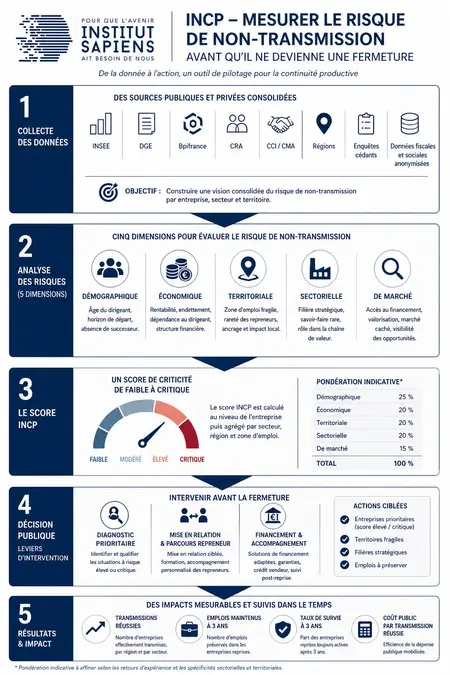
France needs real national management of transmission. This requires first measuring the risk. This is the role that a National Productive Continuity Index could play: an annual tool making it possible to map the risks of non-transmission by region, sector, company size and employment zone.
Germany already has an annual monitoring tool. For more than a decade, Japan has built public centers dedicated to the succession of SMEs, present in each prefecture. France has the necessary players: INSEE, Bpifrance, DGE, CCI, regions, France Stratégie. Above all, he lacks the decision to coordinate everything.
Create a Productive Continuity Tax Credit
We must also address the financing of the external recovery. France has a powerful tax tool for family transmission: the Dutreil pact. It could create a symmetrical tool for first-time external buyers: a Productive Continuity Tax Credit.
The principle would be simple: provide fiscal support to individuals who take over a viable SME, outside their family, in exchange for a commitment to maintaining activity and employment over several years.
This system should not be blindly added to public spending. It could be financed by a partial redeployment of the Dutreil pact, today very expensive and heavily concentrated on the most valuable transmissions. The objective is not to oppose family transmission and external recovery. It is necessary to recognize that the two relate to different logics and deserve adapted tools.
The Dutreil pact keeps the business in the family. The Productive Continuity Tax Credit would keep her in the country.
Consolidate before rebuilding
A serious industrial policy cannot only finance the future. It must also preserve what already works.
Business transfer is not a technical subject for notaries, tax specialists and accountants. It is an issue of productive sovereignty, local employment, continuity of know-how and territorial planning.
The next decade will be decisive. If France does not quickly structure a transmission policy, it risks silently losing thousands of viable businesses, while it spends billions to rebuild elsewhere what it has not been able to preserve here.
A company transferred is a factory saved. A lost business means ten years of capital destroyed.
Full article to read on the Sapiens Institute: https://www.institutsapiens.fr/observatoire/la-vague-de-transmission-des-pme-francaises-2025-2035/


