








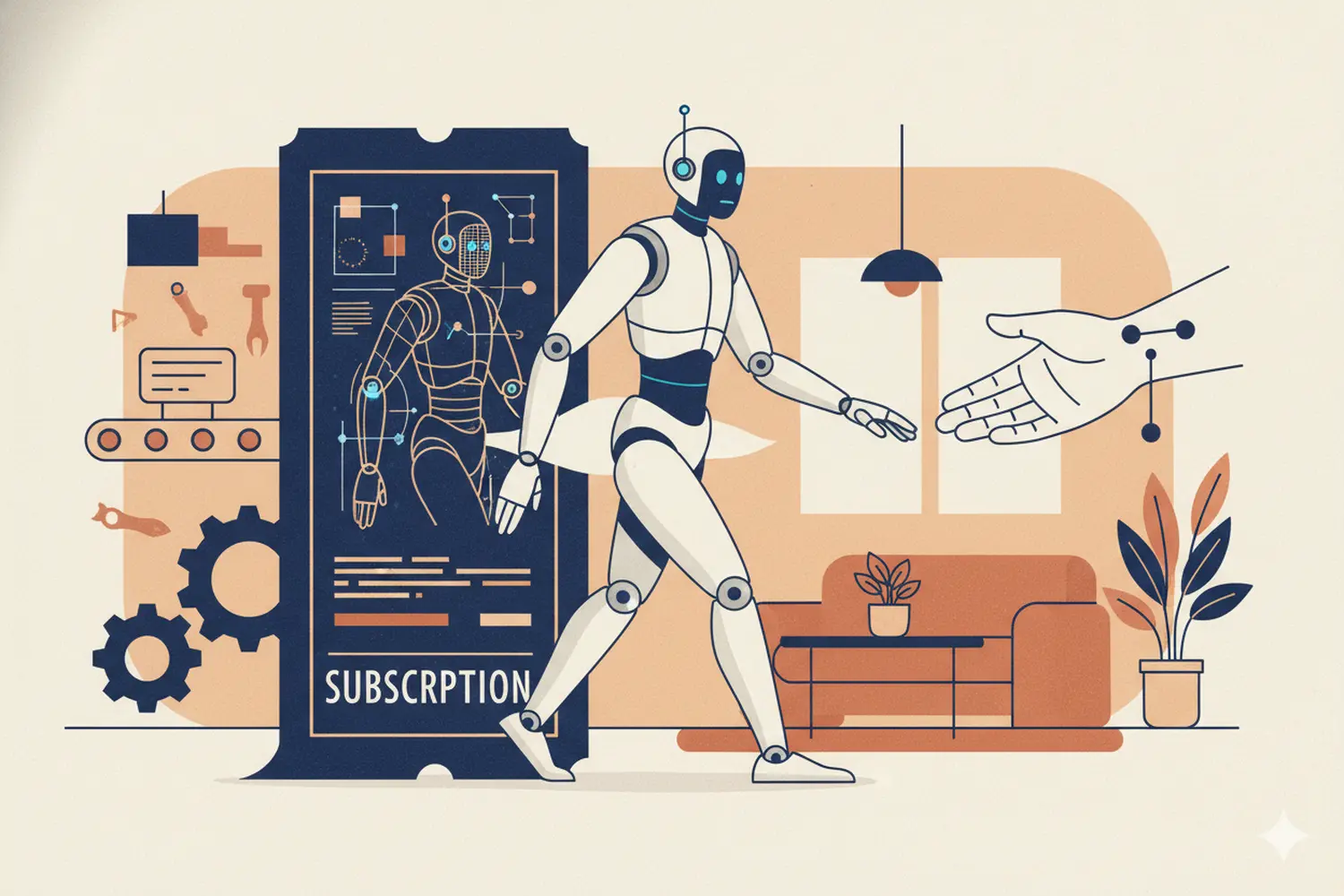
Faced with the high cost of humanoid robots, players in the sector are exploring another route than traditional purchasing: Robot-as-a-Service. Inspired by the subscription software model, it aims to reduce barriers to entry and accelerate the deployment of these machines.
The market for humanoid robots is poised for strong growth. But he faces a major obstacle: the price. For a model capable of working in a factory or warehouse, you need to count on at least 30,000 euros, and up to 300,000 euros for the most sophisticated. This represents a heavy investment for businesses, and still places these machines out of reach of SMEs and the general public.
To get around this barrier, most manufacturers rely on a system based on subscription rental: Robot-as-a-Service (RaaS). Inspired by Software-as-a-Service (SaaS), it allows businesses and individuals to pay a monthly subscription or a rate based on usage. In the case of humanoid robotswe also sometimes speak of “Humanoid-as-a-Service” (HaaS). By offering more flexibility and lowering the barrier to entry, this approach is starting to appeal to certain types of customers.
Flexibility appreciated by businesses
A recent study published by Capgemini revealed that 78% of business leaders are ready to one day deploy humanoid robots at scale. But 63% are currently deterred by the purchase price, the difficulties in training them, and an uncertain return on investment.
“Only certain sectors are already able to make these robots profitable, notably industry,” explains Guillaume Moukala Same, economist at the Asterès Institute and author of the note Humanoid robots, the next technological revolution ?. “We must maximize their utilization rate in order to reduce their hourly cost. Today, many factories remain partially constrained by human rhythms. But with largely automated installations, where only robots and machines operate, it would become possible to ensure continuous activity. In this case, the cost of robots could be amortized much more quickly.”
For the moment, manufacturers are still struggling to know how to integrate these robots or to measure their real efficiency. Renting robots rather than buying them allows them to be tested while limiting financial risks. This model also allows customers to benefit from upstream and downstream service. The supplier can help install the robots, then monitor, deploy software updates, and handle maintenance and repairs. An average humanoid robot is made up of nearly 15,000 parts, some of which wear out and must be replaced regularly.
New players, to offer a turnkey service
The RaaS model therefore allows the humanoid market to take off. At the beginning of May, the British start-up Humanoid signed one of the largest contracts to date with Schaeffler, aiming to deploy more than a thousand robots in the German mechanical parts manufacturer’s factories by 2032. Figure AI has entered into a partnership with BMW to deploy its robots on the automobile manufacturer’s assembly lines, like the French Wandercraft with Renault. And the American manufacturer Agility has started deploying robots for the logistics giant GXO.
We are also seeing the arrival of new players positioning themselves as intermediaries between robot manufacturers and companies. The French start-up Korben offers its customers all kinds of robots based on the RaaS model, from the most basic to the most sophisticated humanoids. “For us, a robot costs around 500 euros per month depending on usage,” explains Korben CEO, Lucas Goumarre, to Journal du Net. This monthly payment includes hardware, software, maintenance, support, updates, as well as technical support. “We want to be a kind of Android of robotics, but at the middleware level: an intermediate layer that manages the robots, their communication and their orchestration.”
He thus highlights another problem encountered by some of his customers, who have several robots from different brands. Korben provides a software platform to operate them in a coordinated manner, while monitoring their usage, to prevent them from remaining underutilized. Skills that companies wishing to deploy robots do not currently possess.
First RaaS offers in domestic robotics
The obstacles to mass adoption are greater in sectors where demand is not continuous, such as services, or for domestic uses. RaaS then appears all the more suitable. “If a robot only works a few hours per week, why bear the full acquisition cost?,” summarizes Guillaume Moukala Same.
If for the moment the humanoid robotics market mainly concerns B2B, the first RaaS offers are starting to emerge in B2C. The American-Norwegian company 1X is a pioneer: at the beginning of the year it launched pre-orders for its domestic humanoid robot NEO. Designed for cleaning private homes, it is offered via a subscription of $499 per month, or for $20,000 each. The first robots must be delivered before the end of the year in the United States, before the offer is opened to other countries.
The subscription notably includes the possibility of involving a remote teleoperator to carry out certain tasks (the robot is not yet completely autonomous), as well as after-sales service including maintenance and repairs.
According to the company, more than 10,000 pre-orders were received in the days following the launch. If interest is confirmed, this could constitute a first signal of a gradual democratization of humanoid robots among the general public.