







SEO is no longer enough: with the rise of generative AI, brands must now optimize their content to be integrated into AI responses, via the new “Generative Engine Optimization”.
For years, SEO has structured online visibility around a clear objective: appearing in the first results of search engines to generate traffic.
But this model is changing with the rise of search engines integrating generative artificial intelligence. Users no longer just access a list of links: they directly obtain synthetic answers, constructed from multiple sources.
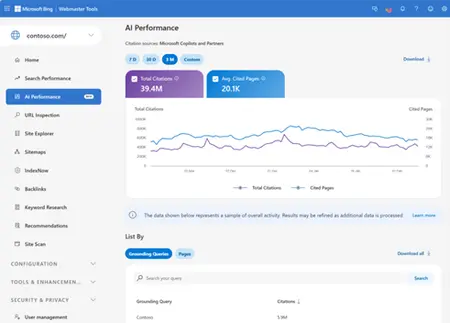
It is in this context that Microsoft launched AI Performance on February 10, 2026 in Bing Webmaster Tools, the first tool to measure the presence and influence of content in responses generated by AI.
This development marks the emergence of a new concept: Generative Engine Optimization (GEO), which complements traditional SEO and transforms the way in which companies and brands manage their digital visibility.
From positioning optimization to contribution optimization
Classic SEO is based on a central objective: improving the position of a site in search results in order to generate qualified traffic. It remains essential because it structures content, improves its readability and guarantees its accessibility in traditional search engines.
GEO introduces a different logic which is not a marginal development, but a real paradigm shift. Indeed, it is no longer just a question of optimizing visibility in a list of results, but of maximizing the contribution of content to the responses produced by AI systems.
In fact:
- The user accesses a synthetic response, often without clicking on a source
- Content is cited or integrated directly into the response
- Performance is based on perceived reliability, clarity and structuring of information
The strategic question is evolving as follows: it is no longer just a question of “am I well positioned?”, but “is my content relevant and reliable enough to be selected by the AI?”
AI Performance: making generative visibility measurable
Until recently, visibility into AI-generated responses was a blind spot in digital performance.
New tools, like AI Performance, fill this gap by introducing metrics specifically tailored to generative environments.
Among the main indicators:
- AI citation count: Number of times content is used as a source of information in an AI-generated response.
- Identification of cited pages: content most used by AI revealing formats perceived as sufficiently structured and reliable to be integrated.
- Analysis of “grounding queries”: queries used by the AI to construct and justify its responses. These are the equivalents of SEO keywords, but applied to the generative universe.
- Monitoring temporal trends: evolution of citations over time in order to measure the real impact of an editorial strategy adapted to GEO.
These indicators introduce a new reading grid: performance is no longer measured solely by the traffic generated, but also by the capacity of content to contribute to a response generated by AI.
A strategic shift
The arrival of tools like AI Performance is a game-changer: visibility in the responses generated by AI now becomes measurable. GEO moves beyond a logic of intuition to become a growth lever driven by data.
In the traditional SEO model, performance is mainly based on position and click. In a generative environment, the competition is now about the ability to be selected as a source of information.
The algorithm no longer simply classifies results: it interprets, selects and assembles the content to produce a response.
This shift marks the transition from a logic of ranking to a logic of informational contribution.
- SEO optimizes visibility.
- GEO optimizes understanding.
This development has a direct impact on acquisition: part of the value no longer resides solely in the traffic generated, but in the presence within the AI responses.
Companies must now address two complementary systems:
- Traditional, ranking-based search engines
- Generative AI engines, based on selection and synthesis.
GEO, a revolution comparable to the beginnings of SEO
The emergence of tools like AI Performance is reminiscent of the first phases of SEO structuring.
In its early days, SEO was based on limited indicators before gradually becoming a strategic lever driven by data.
GEO is now following a comparable trajectory.
Companies must adapt their editorial strategies to produce content:
- Clear, structured and easily interpretable by AI
- Reliable, sourced and demonstrating real expertise
- Designed to be cited and reused in generative responses
Generative visibility becomes a new performance indicator in its own right.
This development marks a transformation of digital marketing.
AI Performance is not a simple technical tool, but a strategic signal: artificial intelligence becomes a visibility channel in its own right.
SEO is entering a hybrid phase, where SEO and Generative Engine Optimization must be thought of in a complementary way.
In this context, companies must no longer just seek to appear in search results, but to establish themselves as reference sources capable of feeding the answers generated by AI systems.
Written by: Manon NANTILLE and Jules VIEVILLE