







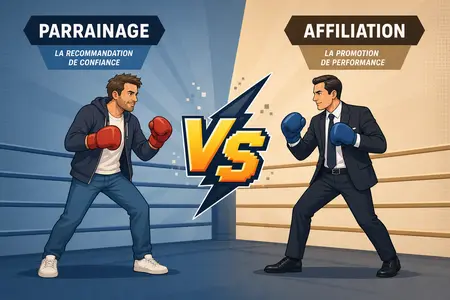
Confusing sponsorship and affiliation is the most common marketing error in performance acquisition. Two economic logics, two temporalities, and a real subject: learning to articulate them.
Many marketing departments still treat sponsorship and affiliation as two interchangeable variants of the same performance acquisition channel. This is a mistake. These two levers respond to different economic logics and temporalities. And as long as we compare them line by line in the same Excel table, we miss the real subject: their articulation.
Two mechanics that are completely opposed
On paper, the resemblance is deceptive. In both cases, a brand pays a third party who brings it a customer, based on performance. The confusion ends there.
In affiliation, the recommendation is made by a professional publisher – a comparator, a specialized media, a content creator, sometimes a cashback. His audience trusts him for the quality of his selection, and he monetizes this trust with advertisers. Traffic is intentional: the Internet user is actively looking for a product.
In sponsorship, the recommendation comes from an existing customer who speaks to their personal network. Trust does not pass through a third-party media, it comes through an interpersonal relationship. Traffic is prescriptive: the referral was not necessarily in the process of purchasing, it is the recommendation that creates the intention.
This distinction is not cosmetic. It determines the nature of the prospect, its conversion rate, and its value over time.
The real economy of each lever
This is where most analyzes miss the point. The displayed CPA says nothing about the actual CPA.
In affiliation, the cost of a client includes the commission paid to the publisher, but also platform fees, fixed promotions negotiated with large partners, and the cost of an often questionable attribution. A customer who saw a Google ad, clicked on a comparison site, then finalized their purchase directly on the brand’s website can be attributed to the affiliate at the last click – even though the brand has already paid to generate it upstream. The subject of attribution remains, in 2026, the blind spot of the majority of French programs.
In sponsorship, the equation is different. The acquisition cost is broken down into two rewards, sponsor and godchild, which may seem penalizing. But this double reward buys something that affiliation does not produce: a customer whose lifespan is, on average, longer. Several academic studies on European banking programs converge on an additional margin of around 20-25% and a significantly lower attrition rate over three years.
In other words: affiliation optimizes the acquisition cost in the short term, sponsorship optimizes customer value over time.
An intuition born from a promo code site
I edited a promo code site for years, which I ended up closing. When I wanted to relaunch a project around good deals, I came across a simple intuition: a sponsorship code resembles a promo code, except for one detail. It is not posted by the brand or by a publisher, it is posted by a client. And it is the customer himself who writes the accompanying text, which explains why the service is worth it.
This is where Parrainage.co came from. Content no longer needs to be produced: it is generated by the community, and it is useful to everyone. The sponsor receives his reward, the godchild saves, the brand acquires a customer. Everyone wins.
This experience made me understand something that I did not see when I operated solely in affiliation: a customer’s recommendation does not have the same value as a publisher’s recommendation. Not because she is absolutely “better” — she is different. It affects other profiles, with other motivations.
When each lever outperforms
Rather than a binary arbitrage, these two levers must be read through a few simple axes.
In mature and competitive markets – telecoms, energy, insurance, online banking – affiliation dominates. The consumer knows what he is looking for, compares standardized offers, and naturally lands on comparison sites. In telecoms, where I have been operating for ten years, the user compares prices and fiber speed, not a brand vision. The third-party publisher is the natural environment for this decision.
As soon as there is adoption friction — a product that requires education, which involves changing a habit — sponsorship takes the advantage. Neobanks, management applications, subscription services: the recommendation of a loved one raises objections that no comparative sheet will ever address.
Two other factors count: unit margin (you have to be able to pay two sides) and retention (a bad product mechanically kills your sponsorship program — this is also an excellent indicator of health).
The real subject: articulating them
The most successful brands do not choose between the two. They articulate them.
Affiliation captures intentionists at the top of the funnel. Sponsorship activates the satisfied base to generate a complementary incoming flow, at often lower marginal cost, and of a different quality. The two flows do not cannibalize each other: they reach prospects that the other channel would not have converted.
Three conditions for it to work. Clean attribution, otherwise you pay the same customer twice. An asymmetrical reward sizing, because a professional affiliate arbitrates on its income per click when a particular sponsor reacts to a completely different logic. And distinct risk management: the frauds are not the same, nor are the countermeasures.
Conclusion
The true cost of acquiring a brand in 2026 is no longer the CPA displayed in a dashboard. It is its ability to transform its satisfied customers into a growth channel. Brands that still see sponsorship as a marketing bonus are likely underestimating their most credible acquisition channel: their own customers.