








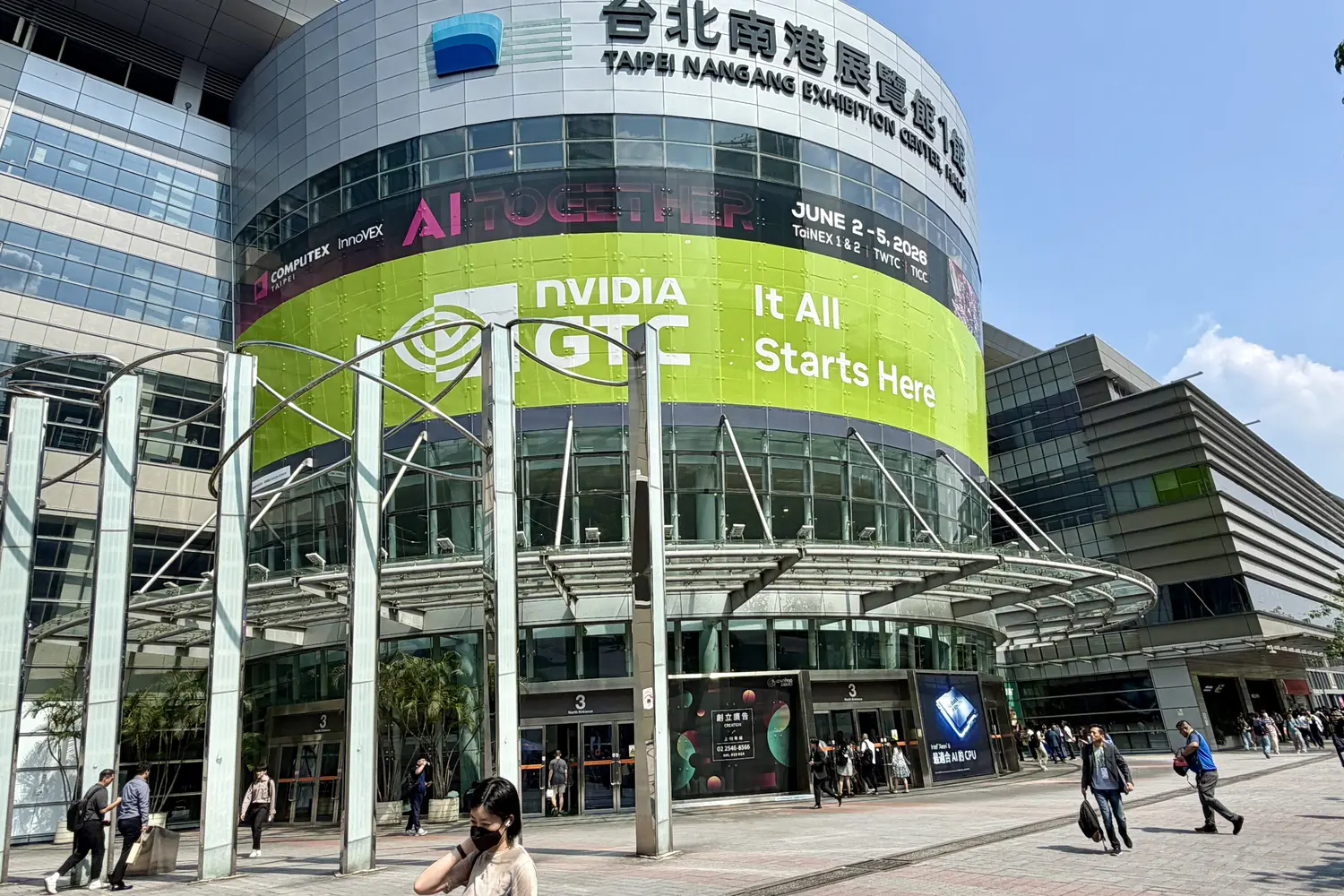
An unmissable event for hardware players, the Computex trade show is held for 4 days, from June 2 to 5, in Taiwan. This year, the 1,500 exhibitors have a single motto: support the AI revolution.
“Taiwan is the epicenter of the artificial intelligence revolution.” On the eve of the opening of the Computex TaipeiJensen Huang, the boss of Nvidia, set the tone. The largest IT exhibition in Asia opened its doors this Tuesday, June 2 in the Taiwanese capital. Computers, semiconductors, roboticsconnected objects: artificial intelligence is now present in almost all sectors represented.
The slogan of this edition, “AI Together”, reflects this omnipresence of AI. “Artificial intelligence is not just a new tool. It is the beginning of a new civilization,” said James CF Huang, president of TAITRA, the organization responsible for promoting Taiwanese foreign trade and co-organizer of the show, at the inauguration. This 2026 edition of Computex is an opportunity for Taiwan to display the richness of its ecosystem. Among the 1,500 exhibitors present, from 33 countries, 956 are Taiwanese companies.
AI in all its forms
Taiwan’s current role in artificial intelligence is the result of decades of investment in semiconductors and computing. “As early as the 1980s, Taiwan was at the forefront of semiconductors, motherboards and personal computing. Today, this expertise has shifted to servers and infrastructure needed for AI,” explains Garrett Dunne, marketing manager at Gigabyte, a Taiwanese giant of servers and computing infrastructure for artificial intelligence.
The island’s strength, he said, lies in the concentration of much of the artificial intelligence value chain, from chip designers to server makers to infrastructure providers. Gigabyte occupies precisely an intermediate position in this ecosystem. “We transform technologies developed by chipmakers into servers ready to be deployed in the cloud,” he explains.
This technological expertise is reflected in the diversity of exhibitors present at Computex. Historical manufacturers like Asus, Acer or Advantech rub shoulders with more specialized players such as Wiwynn, AAEON or Solomon, active in artificial intelligence infrastructures, Edge AI, industrial automation and robotics. From data centers to autonomous vehicles, including digital health and cybersecurity, artificial intelligence is establishing itself as the common thread of the show.
Michael Cheng, chief information officer (CIO) of Lanner, a Taiwanese specialist in Edge AI and network security solutions, says local companies are now looking to cover the entire AI value chain, from hardware to software and services. “We have several years, even several decades, head start on certain hardware aspects. The challenge is now more software,” he believes.
Taiwan attracts desire
The Taiwanese artificial intelligence ecosystem is attracting interest well beyond the island’s borders. Qualcomm, Intel and many American, European and Asian companies traveled to Taipei for Computex. But the most visible offensive is undoubtedly that of Nvidia, which has become one of the main beneficiaries of the global AI boom.
Jensen Huang, born in Taiwan before emigrating to the United States, launched a real seduction operation towards his native island. Arriving several days before the opening of the show, he was seen in the night markets of Taipei and held meetings with the managers of the main local companies.
The boss of Nvidia above all announced the construction of the group’s future Taiwanese headquarters in Taipei, as well as a massive strengthening of the company’s investments in the local ecosystem. Nvidia already works with some 150 Taiwanese partners, including semiconductor giant TSMC, whose factories produce many of the chips used for artificial intelligence systems. According to Jensen Huang, Nvidia’s annual spending in Taiwan could soon reach $150 billion, up from $10 to $15 billion a few years ago.
Thus, AI is becoming one of the main drivers of the Taiwanese economy: the total capitalization of the Taiwan Stock Exchange reached $4.95 trillion at the end of May, making the Taiwanese market the fifth largest stock market in the world. And Taiwan’s GDP grew by 14.55% in the first quarter of 2026.
The latest technological developments could help accelerate this movement. “Taiwan has already demonstrated its excellence in hardware. The next challenge will be to establish itself further in software and artificial intelligence. Physical AI is probably the next big technological wave,” said Benjamin Chen, founder and director of Wyin AI, a Taiwanese start-up specializing in artificial intelligence agents and robotic applications.
For the first time this year, Computex is presenting a pavilion dedicated to robotics and physical AI. You can come across humanoid robotsadmire robotic arms or even discover foundation models intended to train the AI agents that power them. A market in which many Taiwanese players have already started to position themselves, both in hardware and software.


