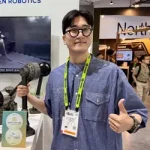





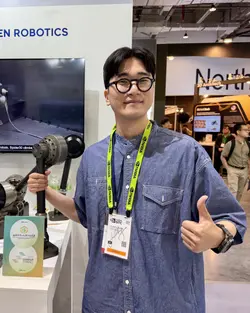
Crossed by Computex in Taiwan, the Korean startup Diden Robotics develops robots capable of carrying out the most dangerous tasks in shipyards. Its objective: to resolve the labor shortage affecting the sector.
JDN. Can you introduce us to Diden Robotics?
Joon-Ha Kim. The name of Diden Robotics comes from a Korean word meaning “everywhere”. Our objective is to develop robotic platforms capable of operating in industrial environments. We are currently developing two types of robots: a spider robot and a humanoid robot.
What uses is this spider robot intended for?
It is intended for the shipbuilding industry, a sector where metal structures are omnipresent. This is why we have developed legs equipped with magnetic systems that allow it to climb walls. Each module weighs approximately 1.8 kilograms, but can support up to 200 kilograms. The system is automatically switchable. When you place the robot on a metal wall and activate the magnet, it remains fixed even if the power supply is cut. It is therefore an extremely safe and very energy efficient solution.
What tasks can it accomplish?
Currently, he carries out welding operations. And in the future, it will also be able to do painting, non-destructive testing, or even stripping by blasting abrasives. Our system is particularly flexible, because it allows different equipment to be integrated depending on needs.
How is the robot able to move around the ship alone?
In shipbuilding, work is generally carried out in confined spaces. Once his task is completed in an area, the robot must join the next one by crossing the openings connecting the different compartments of the ship. Using a combination of artificial intelligence, onboard vision, data from its cameras, digital plans of the ship and predefined waypoints, it can locate itself, navigate the structure, then automatically move to the next compartment.
Who are your customers?
We work with the world’s largest shipyards, including HD Hyundai Heavy Industries, Samsung Heavy Industries and Hanwha Ocean. They began testing the robot in real operating conditions.
What were the challenges faced during the development of the robot?
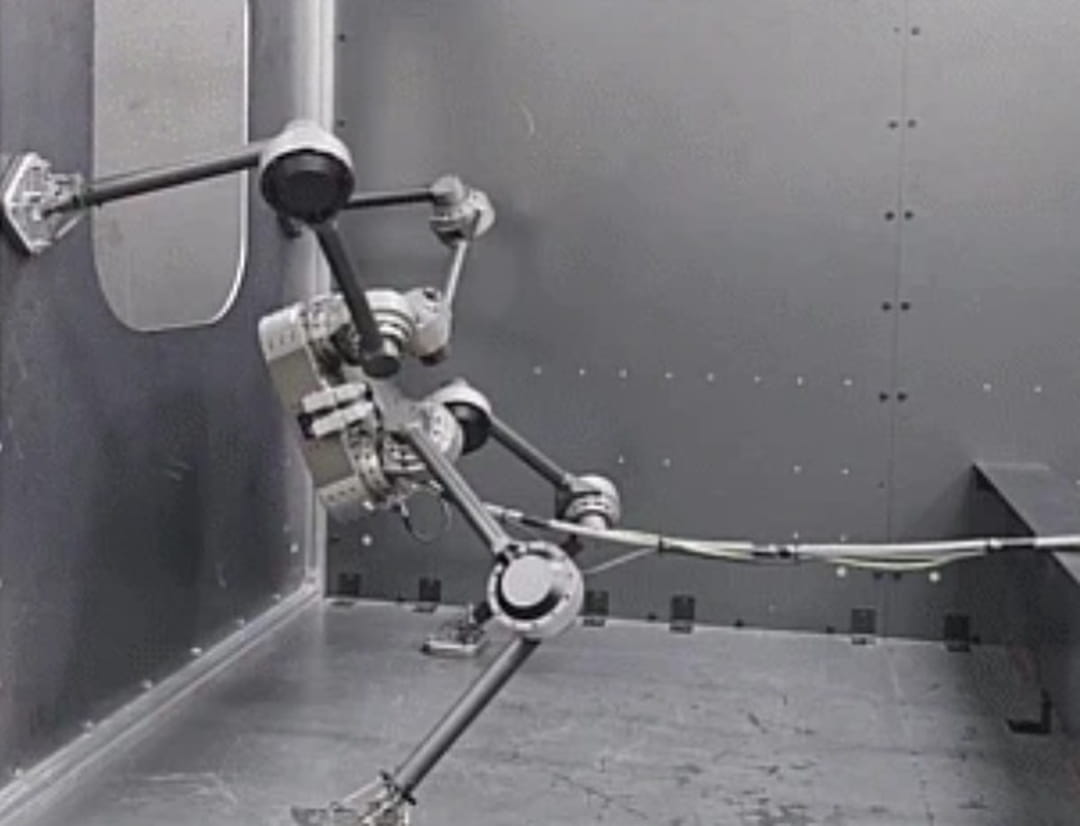
To make this type of robot truly robust, we had to develop our own actuators (the small motors which allow the different parts of the robot to move, editor’s note). Commercially available actuators did not provide a sufficient level of water and dust resistance, and their torque was not high enough for our needs. The wiring is located inside the mechanism to guarantee its watertightness. This actuator is today among the best in the world in terms of torque density. To exploit this level of performance, you must have a suitable motor controller. So we also develop it ourselves.
Why is it relevant to deploy these robots?
Shipyards are particularly dangerous environments, where serious accidents are common. In Korea, the average age of workers in the sector today exceeds 50 and younger generations no longer wish to pursue these professions.
The industry once employed nearly 200,000 people, compared to just 80 to 90,000 today. This labor shortage is explained in particular by the arduousness of the work. In Korea, we talk about “3D jobs”: Dirty, Dangerous, Difficult. Furthermore, conventional robots are not adapted to this environment. The obstacles are numerous, the structures are complex and the loads to be handled are very heavy.
You are also developing a humanoid robot. When did you start this project and why?
We started developing our humanoid robot seven months ago. Our objective is to create a robot capable of operating in the maritime and construction sectors, where obstacles are numerous and heavy loads are frequent. Unlike many companies developing highly sophisticated robotic hands that can reach 22 degrees of freedom and cost up to $55,000, we believe that most industrial tasks do not require such dexterity. Our priority is strength rather than precision. The robot is designed to navigate obstacles, manipulate equipment and transport loads. He can already lift around 50 kilograms.
Is it more complex to develop a humanoid or a spider robot?
In reality, the spider robot is much more complex. A humanoid can perform many tasks with relatively simple AI. Conversely, our robot must navigate in three dimensions on metal structures, climb walls and cross openings autonomously, which constitutes a much greater challenge. This is why we adopted a hybrid approach combining traditional control methods and artificial intelligence. Conventional algorithms define trajectories and waypoints, while AI optimizes the robot’s movements and control. This approach constitutes one of the specificities of our technology.
Ultimately, is the goal for your two types of robots to work together and coordinate their actions?
Yes. The spider robot you see here is connected to a cable. As it carries out welding operations in particular, managing this cable is a difficult task to carry out independently. Today we can deploy eight spider robots for a ship, accompanied by a human operator to manage the cables. In the future, we believe that this assistance role could be provided by our humanoid robot.
What is the current price of these robots?
The spider robot costs around $70,000. For the humanoid, our goal is to reach a price of around $110,000.
What is unique about Korea in the field of robotics?
Korea benefits from a major advantage: its industrial base. We still have many factories and access to large amounts of data from real-world environments, which is essential for developing robots and artificial intelligence systems for the field. Korea also has one of the highest densities of industrial robots in the world. We are therefore used to quickly deploying and testing new technologies in real conditions. Finally, we have recognized expertise in locomotion systems. Our laboratory notably holds a Guinness World Record for the fastest quadruped robot in the world and has also developed a robot capable of running a full marathon.
Why is it important for you to be here in Taiwan?
Taiwan is very strong in industrial manufacturing, semiconductors and embedded computing systems. We want to deploy more robots in the field, but we do not always find embedded platforms that exactly meet our constraints. So we came to meet Taiwanese manufacturers to see if certain configurations could be suitable for our robots.