








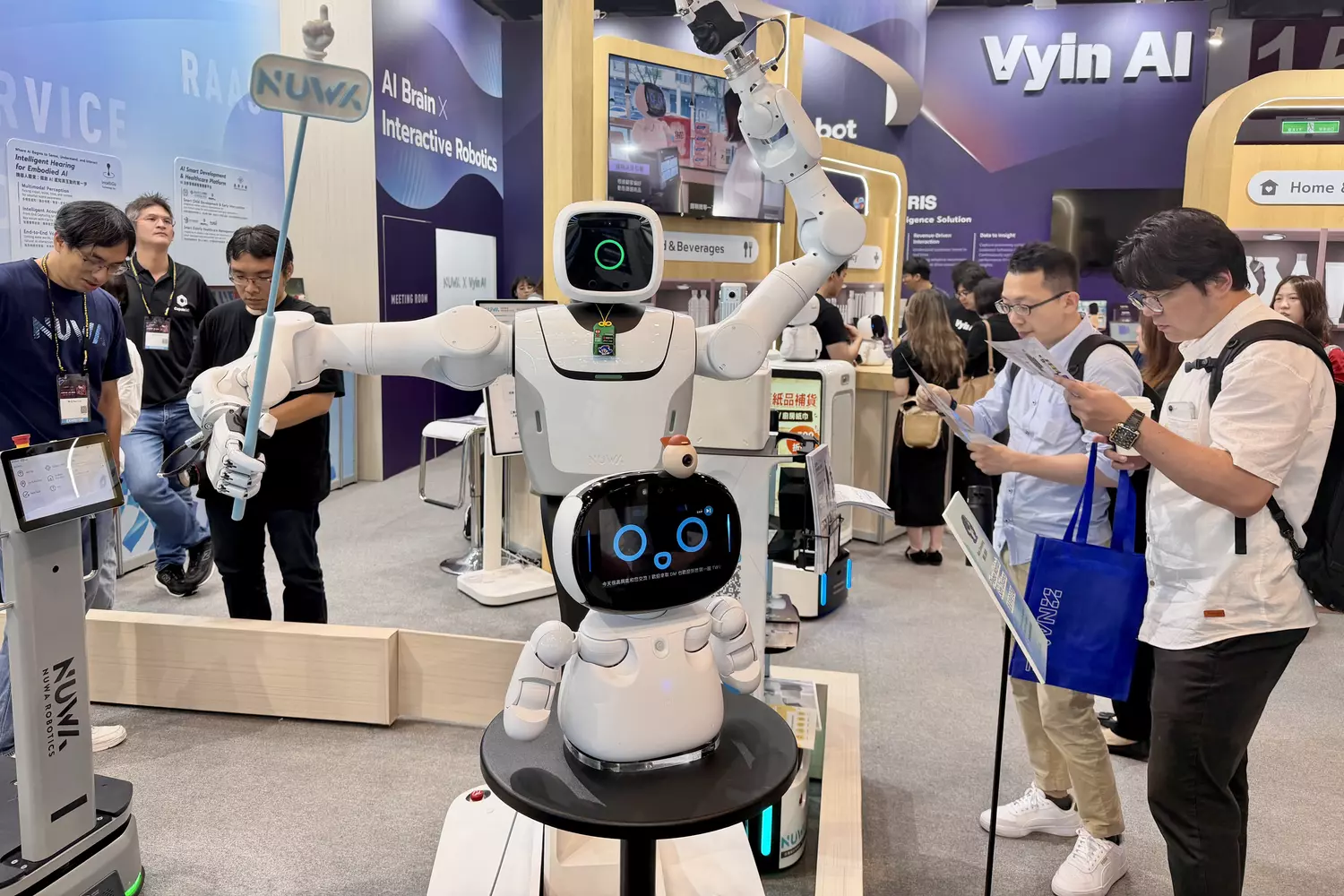
Walking through the aisles of the show this week Computex Taipeiwhich ended on Friday, we could come across an impressive quantity of humanoid robots. For the first time, a pavilion entirely dedicated to robotics has even been set up, illustrating the growing importance of the sector and the vitality of the Taiwanese ecosystem in this area.
A world leader in semiconductor manufacturing for decades, the Asian island is establishing itself as a leading figure in physical AI and robotics. Because, like computer and smartphone manufacturers before them, the largest manufacturers of humanoid robots source their supplies from Taiwan, particularly the Americans.
And Taiwan is now taking a new step, becoming more than just a hardware supplier. Local companies are developing artificial intelligence software that powers humanoid robots, and some of them even build robots from start to finish.
Taiwan, supplier to American humanoid builders
The rich Taiwanese ecosystem is home, among others, to the world’s leading semiconductor manufacturer, TSMC, and Foxconn, the main subcontractor to several Tech giants, including Apple. It was therefore logical that manufacturers of humanoid robots would turn to the Asian country. Because humanoids are not that different from computers and smartphones. These include chips, processors and other similar electronic components.
Many local players have specialized in the supply of parts for humanoid robotics. We can notably cite HIWIN, world leader in precision components (motors, gearboxes, actuators), or Delta Electronics, which develops industrial automation solutions and robotic technologies.
Present at Computex, Tuf One is a company specializing in the design and manufacturing of gearboxes for humanoids. In addition to these mechanical components, it develops integrated actuator solutions combining motors, encoders and reducers in order to offer its customers systems ready to be integrated into their robots.
As its general manager, Markus Wu, explains, the company supplies almost all American humanoid robot manufacturers. “Taiwan’s strength lies in its rich industrial ecosystem and supply chain,” he explains. “Whether we need engines, additional equipment or technical support, we easily find suppliers and partners. Taiwan is a compact territory: it takes only four to five hours to cross the island from north to south. No matter what type of resource or supplier you need, you can usually find a solution quickly.”
It is therefore a very promising new market which is opening up for the country of 23 million inhabitants. According to a recent report published by Markets and Markets, the Taiwanese humanoid robotics market could grow from $41.8 million in 2025 to $144.8 million in 2030, representing growth of nearly 30% per year over five years. And according to this same report, one of the main drivers of this growth could be software.
Software, the new frontier
While robots are made up of a large quantity of mechanical and electronic parts, their intelligence relies on advanced artificial intelligence software. Many Taiwanese companies have therefore started to develop their own solutions for humanoids. This dynamic relies largely on the NVIDIA ecosystem, whose founder and CEO, Jensen Huang, is originally from Taiwan. The American giant is also considerably strengthening its presence on the island, where it recently announced the construction of a new regional headquarters.
Beyond the chips that power artificial intelligence models, NVIDIA also provides the software platforms that allow robots to be simulated, trained and tested in virtual environments before deployment in the real world. Foxconn thus relies on NVIDIA technologies to develop artificial intelligence solutions intended for humanoid robots.
For its part, Solomon Technology, a Taiwanese specialist in industrial artificial intelligence and 3D vision systems, has developed a platform for training humanoid robots using natural language instructions, also relying on NVIDIA platforms.
Start-ups specializing in software powering humanoid robots have also emerged, such as NUWA Roboticswhich is developing its own “robotic brain”, a software architecture bringing together artificial intelligence, sensor perception, decision-making and movement control.
At Computex, ADLINK presented a robotic platform based on NVIDIA’s Jetson Thor chip, capable of processing data from cameras, lidars and other sensors in real time. These systems allow robots to learn more quickly, particularly from simulations or video demonstrations. “For a long time, we were primarily manufacturers. But in recent years, we have evolved into artificial intelligence and robotics,” explains Eddie Liu, product manager of ADLINK’s intelligent systems division. “We benefit from an extremely strong industrial ecosystem. Our suppliers are nearby, which facilitates collaborations and accelerates the development of new solutions. And with a partner like NVIDIA, we can move much faster.”
Some local players have even taken the plunge by developing their own end-to-end humanoid robots. This is the case of Graphen. Although its headquarters is located in New York, the start-up is led by Taiwanese Ching-Yung Lin and relies largely on the local industrial ecosystem.
The start-up is developing two humanoid models: Aiter One, a humanoid robot designed to interact with humans in the service and health sectors, and Aiter Go, a bipedal robot intended for logistics and industrial applications. “We develop almost all of our humanoid robot in Taiwan, with the exception of a few components that we have to import from China,” explains its director, Ching-Yung Lin. “Taiwan has all the technology, and companies like NVIDIA and AMD are investing heavily in our ecosystem. So there is every reason to be excited about the future.”


