








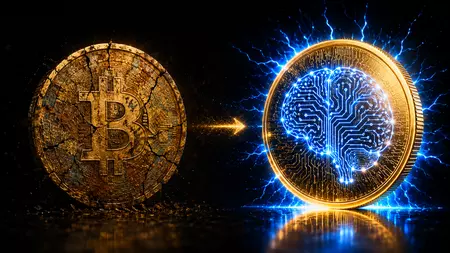
AI is the Bitcoin of 2010. Everyone remembers it. They scared you with AI to sell you subscriptions. They backpedal to sell you stocks.
When I learned that OpenAI and Anthropic were going public, my first reaction was instinctive.
“I buy!”
Seriously. My thought lasted about thirty seconds. AI is the Bitcoin of 2010. Everyone remembers it — that window when it was enough to buy a few hundred euros of BTC to become a millionaire fifteen years later. Those who missed it are still talking about it. With this expression. This mixture of regret and disbelief.
And now history seemed to repeat itself. Two companies that have literally reinvented global IT. Hundreds of millions of users. A technology that is needed everywhere. Stratospheric valuations. The entry ticket to the stock market seemed to be exactly that: the Bitcoin that I hadn’t missed this time.
Then I looked at the numbers. Really watched.
AI-generated image
And I realized that maybe I was being manipulated — like millions of others.
Write down this date. May 26, 2026.
That day, Sam Altman, CEO of OpenAI, declared at a conference in Sydney that he was “really wrong”. AI, he says, will not cause “the jobs apocalypse.” He is even “delighted” to have been wrong. The same day, Jensen Huang, boss of Nvidia, described as “lazy” the speech of managers who lay off workers by invoking AI.
Two weeks later, OpenAI filed its S-1 with the SEC. Valuation: $852 billion.
Coincidence?
The timeline that no one traces
Start the movie from the beginning. Not since today. From the beginning.
- ChatGPT is released. The same leaders who are backpedaling today are starting to raise the specter. The AI will destroy everything. White-collar workers are under threat. Developers, accountants, lawyers, editors — all replaceable. Altman himself speaks of a “real risk” of massive job destruction. Dario Amodei, his rival at Anthropic, speaks of an AI that could “transform 90% of jobs.”
Fear sets in. It is maintained. Thoroughly.
Result: millions of terrified employees are buying AI training. Panicked businesses are signing up for ChatGPT Enterprise licenses at high prices. Leaders are deploying AI tools urgently to “not fall behind.” Training budgets are exploding. OPCOs are being emptied in favor of AI service providers.
Fear was the product. You were the market.
The best choreographed turnaround in tech history
May 26, 2026. IPO imminent. And suddenly the apocalypse won’t happen.
“I thought more white-collar jobs would have been eliminated by now. I’m glad I was wrong.” — Sam Altman, Sydney, May 26, 2026.
Analyze the mechanics. To go public, you need three things: lenient regulators, non-hostile public opinion, and institutional investors who don’t fear a political backlash. A CEO who spent two years announcing massive job destruction is an IPO risk. A CEO who says “actually I was wrong, everything is fine” is bankable.
The discourse has changed. Not the technology. Not the data. The stock market calendar.
Meanwhile, the actual numbers tell a different story. May 2026: 115,000 jobs lost in tech. Meta fires 8,000 people explicitly citing AI. Microsoft: 8,750 departures. Cisco: 4,000 deletions. Standard Chartered announces several thousand layoffs “as AI replaces its employees.”
The apocalypse will not happen. But 115,000 people still lost their jobs in one month.
852 billion for a company that loses 14 billion per year
Let’s focus on the numbers. Really.
OpenAI: 852 billion valuation. 14 billion losses projected in 2026. Profitability announced for 2029 at best, 2030 according to the most cautious analysts. Price-to-sales ratio: 65 times 2025 revenues.
For the record: Meta was worth 104 billion at its IPO in 2012. Uber 82 billion in 2019. These companies were already profitable or close to being profitable.
Anthropic does even better: valuation of 965 billion. OpenAI is not even the most expensive anymore. The historic leader in generative AI is overtaken by its main competitor — a week before its own S-1 filing.
It’s a race. Not a strategy.
And a race towards what exactly? Towards a profitability that no one knows how to date precisely, fueled by an infrastructure that devours capital like a nuclear reactor devours uranium.
The tech that eats itself
Here’s the question that no one frankly asks.
The $500 billion invested in AI in 2026 — where is it actually going?
They go to Nvidia, which sells GPUs. At Microsoft, Amazon and Google, which sell computing power. In data centers that consume the electricity equivalent of entire countries. In larger and larger models that require more compute, that require more GPUs, that require more data centers.
AI funds the infrastructure that powers the AI that justifies the investment in infrastructure.
It is a closed ecosystem that enhances itself. Every dollar invested in OpenAI funds computing power that increases model performance that justifies the valuation that attracts the next billion.
The real question is not “will AI revolutionize the world?” The real question is: “Who is getting rich while she pretends to be?”
The answer is in the S-1.
What the new Claude is hiding from you about himself
I use the latest models. Each day. For years.
The developments are real. Undeniable. The reasoning has improved. The context window exploded. The coding skills are amazing. I’m not saying that technology is a fraud.
I’m saying maybe the narrative around technology is.
Because what the latest models do really well is exactly what they already did — but better, faster, cheaper. This is not an anthropological revolution. This is industrial optimization. Powerful. Useful. But not the civilizational rupture that they sell you.
The civilizational break is the discourse. Not the product.
And this speech has a precise function: to justify valuations which do not hold up in the face of cold analysis of financial fundamentals.
The real question Wall Street isn’t asking
How is a company that loses $14 billion a year worth $852 billion?
By selling a story. The story of impending superintelligence. Of inevitable exponential growth. From the inflection point perpetually “at 18 months.”
It’s the same mechanism as the internet bubble of 2000. The same arguments: “This time it’s different.” “The rules of finance do not apply.” “Those who don’t invest now will regret it.”
In 2000, Pets.com was worth billions. She was delivering dog food. The economic model did not hold up. The stock market has corrected.
The difference with OpenAI? The technology is real. Powerful. Use cases exist. What doesn’t hold up is the valuation.
852 billion for a loss-making company in a market where Google, Microsoft, Meta and Amazon can replicate the same capabilities with their own resources — and already do.
Conclusion: the hummingbird and the Amazon
My 8 year old daughter explained the story of the hummingbird to me.
A huge fire devastates the forest. All the animals flee, terrified, helpless. The hummingbird goes back and forth towards the river. A drop of water on every trip. The other animals look at him, incredulous. “You’re ridiculous. You can’t put out this fire.” The hummingbird responds: “I know that. But I’m doing my part.”
And one by one, the other animals get involved too.
What this story says about AI, no one has yet clearly articulated.
If we abandon critical thinking in the face of these companies’ rhetoric — if we swallow the narrative without looking at the numbers, if we buy into fear and then into actions without ever questioning coherence — then yes. The AI wins. Not because she is superior. Because we have given up.
Each person who decides to look at the real numbers rather than obey the narrative gives permission to another to do the same. Every leader who refuses to lay off “because of AI” to justify an already planned restructuring preserves something essential. Every investor who asks the simple question — “how can a loss-making company be worth 852 billion?” — does its part.
This is not technological pessimism. The technology is real, powerful, useful. I live on it. I deploy it every day.
It’s discernment. The ability to distinguish what technology really does from what its sellers claim it does.
AI only takes power if we give it to it.
Not on a big night. One drop of water at a time.
What you are doing with this reading is one of them.
Denis Atlan is Fractional Chief AI Officer, founder of ENDKOO (Qualiopi organization), European Commission Expert Evaluator (IA), DPO and author of “IA Without Bullshit 2026”. He has deployed more than 200 B2B AI projects in France with a documented median ROI of 159.8%.
Sources: Reuters, Commonwealth Bank of Australia conference, Sydney (May 26, 2026) — OpenAI S-1 confidential, SEC filing (June 8, 2026) — Anthropic S-1 confidential (June 1, 2026) — CMC Markets, OpenAI IPO analysis (June 2026) — Le Journal Guinée, job cuts data May 2026 — Wall Street Journal, OpenAI valuation (December 2025)