









WPP Media sharply raises its forecasts, driven by the performance of the American market in its rush towards AI.
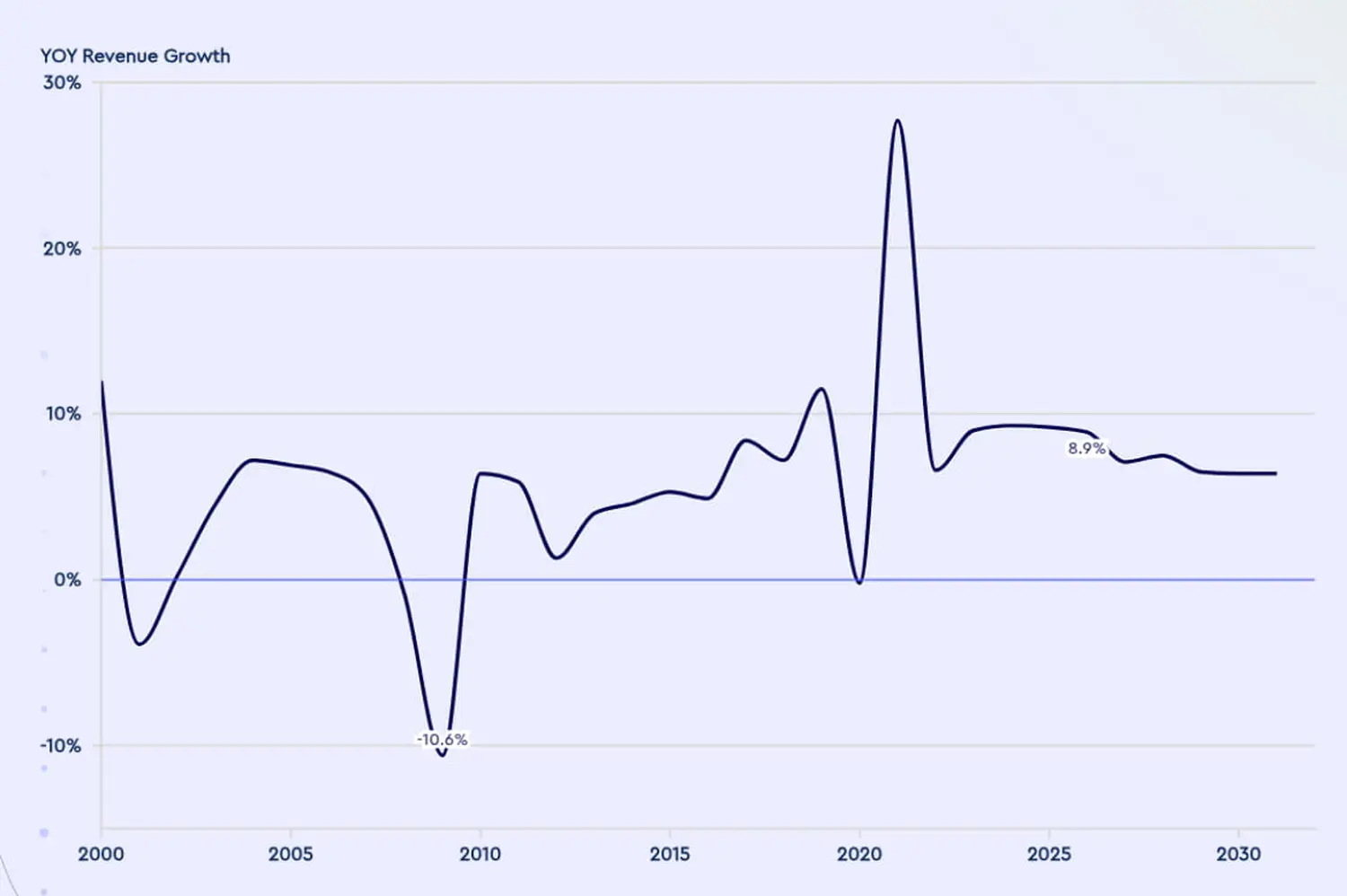
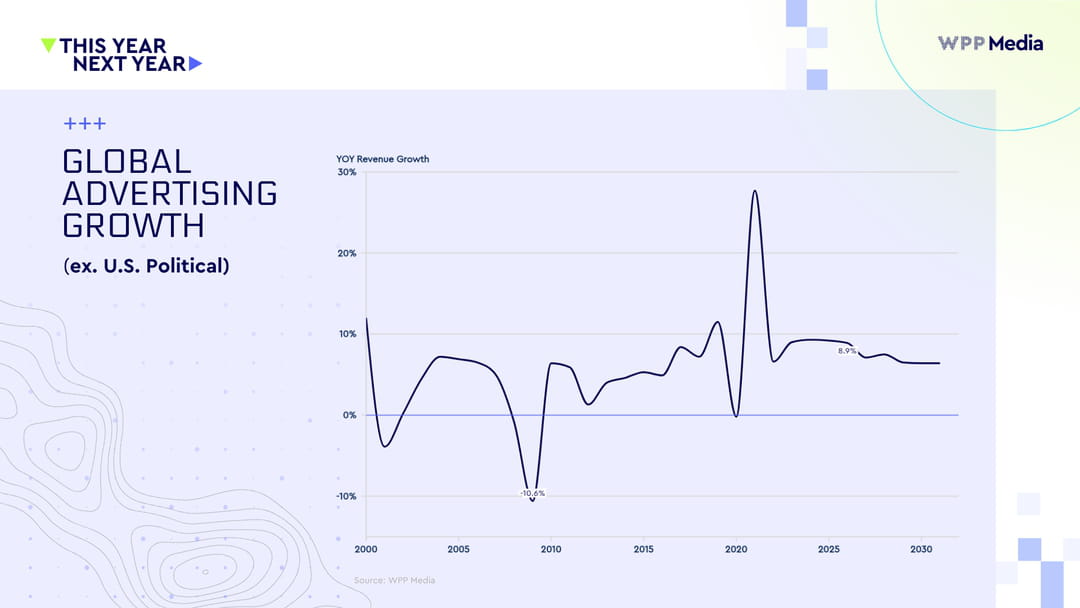
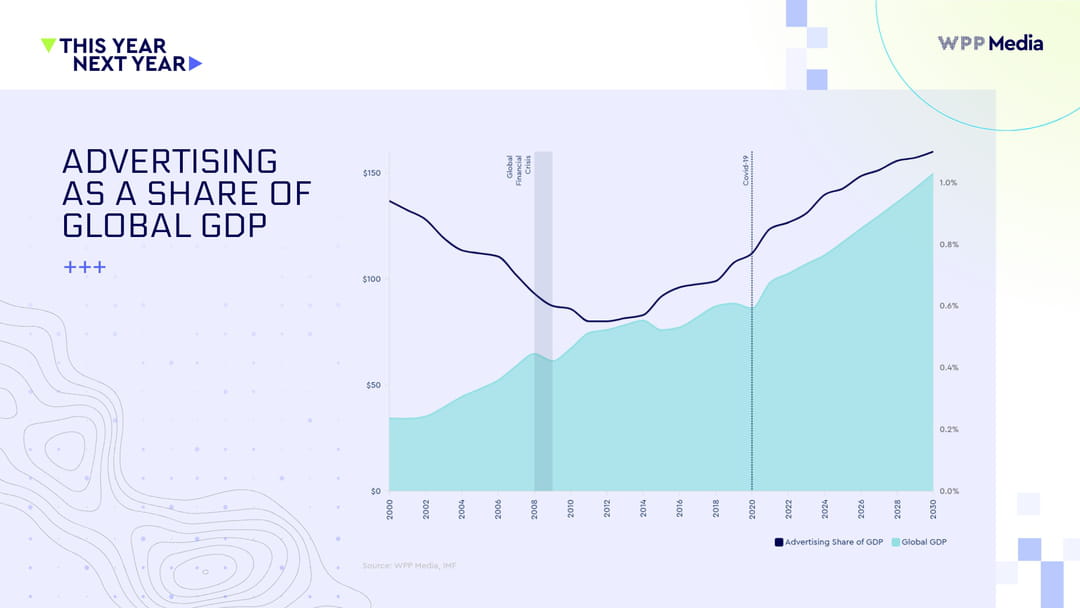
Advertising revenue will increase this year by 8.9% worldwide, excluding American political advertising, according to WPP Media, which is significantly revising its forecasts upwards in the new edition of its This Year Next Year (TVTY), a 75-page publication unveiled this Tuesday, June 16. Barely six months ago, WPP Media only expected growth of 7.1% this year. The share of global advertising revenue in global GDP is expected to reach its highest level since 1999 and continue to rise, the authors indicate. How can we explain such a performance in the midst of global turmoil linked to the Gulf War and the blockage of the Strait of Hormuz? The answer is two letters: AI.
“Investment in AI is a key driver of global advertising growth, not only through direct advertising from AI-enabled companies and AI-driven optimization across advertising platforms, but also through the productivity gains, transformations in cost structures and creation of new business it enables across all advertiser categories,” says Kate Scott-Dawkins, chair of business intelligence at WPP Media and author of the report, who does not hesitate to compare the current dynamics to the gold rush of the late 19th century in the United States.
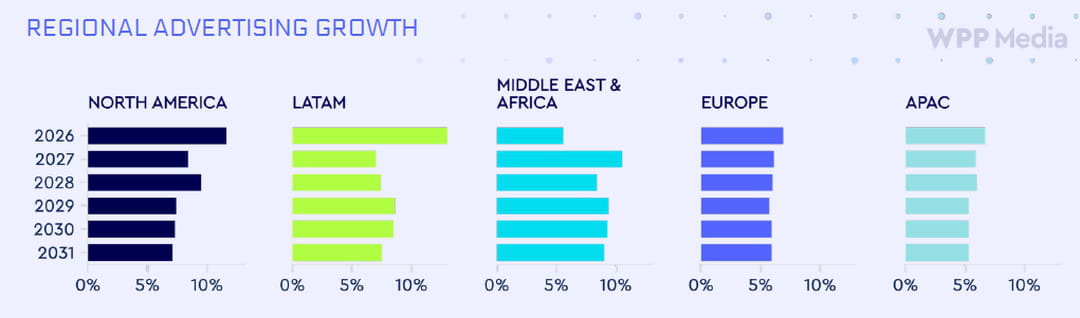
Except that AI boosts above all and above all the American market, the first big engine of global advertising, the United States alone accounting for 40% of revenues. In the United States, growth in advertising revenue should reach 11.9% (compared to 7.4% forecast last December). Outside the United States, the increase forecast for 2026 is 7.8%, “which still represents an improvement compared to the December forecasts”, puts the report into perspective. Latin America stands out with the highest growth forecast in the world: +13%.
France’s situation still fragile
In France, we are still counting on +4.9%, exactly as in December. “The economy is fragile, consumer confidence remains low and the political climate is tense as the 2027 presidential election approaches. Precautionary savings are high, the cost of energy and price sensitivity influence consumer behavior and benefit private labels, promotions and second-hand platforms. Rising prices at the pump affect household spending and put pressure on logistics, transport and agriculture. This macroeconomic context induces a certain caution among advertisers.”
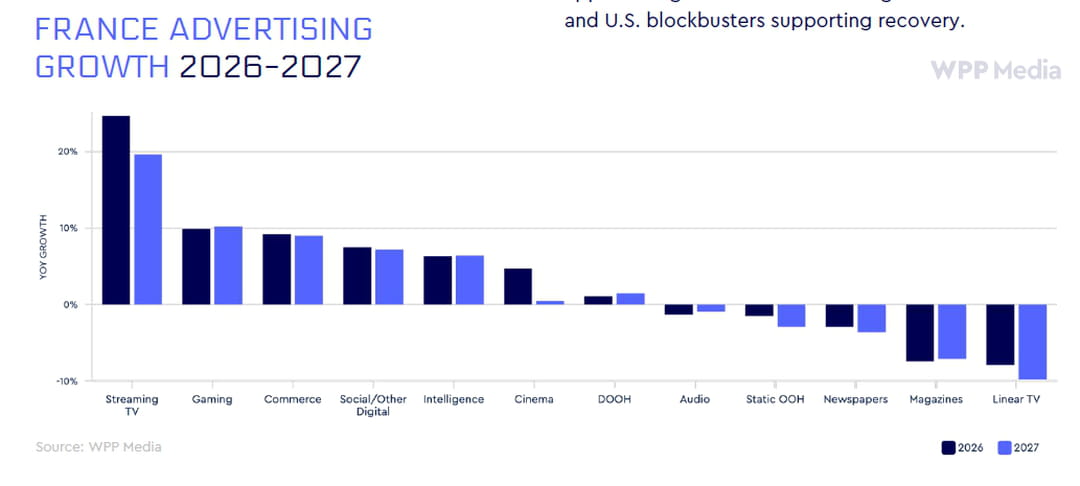
In Europe, “the developed region hardest hit by the Iranian conflict, given its dependence on energy imports”, advertising revenues are expected to grow by 6.9%.
Two worlds two speeds
We can clearly see that the positive figures for the evolution of the global advertising market mask the much more contrasting reality of consumers in the countries most exposed to the war in the Middle East, the purchasing power of the latter being crushed by inflation in the prices of basic necessities. The impact of a protracted war and an El Niño, the devastation of which we are beginning to seriously fear on global agricultural harvests from 2027, could only aggravate this situation.
While suggesting that in such a context caution remains in order for brands, WPP Media argues that the advertising industry has become resilient to crises: “Brands facing cost inflation have an increased need to communicate their value, justify their prices and maintain their visibility with consumers, who examine each purchase with more attention.” And the authors continue: “Even in the event of prolonged conflict, we expect positive growth. The structural protection mechanisms that were lacking during the 2008 financial crisis or the 1991 Gulf War: the concentration of platforms, the efficiency enabled by AI, cross-border digital advertising, media commerce, constitute a floor that was lacking in previous disruptions.”
The big winners
Those who are doing the best are those who have the data, Gafam in the lead. No surprise, the market continues to concentrate: Alphabet, Meta and Amazon now represent 57.6% of total advertising turnover (excluding China), compared to 43.8% five years ago. In total, 25 of the main sellers globally represent around 75% of the sector’s total turnover in 2025: “For the first time none of the 10 largest advertising sellers belong to a traditional media group”, continues the report.
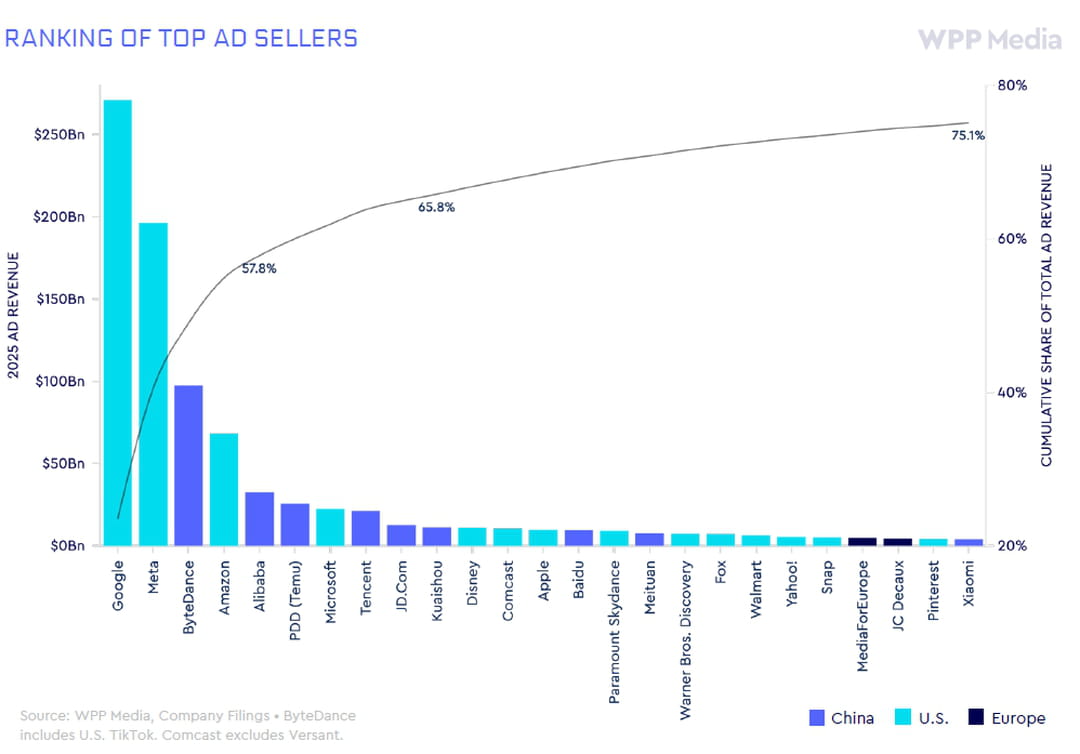
Kate Scott-Dawkins also does not hesitate to predict that advertising will be the main economic model in this new world structured around AI. “As AI capabilities roll out to consumers globally through chatbots, agent-based services, AI-generated content, and embedded intelligence, advertising will likely be the primary economic mechanism that makes these services accessible and affordable at scale.”
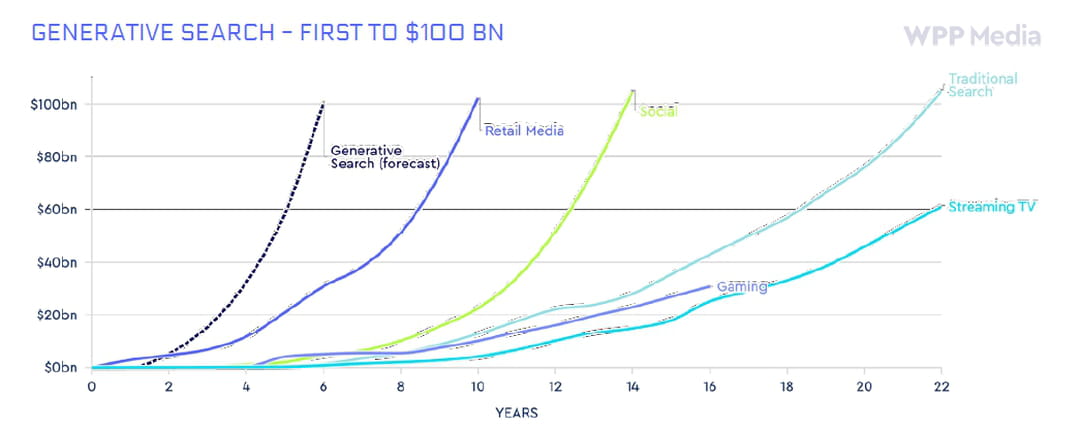
Importantly, WPP predicts that advertising revenue from generative search will explode in the coming years. In 2026, they are already expected to reach $5.1 billion globally, or 0.4% of total advertising revenue. But by 2030, they are expected to exceed $100 billion.