





The largest European show dedicated to start-ups opened its doors in Paris on Wednesday June 17. Digital sovereignty, luxury and space conquest structure an edition dominated by artificial intelligence.
10 years already. For its tenth edition, VivaTech pulled out all the stops. Three floors of hall 7 have been reserved to accommodate no less than 15,000 start-up and 1,500 demonstrations. As for the headliner, Jeff Bezos takes the spotlight. Bernard Arnault (LVMH), Rodolphe Saadé (CMA CGM) complete the poster of highlights of this anniversary edition. Unsurprisingly, artificial intelligence is sucking up all the conversations. The official theme of this edition, “artificial Intelligence: impact, not illusion”, marks a turning point. No more theory, no more measurable results. Germany, country of the year, carries with it the question of European technological sovereignty.
Bernard Arnault and Maurice Lévy as guests
The event opened with a direct exchange between Maurice Lévy and Bernard Arnault. The boss of LVMH immediately pointed to bureaucracy as the main obstacle to innovation in Europe, and presented artificial intelligence as a tool to overcome it: “Thanks to AI, we are able to kill part of the bureaucracy,” he said, recalling that ten years ago the word AI hardly existed in business language. Maurice Lévy praised the major role of Bernard Arnault and Emmanuel Macron in the evolution of the French tech ecosystem thanks to VivaTech, in particular.
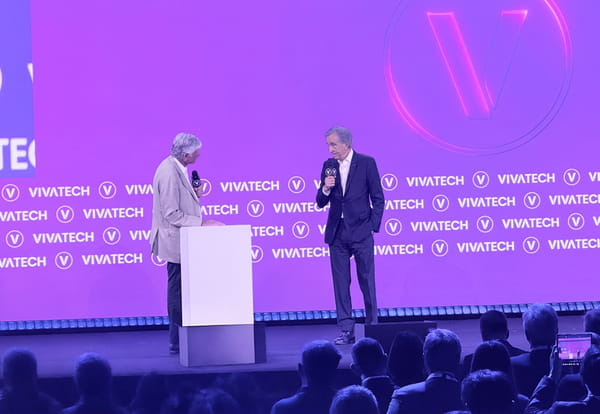
Asked what distinguishes a successful start-up from one that collapses, Bernard Arnault brushed aside the myth of the brilliant idea in two sentences: it’s never the idea, it’s the execution. “Facebook was only one project among around ten clones at the time of its launch, only the execution made the difference,” he recalls. And then this confidence, almost incongruous coming from the boss of a luxury empire: every week, he locks up with a young engineer to generate product concepts using AI, and some end up existing for real. It’s all about execution.
France, Germany: the quest for European sovereignty
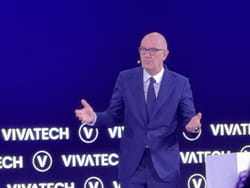
Roland Lescure, Minister Delegate in charge of Industry and Energy, took over in a more political tone. His message is clear: everything is at stake now. According to him, AI will turn everything upside down, “the way of working, interacting, selling, buying, traveling, voting”, and Europe is at a crossroads, between shared prosperity and a scenario at the crossroads of worlds. “Worry is healthy, fear is much less so,” he reminds us again. For his part, Karsten Wildberger, his German counterpart in Digital, took up the European delay without any tongue in cheek. Software, platforms, cloud, chips: Europe has been watching the trains go by for years. With AI, a window opens, but it won’t stay open for long.
Karsten Wildberger reminds us that technological sovereignty is not just a question of defense or protection; access to certain advanced AI models can be cut off overnight. “Everything can change in a single night,” he insists, targeting Anthropic, whose latest model has just been disconnected by order of the White House. His response? Concrete. German computing capacity doubled to six gigawatts by 2030, and a “Deutschland stack”, in-house sovereign cloud.
Space, the new playground for tech
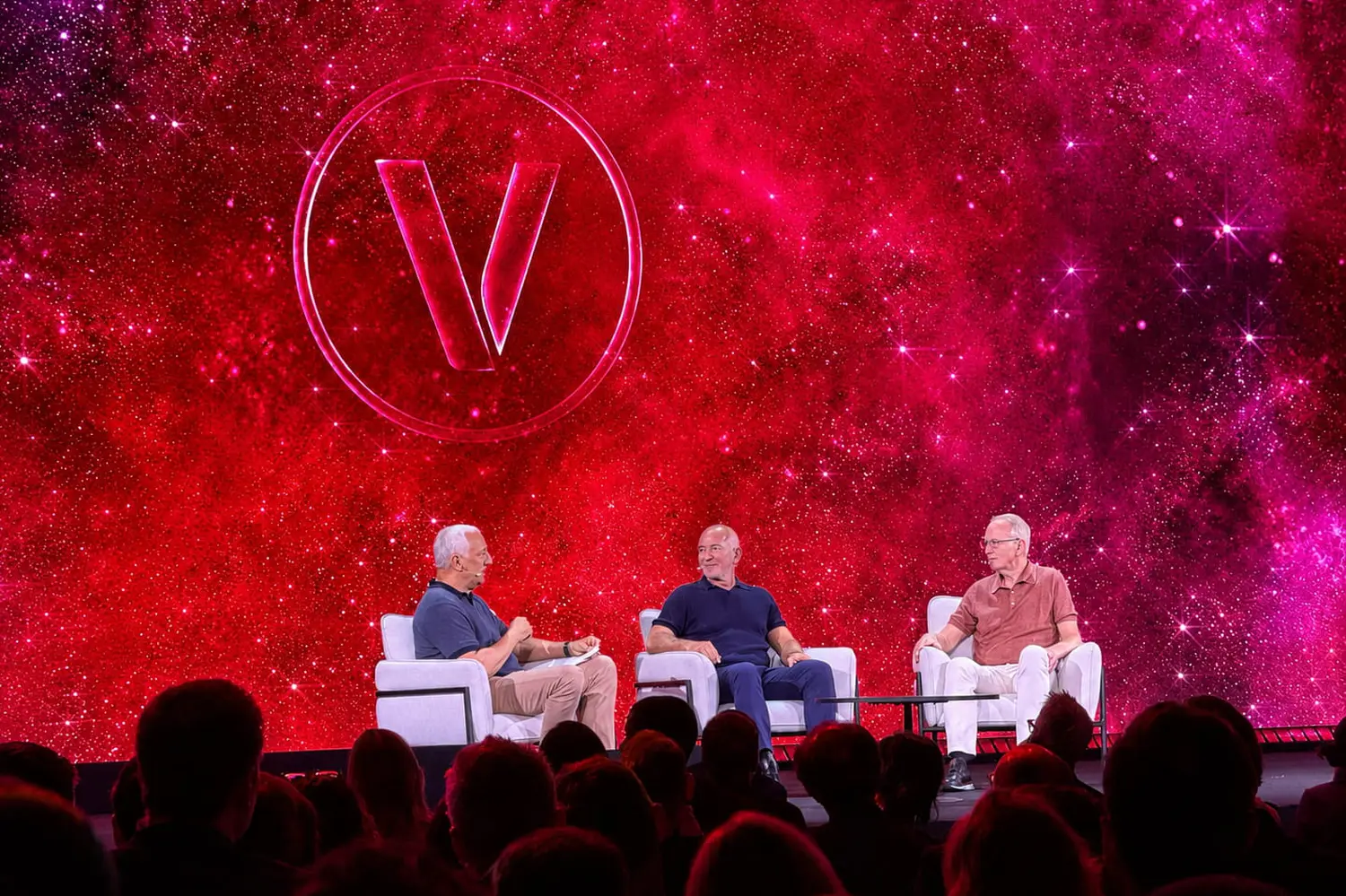
But the real highlight of the morning, awaited by hordes of entrepreneurs from all over Europe, was the intervention of Jeff Bezos. The founder of Blue Origin was accompanied by his CEO Dave Limp and interviewed by NASA astronaut Mike Massimino. The founder of Amazon unfolded his vision of a full-fledged space economy. Its ambition is clear: to build “the road to space”, a heavy infrastructure which will tomorrow allow small structures to launch into the sector, as the web did twenty years ago.
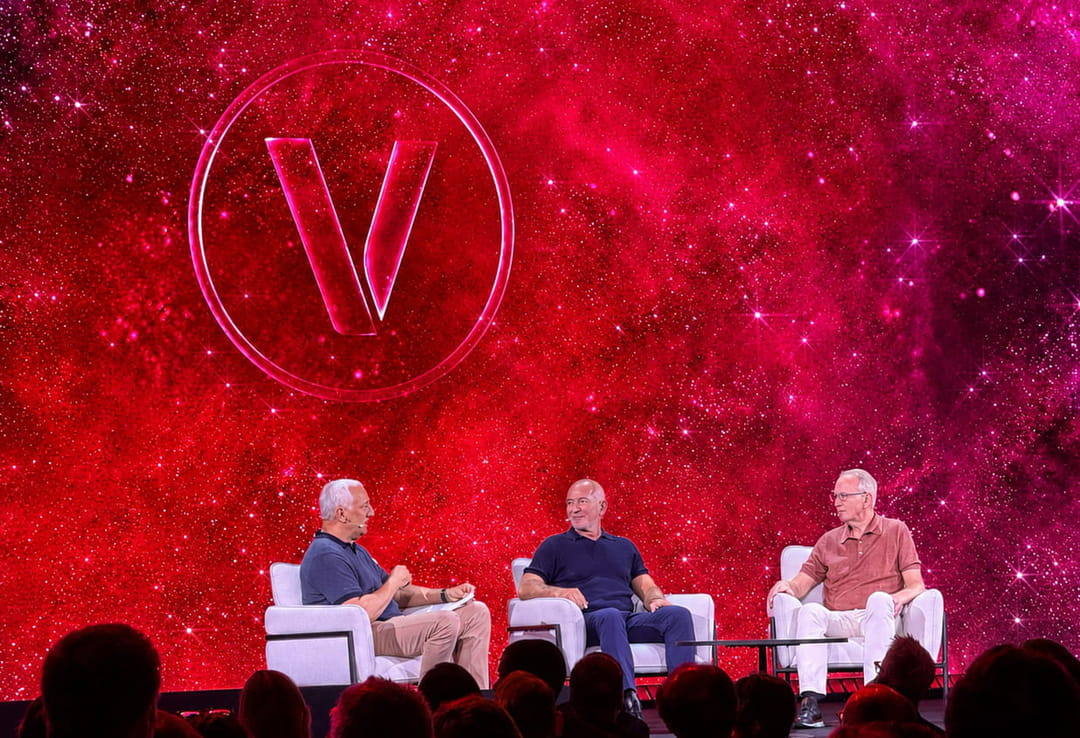
Behind industrial mechanics, the duo assumes a quasi-ecological vision of the conquest of space. The ultimate goal is to move polluting industries off the Earth and send data centers into orbit, to return the planet to its “face before the industrial age”. Dave Limp pushes the reasoning to the end: “transform every corner of the planet into a park and allow the Earth to accommodate three times as many inhabitants”. On orbital calculation, Jeff Bezos brushes aside objections about heat dissipation, “a false problem”, and sees it only as a question of costs. Bezos even sees the day coming when computing will be more economically advantageous in space than on Earth.
Beyond technique, Jeff Bezos above all delivered a series of advice to the entrepreneurs present, with a common thread: speed. For him, it is she who makes the difference in business, including in a company of 15,000 people like Blue Origin. His method is based on a simple distinction: “There are two types of decisions. Irreversible choices with serious consequences must be made slowly, with great care. All others, even important ones, can be decided quickly, by a single person with good judgment.” The fatal mistake, he says, is treating all decisions the same. This is historically what made Amazon successful.