







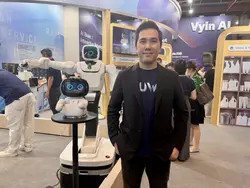
Founded in 2016 in Taiwan, Nuwa Robotics is a major player in social robotics and artificial intelligence in Asia. The company has already deployed more than 100,000 robots, including its Kebbi model, in the education, healthcare, retail and hospitality sectors.
Nuwa Robotics develops both robotic platforms, AI-based software solutions and, now, humanoid robots intended, initially, for the industrial sector. We met Daniel Chang, director of operations (COO) of the company, who discusses the strategy of NUWA Robotics and the ambitions of Taiwan in humanoid robotics.
What sets NUWA Robotics apart from its competitors?
What sets NUWA Robotics apart is its approach focused on human-robot interaction. While many manufacturers focus on mechanical performance or task execution, we have chosen to emphasize the combination of natural movements and smooth conversation. This focus stems directly from our origins in the education sector. Over the years, we have developed expertise in interactions between users and robots. Our solutions incorporate expressive gestures and animated facial expressions, which help create an emotional connection with users.
You are not only developing robots, but also a software platform. What role does it play in your strategy?
Our software platform is offered on the model Robot-as-a-Service (RaaS). It allows users without specific programming skills to create interaction scenarios, workflows or dialogs for robots. Our goal is to provide a complete solution combining hardware and software, so that companies can quickly deploy robotic applications tailored to their needs.
You are now investing in humanoid robots. Why this strategic choice?
We are convinced that humanoid robots represent a fundamental trend. Since the world was designed for humans, human-shaped robots are naturally best suited to our environments. However, their large-scale deployment is still far away. Before they can significantly contribute to productivity, several technological and economic challenges still need to be addressed. This is why we continue to develop semi-humanoid robots, assistance robots and industrial robots in parallel. These solutions are today more mature, more affordable and easier to deploy in concrete use cases. For us, it is not a question of choosing between humanoid robots and specialized robots. The two approaches will coexist and progress in parallel, each responding to different market needs.
At what stage of development is your humanoid robot and what uses are you targeting?
We are currently focusing our efforts on industrial applications. In our opinion, and according to a large part of the sector, the first massive deployments of humanoid robots will take place in factories, before extending to logistics, services and then, in the longer term, to the domestic market. Industrial environments present tasks that are more standardized and easy to reproduce on a large scale. They also offer a more easily measurable return on investment for companies, even when the initial cost of the robot remains high. Conversely, the services or general public markets are much more sensitive to price, which makes their adoption more complex in the short term.
Do you already have customers for these humanoid robots?
Yes. We are already working with customers and are currently in the proof of concept phase.
Can Taiwan become a global leader in humanoid robotics and physical AI?
We do not claim that Taiwan will be the sole world leader in the sectorbut we are convinced that it will be among the most advanced countries in the development of humanoid robots. The island has rare assets: a leading semiconductor industry, solid expertise in artificial intelligence and long experience in the integration of complex systems. The island also has a particularly comprehensive supply chain and benefits from active support from public authorities. At NUWA, most of the research and development is carried out in Taiwan. We develop a large part of the technologies used in our robots ourselves. We still collaborate with certain Chinese partners in specific areas, notably voice processing or certain technological building blocks, but our ambition is to gradually localize all strategic components, both hardware and software, within the Taiwanese ecosystem.
You are not yet present in Europe. Can this evolve?
Since the creation of the company, we have adopted an international strategy. Our customers are present in Taiwan, Japan, South Korea, Singapore, Hong Kong and the United States. Europe today represents a market where our presence is limited, mainly due to a lack of local partners. However, we clearly want to develop there in the years to come. Our expansion follows a trajectory from Asia to Western markets.