








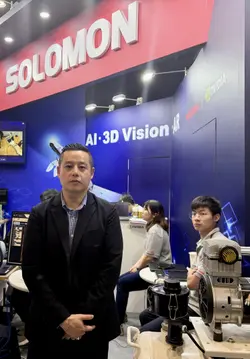
Founded in 1973 in Taiwan, Solomon Technology is one of the major players in computer vision and artificial intelligence applied to industry. For the JDN, its global sales director James Chen reveals his ambitions in the field of robotics.
JDN. What are the main use cases for Solomon Technology’s AI Vision solutions today?
James Chen. They are very numerous. In industry, our solutions are used for automated product inspection. In particular, they make it possible to carry out quality controls and surface inspections on electronic products or other types of manufactured goods. In the roboticswe also carry out pick-and-place applications, that is to say the automated picking and moving of objects, as well as robotic vision guidance. We also use 3D vision associated with artificial intelligence for more complex operations such as bonding, welding, foundry operations or even industrial painting.
Beyond industry, how have recent advances in AI broadened the uses of these technologies?
Today, we combine our vision technologies with new AI models in order to deploy them on different devices: cameras, smart glasses, tablets, smartphones and even drones. These solutions can be used for industrial facility monitoring, infrastructure inspection, operational procedure validation, or many other automated analysis tasks.
When did you decide to focus more on robotics?
A few years ago, we saw industrial automation advancing rapidly. We identified mobile robots as something that would become essential in many factories. So we started distributing autonomous mobile robots. Then we realized that a robot not only needs a body, but also eyes and a brain. That’s when we developed our AI vision sensors and intelligent analytics solutions to complement these robotic systems.
When did you start working on humanoid robots?
Thanks to our experience in industrial robotics, particularly with robotic arms, we already had a solid foundation. About two or three years ago, with the emergence of generative artificial intelligence and the growing interest in humanoids, we saw this as an important market to study. So we started to analyze different humanoid platforms. Today we work with several manufacturers and have already integrated some of their solutions, while other projects are still under development.
What adaptations are necessary to integrate your solutions into a humanoid robot?
A humanoid robot usually leaves the factory with its basic mechanical capabilities. He can move and perform movements, but to become truly useful in concrete situations, he must be able to see, understand and interact with his environment. This is precisely what we bring. On our humanoid demonstrator, we installed vision systems at the head, arms and wrists. At the same time, our AI algorithms analyze the information collected in real time. The robot can thus detect and recognize objects from a distance, even in complex environments.
Concretely, what tasks is a humanoid robot equipped with your technologies capable of accomplishing today?
We have integrated Vision-Language-Action (VLA) type technologies, which allow the robot to understand vocal instructions formulated in natural language. For example, a user can ask the robot to retrieve a specific object from a table. The system identifies the object, moves towards it, grabs it and returns it to its user. We also work on industrial applications. A humanoid robot can be tasked with inspecting equipment, monitoring facilities, or even interacting with machines by operating certain buttons or commands.
What types of customers are interested in humanoid robots today?
We receive inquiries from different parts of the world, including Southeast Asia and the United States. Some customers already have their own humanoid platform and are only looking for our artificial intelligence software and integration solutions. Others want a complete solution, in which case we can supply the entire system. In some international projects, we also work with local partners to ensure the integration and deployment of solutions.
Is being based in Taiwan an advantage?
Yes, absolutely. We benefit from an extremely rich industrial ecosystem. We have access to numerous manufacturers, integrators and automation specialists. This allows us to quickly test our solutions in real conditions and accelerate their development. We also benefit from a very dynamic AI ecosystem, as well as the presence of major players in computer hardware and semiconductors. All these players work together to advance the industry.
One of the main challenges of humanoid robots remains their deployment in open or domestic environments. How do you approach this issue?
This is indeed a challenge that the entire industry is currently working on. We are observing the emergence of numerous manufacturers of humanoid robots in China, the United States and Europe. The sector is still young and several technological approaches coexist. However, certain standards are beginning to emerge and hardware performance is progressing rapidly. As these platforms mature, their capabilities will continue to improve. So I think humanoid robots have a very promising future.
What are Solomon’s priorities for the coming years?
Humanoid robots clearly constitute one of our main areas of research and development. But we also continue to invest heavily in our historical activities, in particular industrial robotic arms, collaborative robots (cobots), autonomous mobile robots (AMR), industrial vision systems, and even automation solutions based on artificial intelligence. All of these technologies will continue to play a major role in our development strategy for years to come.