








Is GEO just rebranded SEO? Between preconceived ideas, recent figures and market studies, discover what GEO really changes for your online visibility.
Currently, we read a bit of everything and its opposite about GEO. Some will say that GEO is SEO… Others that GEO is a discipline in its own right. Let’s take stock in this article and demystify, based on sources, four beliefs about GEO.
Belief #1: Are your pages ranked well in Google? They will necessarily be in the responses of generative AI
For answers to generative AI features in Google Search, such as AI Preview and AI Mode, this is the case. Moreover, the answer from the Google documentation is clear, I quote:
“Is SEO still suitable for generative AI search?
In a word, yes! SEO best practices remain relevant because our generative AI capabilities in Google Search rely on our core Search ranking and quality systems.”
Source : https://developers.google.com/search/docs/fundamentals/ai-optimization-guide?hl=en
Moreover, further Google adds:
“What about AEO and GEO? “AEO” stands for “Answer Engine Optimization” and “GEO” stands for “Generative Engine Optimization.” Both terms are sometimes used to describe actions to improve discoverability in AI search experiences. From a Google Search perspective, optimizing search with generative AI means optimizing the search experience, and therefore SEO.”
Some SEO specialists have relied on this statement to argue that GEO is not a separate discipline.
But what they forget to say is that Google’s market share for AI search is far from being the majority as it is for search via search engines. And above all, Google’s press release does not mention the Gemini AI assistant, but only the AI previews in Google search.
Let’s take a closer look at AI assistants.
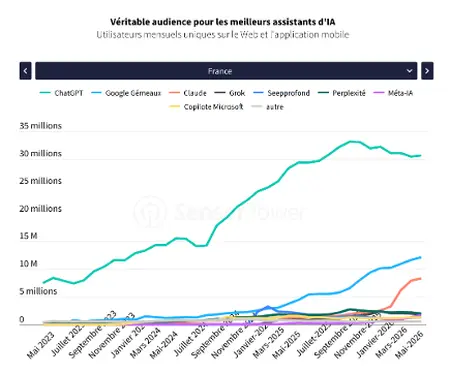
According to SensorTower, as of May 2026, ChatGPT had a 46% share, ahead of Google Gemini (28%) and , (10%). In certain markets Claude has experienced particularly strong growth, driven by user interest in its coding and in-depth research capabilities.
Source : https://sensortower.com/report/state-of-ai-2026/
SensorTower suggests that this progression could have been reinforced by the movement of some users to Claude after the agreement concluded between OpenAI and the US Department of Defense. In May 2026, Claude’s market share in the United States reached nearly 14%, compared to only 5% in December 2025.
So it is true (according to Google’s documentation) that a solid SEO strategy allows you to improve your visibility in Google’s AI features. This is good, because it allows us to work on this part simultaneously. But if Google and Microsoft communicate relatively clearly on the mechanisms that power their AI search experiences, the practices of OpenAI (ChatGPT), Anthropics (Claude) and other AI assistants remain much less well documented.
So, do AI assistants select the same sources as Google?
To try to answer this question, let’s look at the study carried out by Ahref on 15,000 requests on 4 AI assistants (https://ahrefs.com/blog/ai-search-overlap
). Data shows that on average 12% of links cited by AI assistants appear in the top 10 results on Google. Most appear neither in the top 10 nor in the top 100.
For businesses, this distinction is far from trivial. A visibility strategy based solely on Google positions does not seem sufficient to appear in the responses of AI assistants and risks, in the long term, no longer guaranteeing sufficient visibility with their future customers.
Belief #2: GenAI research is still too anecdotal to worry about
The number of Internet users in France represents more than 95.2% of the population.
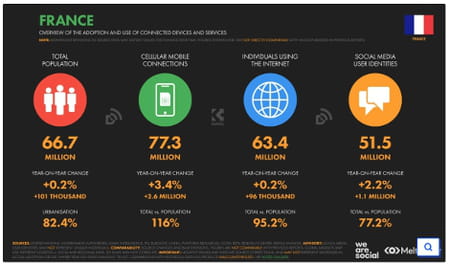
Source : https://www.blogdumoderateur.com/internet-reseaux-sociaux-france-chiffres-2026/
At the same time, according to the digital barometer – 2026 edition (https://www.economie.gouv.fr/cge/barometre-du-numerique-edition-2026), in 2025, 48% of the population uses AI, and this percentage is higher among 18 – 24 year olds, of whom 85% use it.
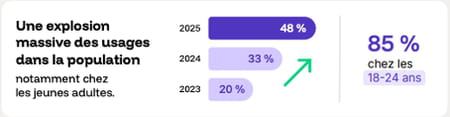
Source : https://www.economie.gouv.fr/cge/barometre-du-numerique-edition-2026
If 34% of generative AI users use it on a daily basis, 51% of users use several generative AIs. In terms of functionality, 73% use AI to find information and save time. They also state that they don’t always verify the information (oops).
Today, GenAI sources still account for less than 1% of total web traffic (https://sensortower.com/report/state-of-ai-2026/download), but according to SensorTower, they can already contribute significantly to brand awareness and influence future purchasing decisions.
You may be wondering where I’m going with this?
1% is (still) very low, but ChatGPT reached 1 billion mobile users in just three years after its launch in 2023, faster than any other app. This progression illustrates the speed at which AI has established itself in general public uses, all regions and demographic categories combined, even ahead of major applications like TikTok, YouTube or Instagram.
And web traffic is only part of the generative AI consultation, for businesses it is not the only objective to achieve. I will discuss this point in more detail in the last part of this article.
So even if for the moment, the share of traffic remains in the minority, we are probably witnessing the first stages of a lasting change in search habits and access to information. Concretely, a company can today be absent from the Google Top 10 while still being cited in certain responses generated by AI. Conversely, excellent SEO visibility does not systematically guarantee a presence in ChatGPT, Claude or Perplexity responses. This requires marketing teams to expand their KPIs and communications plans.
Belief #3: It’s SEO or GEO
Many SEO agencies defend the potential of SEO.
GEO experts declare the death of SEO.
But why choose one or the other of these acquisition channels? Let’s go back a few years.
Since the creation of the Web in the 1990s, methods of accessing information have continued to evolve. Originally, Internet users mainly went through directories and then through search engines, with the arrival of Google in 1998. SEO then established itself as an essential lever for gaining visibility.
In the early 2000s, social networks opened a new path. LinkedIn (2003), Facebook (2004), YouTube (2005) and Instagram (2010) have gradually allowed companies to reach their audience without using only search engines.
A third development then appears with recommendation platforms. The algorithms of YouTube, TikTok or Google Discover now suggest content to users, even when they are not actively looking for it.
Since 2022, the rise of generative AI marks a new evolution. ChatGPT, Gemini, Claude or Perplexity in turn become entry points to information. GEO is part of this continuity: it does not replace SEO, any more than social networks have replaced Google. It constitutes an additional channel to gain visibility among Internet users.
For brands, the challenge is the evolution of behavior. When a user gets into the habit of searching for information in ChatGPT or Gemini, they gradually change their purchasing journey and sources of information. Companies therefore have an interest in observing these new uses now rather than waiting for them to become the majority.
Belief #4: GEO is all about being cited by AIs
Being cited is obviously important, but it’s only part of GEO, because visibility in generative responses plays out on multiple levels, with different effects and depending on user intent.
- Brand visibility: the AI cites or evokes your company as a relevant player in a market, even without referring to your site. In this case, the issue is above all memorization and the association between your brand and a subject.
- Informational visibility: AI uses a definition, a statistic, a method or an explanation from your content. You become a reference source in the synthesis produced.
- Transactional visibility: AI recommends a solution, a tool, a product or a service provider in a comparison or decision context. Here, the impact can be direct on brand preference, even if the purchase journey does not start with a classic organic click.
- Traffic generated: the AI provides a clickable link to your page and the user decides to continue their search on your site. This is the closest form of SEO logic.
The real question is: “How are my brand, my content and my offers represented in the responses generated?” A GEO strategy must therefore measure mentions, the context of these mentions, the sources used, the recommended competitors and, when possible, the traffic actually sent to the site.
Finally, the debate around GEO poses a broader question: how can companies remain visible when uses evolve? The history of the Web shows that new acquisition channels do not replace previous ones: they add to them. Search engines remain central, but AI assistants are gradually becoming new intermediaries between Internet users and brands. In this logic, GEO appears as a new visibility lever to be integrated into a global acquisition strategy.
My advice for businesses: don’t choose between SEO and GEO. Keep the same principle when you have decided to choose between opening an account for your business on Instagram or on LinkedIn: simply look at where your future customers are and how they search for your services or products. The thing that ultimately doesn’t change is understanding where your customers are and how they search for information before choosing where to invest your visibility.