








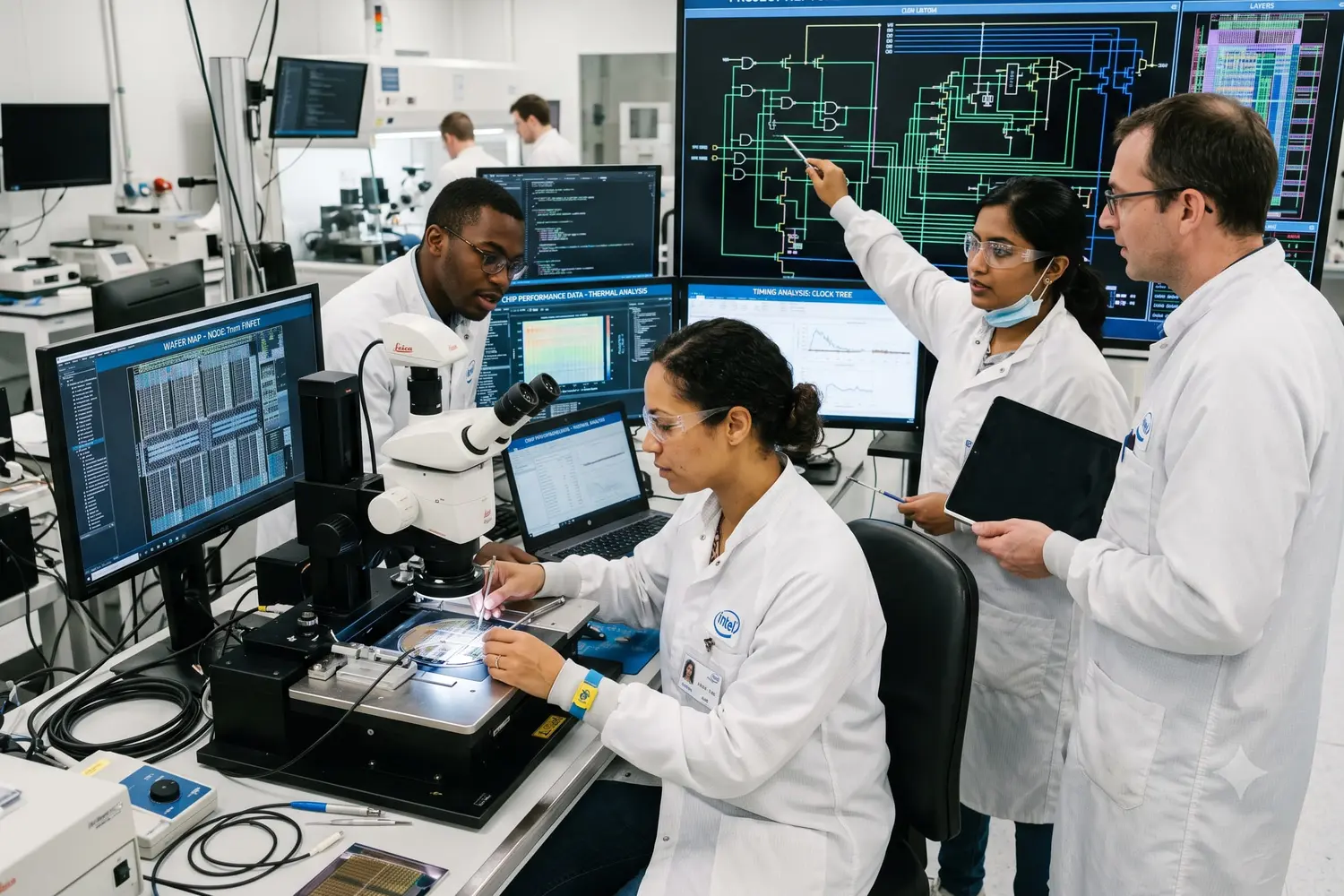
Reliance on proprietary American technologies for hardware, such as that used to melt chips or run data centers, is problematic.
With the return to power of Donald Trump and his threats towards Europe, the question of the technological dependence of the Old Continent returns to the top of the table and the debates around European technological sovereignty generally focus on two aspects.
The first is that of Europe’s dependence on American software, whether SaaS or major artificial intelligence models, in the face of which European alternatives should be built, relying in particular on the open source software. The second is dependence on technological infrastructure: factories to produce cutting-edge semiconductors, data centers, drone factories. The solution: build these infrastructures in Europe.
Open source hardware: kesako?
But there is a third dimension that often gets overlooked: the question of who controls the design tools, blocks of intellectual property and chip architectures that power these foundries, factories and servers, make up these supply chains and support this production. A deficiency that a movement, theOpen Source Hardware (OSH), or open source hardware, is now working to compensate.
“OSH can be defined, according to the Open Source Hardware Alliance (OSHWA), as hardware whose design is made publicly available so that anyone can study, modify, distribute, manufacture and sell the hardware based on that design,” explains Jonathan Linaker, researcher at RISE Research Institutes of Sweden, specializing in open technologies.
“Source code, including design specifications, software and documentation, must be published in an easily modifiable form. Hardware open source must further use components, processes, infrastructure and tools that promote (rather than limit) the sharing and reuse of open technology. As with open source software (OSS), no use case or user should be discriminated against, and commercial adoption is encouraged,” he explains.
Open source and semiconductors
In the field of semiconductors, we can cite open source silicon, which refers to processor cores, accelerators, intellectual property blocks and system-on-chip components whose design is open in its entirety, from the high-level hardware description to the physical layout of the circuits. The RISC-V architecture, managed by a non-profit organization based in Switzerland with more than 4,500 members, is a fundamental pillar. It allows anyone to design, manufacture and sell custom microprocessors without paying royalties.
“Before RISC-V, European players were totally dependent on foreign technologies on processors. RISC-V opened the way to the possibility of designing chips without legal obstacles, opening the right to anyone to design these chips and then have them manufactured,” explains Javier Serrano, member of the European Open Source Academy, which promotes open source software and hardware.
Let us also mention, still in the field of chips, field programmable gate arrays (FPGAs), for networks of gates programmable by the user. These electronic chips are a kind of blank circuit that can be configured at will to perform different types of tasks, more flexible than ASIC chips (designed for a single task) and more economical than GPUs (also flexible but resource-intensive). The FPGA market is traditionally dominated by two American proprietary technologies, AMD and Intel. But the sector has recently seen the arrival of a small European company focusing on open source, the German Cologne Chip.
Europe finally has research institutes that are very active in open source chips, like the Leibniz-Institut für innovative Mikroelektronik, which launched the first European open source process design kit (PDK), a toolbox that chip designers use to translate their design into instructions understandable by the foundry. These PDK technologies have traditionally been proprietary and dominated by American companies like Synopsis and Cadence Design Systems.
Open source and data centers
OSH is also relevant in the context of data centers and network equipment, another major sovereignty issue in the era of the AI race. Having your own models like Mistral is not enough if you do not also have the infrastructure to run them, and the know-how regarding the software and hardware present in these infrastructures.
This includes servers (for computing), storage systems (for backing up data), and networking equipment such as switches and routers (to interconnect everything), as well as essential supporting infrastructure like power supplies and cooling systems that enable these operations to run smoothly.
In this area too, a dynamic ecosystem of European start-ups is emerging. These include Circle B, a Dutch company that deploys data center infrastructures based on open source designs; ScaleUp Technologies, the first German cloud provider to massively deploy open hardware; or Maincubes, a very active data center operator in OSH.
The EU has become aware of the issue
The movement has even begun to attract the attention of European authorities, as illustrated by the creation of theOSAwards.eu. “It is an EU-funded project, supported by the European Commission, and which was, among other things, responsible for contributing to the establishment of the European Open Source Academy. The OSH is, along with open source software, an integral part of our initial mandate. We have established four sections within the academy: Excellence and Achievement, Business and Impact, Advocacy and Awareness, Skills and Education.
We seek to raise awareness of these different areas as part of our work across Europe, but first and foremost we are a team promoting open source software and hardware. To do this, we organize an annual awards ceremony, the European Open Source Awards, which takes place every January in Brussels during EU Open Source Week,” explains Nicholas Gate, one of the project leaders.
Also worth mentioning is the White Rabbit project, hosted within CERN and funded by the EU, of which Javier Serrano is a part, another open source project which aims for ultra-precise synchronization of devices without using satellite geopositioning systems. “There is a significant effort, particularly in Europe, to become less dependent on GNSS signals, such as GPS, Galileo, Baidu and Glonass. This is because the signals, when they arrive on Earth, are very weak because they have traveled a very long distance in a relatively narrow band. So, with a simple transmitter, you can easily jam the signal, which is potentially very dangerous, because if GPS or the equivalent systems supported by other countries were to disappear, the economy would take a very severe hit.
The technology developed by White Rabbit aims to guarantee synchronization below the nanosecond, even at great distances, by relying on Ethernet technology with optical fibers.”
Hardware and software: increasingly porous boundaries
The ground is currently fertile for the development of OSH, as we are witnessing a convergence between hardware and software, which facilitates this development.
“Open source software and hardware must be considered together. On the one hand, software essentially consists of 0s and 1s, while hardware consists of atoms. On the other hand, today’s physical hardware is the result of a digital manufacturing process. This means that there is a strong dependence on software also in the context of hardware, which is incidentally the platform on which the software runs,” explains Johan Linaker.
“When you want to solve an engineering problem, you often have the choice of solving it in software or hardware, and the creative process is very similar, it’s a decision you can make quite late in the process. So my belief is that many of the reasons for adopting free and open source software also apply to the case of hardware. During the design phase, you can apply much the same collaborative workflow that you would use to develop software, “says Javier Serrano.