








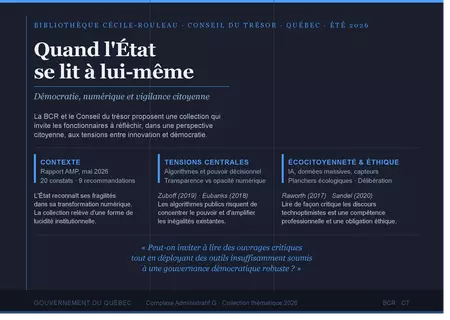
The Quebec government invites civil servants to think, from a citizen perspective, about the tensions between technological innovation and democracy — a courageous bet, not without blind spots.
The Cécile-Rouleau Library (BCR) of the Administrative Complex G of government du Québec and the Conseil du trésor du Québec are offering a collection this summer that invites civil servants to reflect, from a citizen perspective, on the tensions between innovation technology and democracy — a courageous bet, not without blind spots.
A government context under pressure
The approach takes on particular relevance in light of the report submitted in May 2026 by the Public Procurement Authority (AMP). Following a mandate entrusted in 2025 by the President of the Treasury Board, the AMP formulated 20 findings and 9 recommendations, highlighting significant gaps in terms of governanceproject management and activity-based costs, supervision, expertise and accountability in public digital projects. Its first recommendation: reposition the governance of digital projects within the Treasury Board Secretariat. In other words, the Quebec state itself recognizes its weaknesses in leading its own digital transformation. Proposing a collection on democracy and disruptive technologies is therefore a form of institutional lucidity — or a catching-up exercise.
Digital innovation and technocratic risks: the central tension
This is where the collection hits the nail on the head. Researchers in digital governance have extensively documented the paradox of public modernization: by wanting to improve the efficiency of services, states risk concentrating power decision-making in opaque algorithms, distancing citizens from the democratic process. Shoshana Zuboff (2019), in The Age of Surveillance Capitalism, describes how large digital infrastructures can become mechanisms of behavioral control—a dynamic that applies to businesses and governments. Virginia Eubanks (2018), in Automating Inequality, shows how algorithmic public management tools tend to reproduce and amplify existing inequalities.
The government of Quebec has, however, affirmed that digital transformation represents an essential opportunity to strengthen the free flow of information and citizen participation, a position which is consistent with the principles of the Open Government Partnership (OPG), to which Quebec officially joined in October 2020. The intention is laudable. But between the discourse on transparency and the reality of non-auditable algorithmic decisions, a gap persists – which the BCR thematic collection has the merit of highlighting.
Eco-citizen commitment: a still marginal angle
The eco-citizen dimension deserves a special look. Disruptive technologies — artificial intelligencemassive data analysis, environmental monitoring by sensors — are sometimes presented as levers for climate action, sometimes as sources of unsustainable energy consumption. Kate Raworth (2017), in Donut Economics, recalls that public governance must reconcile institutional performance and ecological floors. For civil servants called upon to design public policies integrating these realities, critical reading of techno-optimist discourses constitutes a professional skill as well as an ethical obligation.
Ethics in public management: do not avoid discomfort
Source: Gilles Couture Ltd.
The initiative of the BCR and the Treasury Board finally raises a fundamental question: can we invite civil servants to read critical works on the risks of technocratic surveillance while continuing to deploy digital tools that are not yet subject to robust democratic governance? The honest answer requires going beyond book collecting. Authors like Michael Sandel (The Tyranny of Merit, 2020) or Corinne Gendron (Sustainable development and political economy, 2006) insist on the need for institutions capable of self-criticism and collective deliberation


