








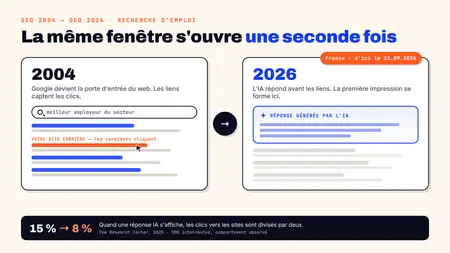
Google will deploy its AI responses in France by September 23. For employers, this deadline opens a short window: one where getting ahead is still inexpensive.
On June 29, Google sent a letter to French press publishers: its generative AI features, AI Overviews and AI Mode, will be deployed in France by September 23, 2026. Concretely, a response written by an AI will be displayed at the top of the search results, before the links. More than 120 countries have been living with it for two years. France will be one of the last served, for legal reasons linked to neighboring rights.
This French delay, often commented on as a handicap, is in reality a boon for HR departments. On one condition: do not confuse deadline and exemption.
What changes when AI responds for your pages
We already know what is happening in countries where these generative responses are active. The Pew Research Center analyzed the behavior of 900 American Internet users in 2025: when a summary generated by AI is displayed, users only click on a classic result in 8% of cases, compared to 15% without a summary. The click-through rate is halved. And links cited within the summary itself are only clicked on 1% of visits.
Transposed to recruitment, this means that a growing proportion of candidates will form an opinion about your company without ever reaching your career site. The question is no longer just “what do they find about us?” but “what does the AI respond when we talk to it about us?”. Salaries, atmosphere, teleworking, recruitment process: the first impression is now formed in the answer, not on the page.
GEO is exactly where SEO was in 2004.
The 2004 remake
The oldest marketing teams remember it: in the early 2000s, a few companies understood before the others that Google was going to become the gateway to the web. They structured their content, worked on their SEO when no one was talking about it, and built visibility that their competitors took ten years and considerable budgets to catch up with. Natural referencing then became a commodity: everyone does it, no one gains any decisive advantage from it anymore.
Optimization for generative engines, which we call GEO, is exactly where SEO was in 2004: rules still in flux, few players seriously interested in it, and a real advantage for first movers. With one big difference: this time, everyone has seen the previous film. The window will be shorter.
Why the advance taken now will be expensive to make up for
Conversational AI constructs its responses from existing sources: your site, the press, employee reviews, job platforms. Today, very few employers structure these signals deliberately. Whoever starts it is therefore almost alone on his request. When the entire sector understands the issue, it will be necessary to dislodge already established citation habits, and the cost to benefit ratio will be reversed.
On the candidate side, the movement is already underway, and it is not new. By 2023, Indeed’s global survey (Global AI Survey, more than 7,000 respondents in seven countries) measured that seven out of ten candidates were already using generative AI to learn about companies, write their applications or prepare for their interviews. In France, according to the HelloWork survey conducted in 2025 among 2,247 candidates, one in two uses generative AI in their job search, and 63% among those under 30. September 23 is therefore not the beginning of the phenomenon. This is the moment when it becomes massive, because it will settle into the most anchored reflex of the French web: Google search.
Between now and the start of the school year, simply take stock of the situation
It is not a question of launching a mammoth project this summer. The first step is an inventory: knowing what assistants say today about your company as an employer, what sources they rely on, and how you stack up against your direct competitors. A point of method, however: a query typed one evening in ChatGPT does not constitute a diagnosis. These tools are probabilistic: the answer varies from one assistant to another, from one formulation to another, sometimes from one day to the next. Judging your employer brand on an isolated test means gauging your notoriety by questioning a single passerby in the street. A serious inventory crosses several assistants, several types of questions, those that the candidates actually ask, and follows the evolution over time. It’s this structured measurement that dates your starting point, reveals the sources that speak for you, and turns an unclear topic into an action plan.
Because it is indeed a question of date. Between now and when your entire industry optimizes its presence in AI, there is a window. It is open. She won’t stay that way.