








The main reasons that lead companies to give up selling medical devices on the EU market are, at 91 percent, the high certification costs according to MDR, which lead to the products being unprofitable, and at 74 percent, the bureaucratic effort. This critical situation for medical technology manufacturers will worsen in the next few years. Innovations are typically accompanied by an increase in technological complexity. More components, more complex component interaction, AI-based components and other complexity factors make risk management for medical devices more comprehensive. At the same time they will Quality demands on risk management are increasingas notified bodies use AI tools to find deficiencies in the risk management file and related documentation.
As Medical device manufacturer, Medical device supplier or Risk management consultant These developments can have a significant impact on your future success or your entire business model. This blog post gives you an overview of how to prepare yourself for the future when it comes to risk management. He shows how modern, AI-powered Risk management for medical devices can automate manual documentation processes, which solutions already exist on the market, and classifies the dynamic development around AI-based risk management and compliance. Learn how to avoid typical inconsistencies in development, shorten time-to-market and how Project MedSafe Supports you as a digital compliance assistant on your way to secure approval. MedSafe aims to close the gap in AI-supported risk management that many providers have so far left open.
The modern one Risk management for medical devices includes the systematic identification, assessment and control of risks over the entire life cycle of a medtech product in accordance with Vrequirements of the MDR (Medical Device Regulation) and the ISO 14971 standards as well as ISO 13485.
Through the EU AI Act Additional, complex compliance requirements are added for AI-based high-risk medical systems.
In addition, the specific requirements of medical devices that contain software or even consist only of software also apply IEC 62304 for the development of the software.
What is relevant in practice is the linking of these specifications in a consistent traceability, which runs from the intended purpose through requirements, architecture, implementation and verification to the post-market phase.
Why classic risk management fails in medical technology
Traditional risk management for medical devices is usually based on isolated Excel lists and manual documentation processes. This analog approach leads to critical problems, particularly with a large number of software components with complex interactions and agile software development:
- Inconsistent safety artifacts: Manual changes to software components are made late or incorrectly in the risk assessment.
- Pre-audit: Processes sometimes only exist on paper and are adjusted shortly before the audit.
- Admission delays: Manually creating compliance documentation dramatically increases time-to-market.
- Lack of audit readiness: The complete traceability from the source code to the risk analysis can hardly be represented manually without errors.
- Risk update: Taking on risks from previous products leads to increased effort and increasing complexity.
- Post-market connection: Clinical follow-up and market feedback are rarely systematically linked to the risk file.
- Tool landscape: General LLMs (e.g. Claude, Copilot) are used selectively, but are not technically specific enough for specialized medical devices and have too little product-specific data base.
The solution: AI-supported risk management & compliance
The implementation of artificial intelligence in regulatory engineering transforms compliance from a static documentation requirement into a dynamic, automated process.
Comparison: Traditional vs. AI-supported risk management according to ISO 14971
| criterion | Traditional risk management | AI-supported risk management (MedSafe) |
|---|---|---|
| Data maintenance | Manual Excel spreadsheets, isolated documents | Centralized, model-based data graph |
| Consistency check | Random, manual reviews | Automated, real-time semantic checking |
| Traceability | Subsequent, error-prone assignment | Seamless, automated linking of development artifacts and risk |
| Change management | High manual effort for system updates | Automatic impact analysis when development artifacts change |
| Hazard identification | Brainstorming, lists from previous projects | Architecture-based, field and literature data-based |
| terminology | Inconsistent | harmonization |
Digital compliance assistants at a glance
Many start-ups (e.g. Meddevo, RematiQ, Phablo.AI, Flinn.ai, RegCheck, CertHub, Greenlight Guru, Qualio, MatrixReq, MyAuditCorner) offer AI-supported functions that support medical technology companies in compliance with quality and risk management. The value propositions and AI-powered features offered by these startups are similar. For example, several start-ups offer gap analyzes and completeness checks of technical documentation for medical technology manufacturers, but also for notified bodies. Existing documents such as the risk management file are compared with the requirements of, for example, MDR and ISO 14971 in order to point out gaps or deficiencies. Another common feature is the integration of data from different sources and the subsequent traceability between regulatory or normative requirements and their implementation as well as support in dealing with changes.
| Compliance check | Gap analysis of existing documents against MDR/ISO 14971 |
| Data integration | Combining information from various sources such as standards, Excel tables with risk analyses, Word documents with descriptions of risk-reduced measures, or modeling tools with system and software architectures that implement these measures |
| Traceability | Elements in the integrated data world are clearly linked to one another, e.g. requirements from standards regarding the software architecture with the software architecture |
| Change management | Support in dealing with changes to elements in the integrated data world, identification of changes required in the integrated data world such as requirements due to new/updated standards |
| Risk management | Uploading and checking existing risk management documents (see compliance check) |
| Software architecture modeling | Not shown or only shown superficially |
Our comprehensive market analysis shows that numerous start-ups already offer sophisticated AI-supported compliance functions that serve the entire range of regulatory and normative requirements. Risk management in system and software development is only one aspect alongside market surveillance and many other topics. Accordingly, only the most necessary risk management information is extracted from system and software development tools. A compliance tool for risk management does not notice when the connection structure in the software architecture changes and new dangerous situations can arise as a result. It does not aim to carry out software-related risk management in such a way that the highest possible level of safety is achieved as efficiently as possible. The primary objective is to demonstrate that the risk management activities carried out meet the requirements of the MDR and relevant standards.
The more complex and critical the software is, the more important the support becomes for carrying out software-related risk management. IEC 62304 requires the systematic analysis of software-related threats and traceability to architecture, requirements and verification. With complex software with a high security class, such normative requirements can no longer be implemented efficiently with sufficient quality without dedicated tool support. The MedSafe project starts at exactly this point.
AI-supported risk management of complex (networked) software
When many software components interact with each other in a complex manner, nested cause-and-effect relationships arise between errors. Understanding these relationships is essential to derive effective risk-reducing measures and demonstrate their effectiveness.
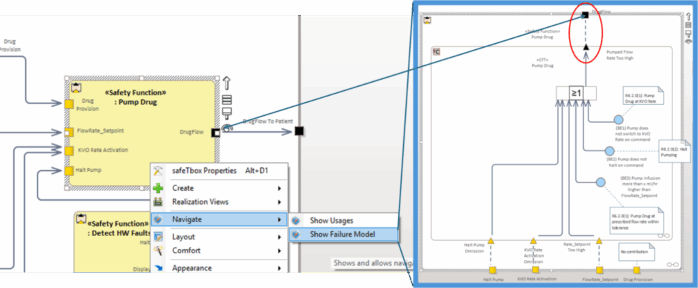
For example, consider a software-controlled infusion pump and the risk of overdose. From the data flow in the software architecture, it is possible to determine which errors or combinations of errors lead to excessive delivery of the injected agent. This can be done by analyzing how an output error (black triangle) can be caused by a combination of input errors (yellow triangles) and internal errors (blue circles), as shown in the following figure. It can then be analyzed along the data flow which output errors from other components can cause the identified input errors.
This integrated view makes it possible to deal with changes efficiently. For example, if error detection and handling mechanisms are introduced, a distinction can be made based on traceability between normal architectural elements such as output ports (black rectangles) and safety-related architectural elements such as output error modes (black triangles). This enables traceability to efficiently determine the cause-effect relationships that need to be adjusted.
Model-based safety engineering combines various aspects:
- Output errors and component errors with architectural elements,
- security requirements,
- Measures against component errors,
- and other relevant safety aspects.
The AI-supported risk management of MedSafe relies on this model-based safety engineering on. It enables the generation of the cause-effect relationship, and the generation of measures to prevent the occurrence of the potential component errors or to break the cause-effect relationship. Normative specifications or recommendations are taken into account. The compliance level is no longer a parallel world based on imported data from a development tool, but rather automatically refers directly to the current status of development. Inconsistencies due to outdated imports can thus be constructively avoided. The main advantage, however, is that the AI provides constructive support in risk management and not only helps to show that the documented risk management is compliant with requirements.
Optimize compliance and minimize approval risks
The automation of compliance processes will determine competitiveness in the medical technology market in the future. Anyone who sets up risk management digitally and with AI support minimizes liability risks and significantly shortens the approval phases.
- Are you unsure whether you have really taken adequate measures to address all risks?
- Are you no longer able to keep up with risk management tasks and would you like a digital agent to support you?
- Do you see disruptive potential for AI in risk management for medical devices?
- Would you like to avoid typical documentation errors, significantly shorten your time to market and minimize the approval risks for your medical device?


