








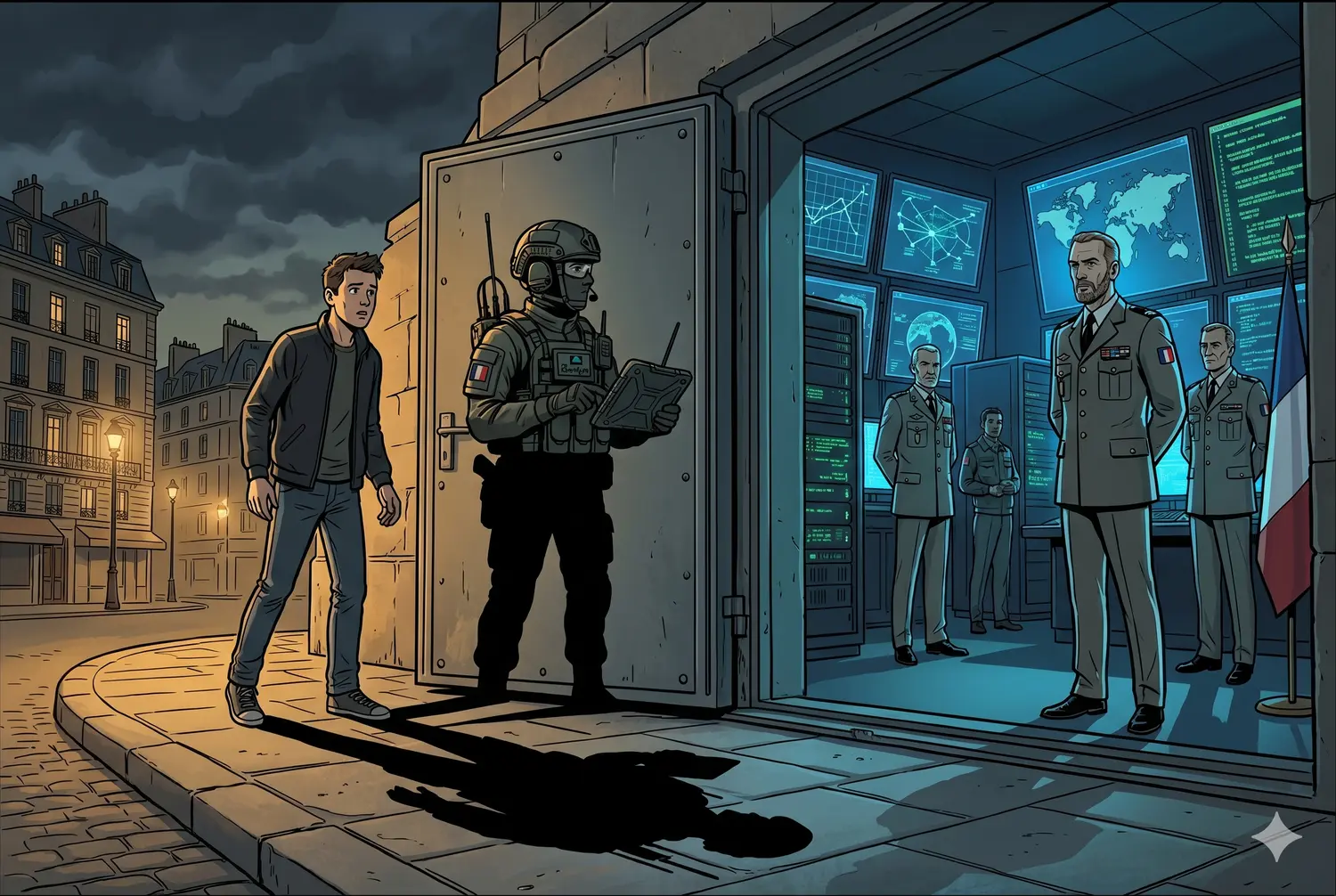
The Army is diversifying its recruitment methods to attract young qualified profiles in cybersecurity, by highlighting the unique skills that it allows them to acquire.
Formerly considered a dusty institution populated by “stone pushers”, according to the mocking expression that sailors use to designate land soldiers, the Army is experiencing a renewed vitality, driven by new geopolitical conflicts. So much so that in 2025, 83% of French people said they were in favor of a return to military service, according to a CSA survey. However, if the institution manages to achieve its objective of recruiting around 15,000 young people per year, it struggles to promote the technical professions it offers, such as those linked to cybersecurity: “Young French people know the Army very well. But, for them, it is above all a huge band of infantrymen with a rifle in their hands and a knife between their teeth. We must succeed in making all our technical professions of specialized fighters known, which is not yet the case”, observes General Goujon, deputy director of youth recruitment of the Army Human Resources Directorate (DRHAT).
However, professions linked to digital technology and cybersecurity are on the rise in the institution: “The weight of recruitment in this field is always greater. It is even in an acceleration phase”. Currently, 450 people are recruited per year in digital professions, such as those linked to networks or communications. Among these recruits, around a hundred are assigned to cybersecurity professions. For these specialist jobs, the difficulty encountered by the DRHAT is to attract competent and motivated profiles. “Especially for these highly sought-after professions and facing private sector employers who pay better than us,” concedes the general. To do this, it is deploying a strategy aimed at convincing young people to “carry the cyber weapons of the republic”.
Recruitment adapted to Gen Z
“We have particular experience to sell and we have to accept that young people come to us for only a few years and then leave,” specifies the general. The new generation of 18-30 year olds is in fact less inclined to make a long-term commitment to an organization than their elders. “It is more mobile than the previous one. We therefore have to accept this situation.” To adapt to this, the DRHAT has notably “diversified the paths of access to these professions in order to attract young people who have the necessary background and appetite”.
“In a minority of cases, we will recruit young people who already hold a bachelor’s or master’s degree in cybersecurity and to whom we will directly offer a position in cybersecurity after a short period of military training.” They are then offered contracts lasting around five years for positions such as, for example, cyber operations engineer or cyber-offensive engineer. “But in the majority of cases, we will take young people who have a base of generic skills that we will militarize.”
This is the case for students of the BTS Cybersecurity, IT and Networks, Electronics (Ciel), located at the Saint-Cyr-l’Ecole military high school, and intended for holders of a scientific, technological or professional baccalaureate. It is made up of two classes of 30 students. Building on its success, this BTS will benefit from the creation of a new class in 2028. Following this training, students are offered non-commissioned officer contracts ranging from 5 to 9 years within military intelligence, the Cyber Defense Command (ComCyber), the cyber defense regiment, etc.
Finally, partnerships are concluded between the army and higher education establishments specializing in cybersecurity, offering students the possibility of carrying out internships or work-study courses within joint cyber structures or the Army. This is for example the case of the framework agreement concluded in March 2026 between the Defense Digital Commission and the French School of Electronics and Informatics (Efrei). “In the cyber defense regiment, we have seen around ten work-study students come through over the past six years. They are happy with these work-study programs and can then be recruited. This brings new perspectives, new blood with new knowledge that is beneficial for us”, testifies Alexandre, a former student of the BTS Ciel de Saint Cyr and now a sergeant in the cyber defense regiment, near Rennes.
Unique skills
Throughout their journey, these cyber-fighters develop experience and skills that are impossible to acquire in the civilian world, praises the general. “Military cyber is present in three areas of combat: the defensive domain, the offensive domain and the information domain. Our vision of cyber is therefore global.” The reason is that military cybersecurity has a capacity for action unmatched by the private sector and commensurate with the threats it must face: “Our problem is not the hacker in the corner of the woods. Our subject is state threats equipped with very powerful technical means. Consequently, the young person tells himself that if he joins us, he will do things that he will not be able to do elsewhere”, specifies the general.
“When we deal with threats, these are in fact not the same issues as in the private sector. When we know that behind the alerts we deal with it is the lives of comrades or the security of the country that are at stake, and not simply the productivity of an organization, it is different,” maintains Adrien, a young master sergeant in the cyber defense regiment, and also a former student of the BTS Ciel. To deal with these alerts, “they have access to resources that would be difficult to find in the private sector and which are not common”, specifies the general. “We do indeed use specific tools, but it is above all the way of using them that will differ from the private sector. For example, when we use them in an external theater of operations, it is not the same conditions as in an air-conditioned office,” adds Adrien.
“I have a formula to describe this: those who do a non-military Sky BTS can find themselves setting up antennas at Orange. And we can do the same thing, but in the sand or the snow,” laughs Alexandre. “It is these constraints, specific to the environments in which we work, which allow us to improve our skills. For example, the internet network is not the same everywhere, etc. We have to know how to deal with these constraints,” adds Adrien. “Finding yourself in such complex environments, sometimes seconded to special forces, also leaves a lasting imprint,” the general also insists. Thrust to the forefront of geopolitical conflicts, these soldiers also develop a solid understanding of international issues, reinforced by specialized training in geopolitics, as is the case at the BTS Ciel de Saint-Cyr, to better understand the origin of the cyber threats they face.
A first job before the private sector
The skills acquired are so rare that such positions within the Army can constitute real springboards towards the private sector, by promoting these particular skills acquired in the exercise of these functions. Aware of this reality and keen to adapt the DRHAT’s offer to the aspirations of Generation Z, the general takes note of it and accepts this dynamic to encourage their return to the Army: “We must accept that they leave and that they come back a few years later. We now have more mobile young people who like to leave and come back. This is also something that we are developing.” Adrien Le Sech, analyst at Recorded Future, is one of these former officers under contract who were able to use their cybersecurity skills acquired within the Army to access a job in the private sector. Before joining the American threat intelligence firm, his first job was as an analyst at ComCyber: “I also noticed that in France, people like me from the army have a rather good reputation in the private sector, particularly in terms of rigor of work”, he explains.
The Army can also provide a real opportunity to enter professional cyber life in the face of a private job market that is increasingly difficult to access. Vincent Cosson, project manager at Efrei, also observes that some students are increasingly considering the army as an opportunity to complete work-study courses in cybersecurity that they struggle to find elsewhere. In the same vein, Léo (first name has been changed), 25 years old, holder of a master’s degree from a cybersecurity school, and who is unable to land his first job as a pentester, applied for a position as an operational reservist in cybersecurity within the Army to demonstrate his “proactivity” with employers and “work on threats different from the private sector”. “And also to serve the Nation, of course,” he concludes.


