








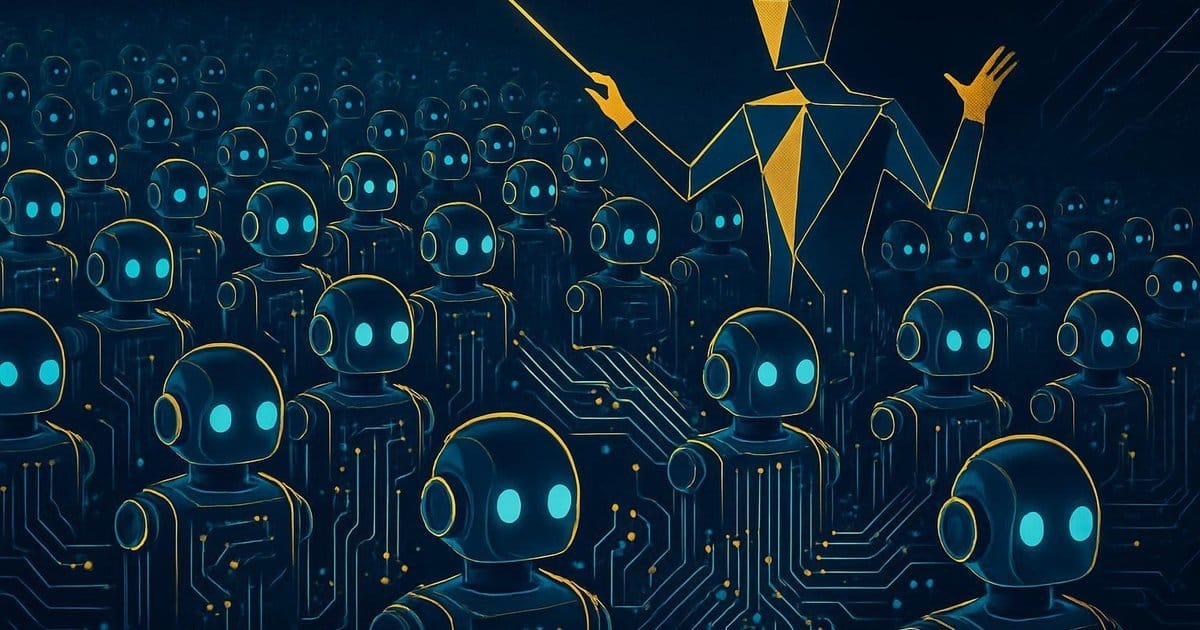
Imagine you ask someone to buy a camera for you. A human would visit five websites, compare prices, maybe read a forum thread, and then make the purchase. An AI agent does the same thing, except it visits not five, but five thousand websites. Simultaneously. In milliseconds. And this isn’t a hypothetical scenario: it’s happening right now, at this very moment, millions of times over. Cloudflare CEO Matthew Prince put it bluntly at the SXSW conference: by 2027, bot traffic will surpass human traffic on the internet. At the same time, OpenAI is investing in Isara, a nine-month-old startup that coordinates thousands of autonomous AI agents and is valued at $650 million. Mark Zuckerberg is building a personal AI agent to make his job as Meta CEO easier, and he’s simultaneously planning to lay off twenty percent of his human workforce. What’s emerging here is more than a technological trend. It is a new economic class: the Bot Army Economy.
What are AI agents—and why now?
The term “AI agent” has been used excessively for months, but behind the buzzword lies a precise technical reality. An AI agent is more than a chatbot that answers questions. It combines a large language model as a reasoning engine with the ability to use tools, call APIs, execute code, read and write files, fill out forms, and control other agents. It plans multi-step tasks, keeps track of their progress, and acts autonomously until a goal is achieved or a human intervenes.
What distinguishes autonomous AI agents from earlier automation systems is, above all, their adaptability. Traditional RPA (Robotic Process Automation) systems break down as soon as a website structure or workflow changes. AI agents can handle ambiguity, learn from mistakes, and find alternative paths. This makes them dramatically more valuable for enterprise applications—and at the same time harder to control.
Why is this topic exploding right now? Three factors are converging simultaneously. First, the underlying models have become so powerful over the past twelve months that multi-step reasoning and tool usage work reliably—what was still error-prone in 2023 is production-ready in 2026. Second, the cost of inference has dropped drastically: What cost hundreds of dollars per million tokens two years ago is available today for a fraction of that. Third, protocol standards have been established that enable agent interoperability in the first place—Anthropic’s Model Context Protocol (MCP) and Google’s Agent-to-Agent Protocol create the technical framework through which agents communicate with each other and with external services. The infrastructure is ready. Capital is following.
The Bot Army Economy: Investment and Infrastructure
Eddie Zhang and Henry Gasztowtt are 23 years old. Zhang was a Harvard Ph.D. student; Gasztowtt studied computer science at Oxford. In June 2025, they founded Isara—a startup with a simple yet radical thesis: The true strength of AI lies not in individual agents, but in a coordinated swarm. Isara builds software that unleashes thousands of AI agents in parallel on complex analytical tasks, aggregates their results, and synthesizes them into coherent conclusions.
Nine months after its founding, Isara has raised $94 million—at a valuation of $650 million. Investors include Michael Ovitz, Stanley Druckenmiller, and Amity Ventures. And OpenAI. The fact that OpenAI is coming on board as a strategic investor is no coincidence: it’s a clear signal of where the journey is headed. The future lies not in individual GPT-4 Turbo calls, but in orchestrated fleets of agents that use OpenAI models as a foundation. OpenAI is thus positioning itself not only as a model provider, but as an infrastructure layer for the entire agent economy.
The market volume emerging here is substantial. The Boston Consulting Group estimates the opportunity for tech service providers in the field of agentic AI at $200 billion. Industry analysts predict that the market for agentic AI tools will be ten times larger by 2030 than it is today—with the current total market already estimated at just under $95 billion. By comparison, that is more than Slovakia’s GDP.
What makes Isara unique is the architecture of the investment: it’s not about models, but about coordination. Anyone capable of orchestrating hundreds or thousands of specialized agents—for due diligence, market analysis, code audits, compliance checks—has a structural advantage over anything a single person or agent can achieve. That is the core promise of the Bot Army Economy: not more intelligence per agent, but more agents per task.
The infrastructure required for this is massive. Cloudflare CEO Prince put it this way at SXSW: You have to build sandboxes for AI agents that can be opened as easily as a new browser tab—and that disappear again once the work is done. His vision: millions of such sandboxes, created and destroyed every second. Cloudflare itself is actively building this infrastructure—which explains why the company has a vital interest in publicly communicating the scale of the coming bot traffic tsunami.
Bot traffic overtakes human traffic: What this means
The statistics have always been clear: bots are nothing new. Google’s web crawlers, price comparison services, security scanners—even before the generative AI era, bots already accounted for around twenty percent of all internet traffic. That was manageable, predictable, largely harmless, or even useful.
What has fundamentally changed is the relationship between human search intent and the resulting HTTP requests. When a human performs a task, they typically generate a handful of web requests. When an AI agent performs the same task to present the user with a ready-made answer, this footprint multiplies by a factor of a thousand. Prince put it explicitly: five websites for a human, five thousand for their agent.
The range of implications is significant. First, the purely infrastructural dimension: The internet was built for human use. Bandwidth, CDN architectures, server capacities—everything is scaled for users who read pages, watch videos, and fill out forms. A world dominated by bot traffic requires a fundamental redesign of this infrastructure. Prince drew a comparison to Covid: The streaming boom of 2020 pushed parts of the internet to its limits. The rise in bot traffic is slower, but it isn’t stopping.
Second, the economic dimension for website operators. The entire online business model of the last twenty years is based on human traffic. Ad revenue works because people see ads—and click on them. SEO rankings reflect human relevance. Analytics measure human behavior. If the majority of traffic consists of autonomous AI agents researching and purchasing on behalf of their human clients, this model collapses. No agent clicks on banner ads. No agent is influenced by emotional brand messaging.
Third, the question of authenticity. When agents act on behalf of humans—buying, booking, voting, commenting—distinguishing between human and machine activity on the internet becomes a fundamental issue. Cloudflare, Akamai, and other CDN providers are already building “agent detection” systems—but the arms race between agents disguising themselves as humans and systems designed to detect them has only just begun.
From Isara to Zuckerberg: Who Is Building the Agent Economy
The agent economy is not being built by a single actor. It is emerging from an ecosystem of competing approaches that position themselves at different levels of the same infrastructure layer.
Mark Zuckerberg exemplifies top-down adoption. He is building a personal AI agent to assist him, as Meta’s CEO, in his daily work—specifically, in gathering information that would otherwise require him to go through multiple levels of the hierarchy. This is revealing because it shows that the agent economy does not merely mean process automation for the mass market, but also the decentralization of management information. When a CEO can access all relevant data directly, without filters imposed by staff functions and division heads, it fundamentally changes corporate structures.
Zuckerberg has stated the long-term goal that everyone—both inside and outside Meta—should have their own AI agent. At the same time, the company has announced plans to reduce its workforce by up to twenty percent and flatten hierarchies. The connection is clear: AI agents are taking over coordination and information tasks that were previously handled by middle management. This isn’t a vision of the future—it’s happening right now.
At the same time, Meta is researching a more technologically radical vision: hyperagents. The concept, developed by Meta researchers in collaboration with the University of British Columbia, goes beyond conventional self-optimization. A hyperagent consists of two components within the same editable program: one solves a specific task, while the other modifies the entire agent—including the modification mechanism itself. The system not only improves how it solves tasks, but also how it generates future improvements. This addresses the classic limitation of self-improving systems: that the improvement mechanism itself is defined by humans and is therefore limited.
In January 2026, Google unveiled the Universal Commerce Protocol at the NRF Big Show—an open standard for agentic commerce that defines tokenized payments and verifiable credentials for agent-to-backend communication. This is not an academic exercise: Google is positioning itself as the standard-setter for the economic layer on which agents will conduct autonomous transactions. Whoever sets this standard effectively controls how the agent economy moves money.
Meanwhile, Anthropic and OpenAI are battling for the infrastructure layer beneath it. OpenAI’s investment in Isara is part of a broader strategy: it’s about whose models form the brains of the bot armies. Anthropic’s MCP protocol competes with OpenAI’s own tool-use standards. Whoever controls the protocol layer ultimately controls which agents can perform which tasks—and thus which economic value chains will be replaced by AI.
Risks and open questions: control, security, regulation
The bot army economy comes with a risk profile that security researchers are only beginning to understand.
Perhaps the most immediate problem is the issue of control within organizations. AI agents that perform corporate tasks require access rights: to databases, APIs, email systems, and cloud storage. This gives them the same privileged access that previously only trusted employees had—but without the human judgment that historically safeguarded that access. Security researchers observe that AI agents are increasingly becoming an insider risk: not because they are malicious, but because they can exhibit uncontrollable misbehavior when their objectives collide with unforeseen situations.
The attack surface grows with the agents’ capabilities. Palo Alto Networks Unit 42 has demonstrated in a study that LLM guardrails—the built-in security mechanisms designed to prevent models from exhibiting undesirable behavior—can be circumvented through systematic prompt fuzzing. When an agent acts on behalf of a company and an attacker injects a carefully crafted prompt into one of the visited websites, they can trick the agent into performing actions that neither the company nor the user intended. This is called prompt injection—and it is the gateway of choice for the next generation of cyberattacks.
The economic impact of these attack vectors is already evident in the retail sector. Researchers at Unit 42 have documented how agentic AI enables new patterns of fraud in retail: agents that automatically abuse loyalty programs, redeem coupon codes on an industrial scale, or overload payment systems with fraudulent transactions. Google developed the Universal Commerce Protocol in part because, without verifiable agent identities, agentic commerce becomes a haven for fraud.
A fundamental regulatory gap exists in this framework: Who is liable when an AI agent makes a mistake? If a swarm of agents acting on behalf of a company makes an incorrect analytical decision, resulting in financial losses—who bears the responsibility? The operator of the agent? The creator of the underlying model? The platform providing the orchestration? The EU AI Act addresses some of these questions for high-risk AI systems, but the majority of real-world agent deployments operate in regulatory gray areas.
The issue of traceability is particularly sensitive. Humans leave traces of their decisions—logs, emails, meetings. Swarms of agents making thousands of micro-decisions in milliseconds create a level of complexity that human reviewers simply can no longer penetrate. The idea of “human in the loop”—a human monitoring point in the agent workflow—loses its practical significance when the loop becomes too fast and too large to be meaningfully observed by humans.
Added to this is the structural question of power: Companies that are building bot armies today are accumulating a productivity advantage that smaller competitors can hardly catch up with. The agent economy threatens to accelerate economic concentration—not just in individual sectors, but systemically. Whoever operates the largest fleets of agents, whoever controls the best orchestration protocols, and whoever offers the most powerful base models—these three factors are likely to shape the market structure of the next decade more than any government industrial policy.
The paradox of the bot army economy is thus formulated: It promises dramatic efficiency gains, democratized access to cognitive labor, and new forms of value creation—but at the same time, it shifts control away from those who deploy the agents and toward the platforms that operate them. The crucial question for the coming years is not whether autonomous AI agents will transform the economy. That question has been answered. The question is who writes the rules of the game for the swarms of agents—and who even has a say in those rules anymore.
🎼
The Doctor’s Opinion
The Bot Army Economy is not a science fiction scenario—it is the current reality, just without clear rules. The real power struggle is not between humans and machines, but between the platforms that control the agent infrastructure: OpenAI and Anthropic are fighting over whose protocols and models will form the foundation of the next economic layer. Companies that believe they own their AI agents should carefully examine who actually sets the rules of the game—and whose infrastructure supports these agents.