









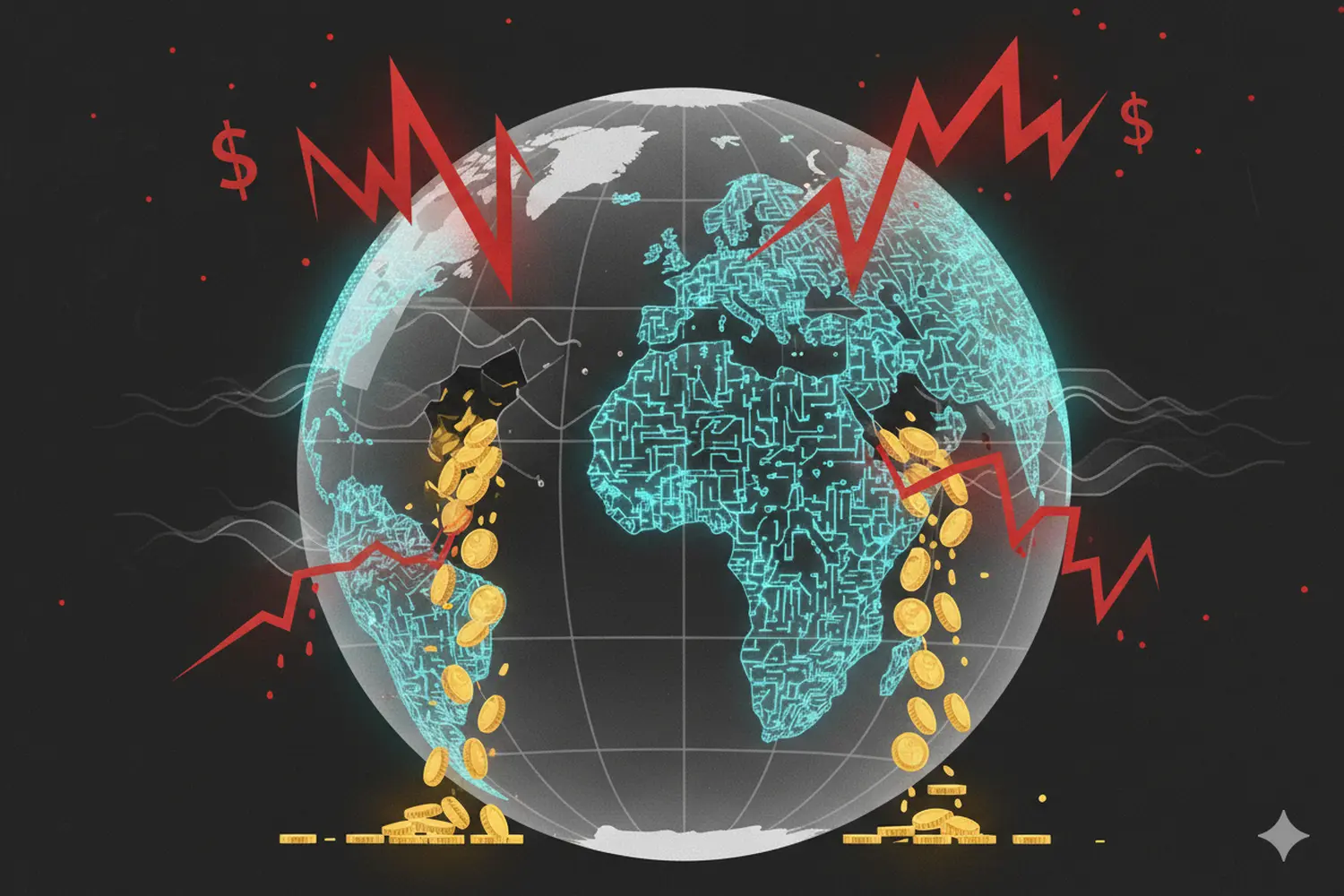
Energy shortages, soaring sovereign debts, the AI bubble and discord in the private credit market… The global economy faces an explosive combination of risks.
After a year 2025 disrupted by the all-out trade war triggered by Donald Trump, the markets expected a calmer and better year 2026 for business, marked, in the United States, by the positive impact of the tax cuts included in the Big Beautiful Bill, and in the rest of the world by a stabilization of the trade war and a return to normal after the end of the post-Covid inflationary wave.
This was without taking into account the unpredictability of the American president, who, by attacking Iran, triggered a new potentially devastating cycle for the world economy. “As the first third of the year comes to an end, hopes of being able to easily combine growth and the fight against inflation have been dashed, and central banks are moving towards a further increase in the key interest rate,” says Lotfi Karoui, managing director of PIMCO, an American asset management company specializing in bonds. “However, the markets have for the moment withstood the shock, visibly betting on an easing of the conflict and a return to the optimism that we felt at the end of 2025.”
The global economy having suffered several systemic shocks in recent years, from the war in Ukraine to Donald Trump’s tariffs, the markets are betting that the same will happen with the Iranian conflict. The economy, however, faces a particularly explosive combination which makes this bet hazardous.
The war in Iran and the energy shock
Almost two months since the war was started, and despite the negotiations going well between the two camps, we do not yet know when it will end. Trump increase the number of announcements agreements and ceasefires immediately contradicted by the Iranian authorities, followed by warlike and conciliatory rhetoric, the strait was decreed open, then closed again a few hours later… It is difficult to see clearly in such a context.
But whether peace is signed soon or not, Pierre-Olivier Gourinchas, chief economist of the IMF, estimates in a recent interview that the war already constitutes an energy shock greater than that of 1973. According to him, each day during which the conflict continues increases the risk of seeing disruptions in energy markets continue until next year, with the risk of seeing global growth fall to 2% this year, compared to 3.3% planned at the start of the year. “Even if we are seeing a de-escalation in Iran, there is a lot of uncertainty about the speed at which production and energy flows will be able to get back up to standard,” said Andrew Balls, chief investment officer for global fixed income at PIMCO.
Especially since the supply crisis caused by the Iranian conflict does not only concern fuel, but also fertilizers and pesticides. “We are on borrowed time,” said Pablo Galante Escobar, LNG director at Vitol, an oil trading company, at a recent event in Lausanne. According to him, about 40% of the drop in gas demand comes from factories, particularly fertilizer plants, since the United States and Israel attacked Iran. Natural gas is in fact an essential raw material in nitrogen fertilizers such as ammonia. “This is not sustainable, the energy crisis risks becoming a food crisis,” he warned.
A situation that is both better and worse than in 2022
In a recent note, the IMF asserts that the situation is very different from 2022, when Russia attacked Ukraine. On the one hand, inflation is more moderate than then, which puts us in a better position. “In 2022, inflationary pressures were already high, fueled by post-pandemic supply-demand imbalances, tight labor markets and abundant liquidity. Today, the slowdown in labor markets and the normalization of balance sheets have eased underlying pressures, even if inflation remains above its target in some countries, notably in the United States,” note experts from the International Monetary Fund.
On the other hand, the economy is still slowly recovering from the shock of 2022, which means that the markets are more on alert and quicker to get carried away. “The last episode has left its mark. Structurally higher price levels have revived concerns about the cost of living and made inflation expectations more sensitive to further price increases.”
Can AI continue to support the economy?
For the moment, however, the markets have not reacted too badly: the three major American stock indices have not only returned to their pre-war levels, but have even exceeded them. Like last year, the economic shock is partly absorbed by the crazy spending of technological giants in AI, which play a role of economic stimulus. The nine largest American market capitalizations, all tech giants, now account for 35% of the S&P 500, an unprecedented concentration, and all their valuations are partly linked to a bet on the future of AI.
Hyperscalers have planned to put 700 billion dollars of Capex into AI infrastructures this year, and an additional 800 billion next year, colossal sums which create jobs, generate demand in adjacent industries (construction, energy, semiconductors, computer equipment, etc.), contribute to the dynamism of financial markets and more generally generate optimism in the economy which pushes companies to count on future productivity gains, to invest and to hire.
But the increasing recourse of these companies to debt to finance their investments begins to worry and to instill doubt about their abilities to maintain such a pace. Especially since the war in Iran also affects them indirectly: first because the energy and maritime freight crisis will complicate, delay and increase the cost of building data centers, then because funds from the Middle East are among the big money makers of AI. A drop in their investments following the conflict could therefore be cruelly felt.
Private credit continues to worry
On the one hand, the explosion of the bubble could generate a major shock. On the other hand, the rise of AI also carries its own risks, insofar as it threatens the values of the software, which in turn could precipitate the crisis of private creditwhich is causing more and more concern in high financial circles. The consensus among experts for now is that a private credit crisis would be bad news, but would not have the systemic contamination effects that the subprime crisis had.
“Some people will certainly lose money and so on. But it doesn’t seem to have the characteristics of a broader systemic event,” Jerome Powell, the head of the Fed, recently told Harvard students. Even without a systemic impact, a private credit crisis would nevertheless be an element of additional economic deterioration which, on an economy already weakened and prey to numerous shocks, could still have a significant impact.
Sovereign debts in the crosshairs
Especially since all this is combined with growing concern around sovereign debts, in particular that of the United States. It is even the main risk currently weighing on the global economy, ahead of all others, according to the head of the Fed. “The federal government’s debt is growing much faster than the economy, which is by definition unsustainable,” he told Harvard students.
The American debt today reaches 125% of GDP, compared to only 60% twenty years earlier, and Donald Trump’s Big Beautiful Bill will make the problem even worse. A continued rise in US debt, without any attempt to redress the situation, could lead investors to question the safe haven value of the dollar and US Treasury bonds, which have already seen their rates of return rise quickly. Questions about the independence of the Fed, while Donald Trump continues to put pressure on Jerome Powell and appointed one of his followers to take over from him, as well as the alternatives to the petrodollar who draw in the context of the war in Iran, could further reinforce this phenomenon. Don’t throw any more away!