








Anthropic is accelerating in the AI race. With Claude Opus 4.7, the company offers a more efficient model in programming and capable of processing high-resolution images.
For several months, Anthropic has been multiplying iterations of its Claude models to stay in the race against OpenAI or Google. Barely two months after the release of Opus 4.6the company is already unveiling Claude Opus 4.7, presented as its most efficient public model to date.
Available now for professional users, this new model aims in particular to improve performance in software engineering, complex reasoning and long tasks. However, Anthropic recognizes that this system is not the most powerful it has developed…
Notable progress on AI benchmarks
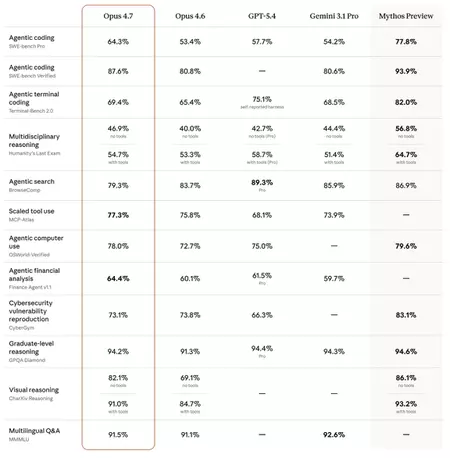
An overview of Opus 4.7 performance – Source: Anthropic
As we can read in the company press releasewith Opus 4.7, Anthropic highlights several measurable improvements on the reference benchmarks. On SWE-bench Pro, a widely followed test to evaluate the performance of agentic programming models, the model reached 64.3%, compared to 53.4% for Opus 4.6.
In some cases, it is even positioned ahead of competing models. The comparisons cited show in particular:
- 64.3% for Opus 4.7 on SWE-bench Pro
- 57.7% for GPT-5.4
- 54.2% for Gemini 3.1 Pro
On the SWE-bench Verified benchmark, the score climbs to 87.6%, while the model obtains 94.2% on GPQA Diamond, an advanced reasoning test close to doctoral level.
Beyond raw performance, Anthropic also says it has improved the model’s ability to accurately follow instructions and check its own answers before providing them.
A model designed for long and independent tasks
One of the main directions of Opus 4.7 concerns so-called “agentic” uses, that is to say systems capable of carrying out complex tasks with little human supervision.
According to Anthropic, the model can manage multi-stage projects over a long duration while maintaining consistency over a context window of up to one million tokens. This ability allows him to work on large projects, such as software development or document analysis.
Furthermore, the multimodal vision has been reinforced. The model can now analyze images up to 2,576 pixels on the long edge, more than three times the resolution accepted by previous Claude models. This opens the way to uses such as analyzing complex screenshots or extracting data from detailed diagrams…
A two-tier strategy for Anthropic models
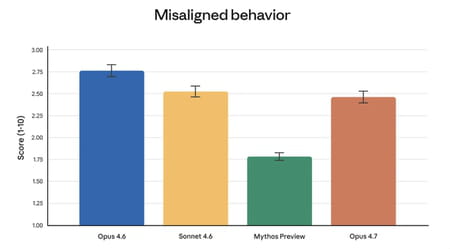 Impressive capabilities… but not on all levels – Source: Anthropic
Despite these advances, Anthropic specifies that Opus 4.7 is not its most powerful model. Internally, the company hasa more advanced system called Mythoscurrently reserved for a limited number of partners under the Project Glasswing cybersecurity program.
This model would display even better performance, particularly in tasks related to IT security. However, Anthropic has chosen to limit its distribution in order to better control the risks associated with these capabilities.
In this strategy, Opus 4.7 therefore plays an intermediate role: it makes it possible to deploy certain innovations on a large scale while testing the necessary safeguards before a possible release of even more powerful models.
Available now via the Claude API, Amazon Bedrock, Vertex AI or Microsoft Foundry, the model maintains the same pricing as its predecessor: $5 per million tokens for input and $25 for output.


