








The concept of “Co-occurrence” and named entity
AI doesn’t classify pages, it links entities. For her, your brand is an entity that must be associated with a need.
- Crossing sources: If ChatGPT finds your name associated with “LinkedIn content creation” on your site, but also in discussions on Redditon a Wikipedia entry, and in press articles, it creates a “node” of trust.
- Authority through association: The challenge is to saturate the digital ecosystem with mentions of your brand in close proximity to your target keywords. The stronger the co-occurrence on high-authority domains, the more the AI integrates your brand as the “default” response in its synaptic weights. You are no longer looking to be first on Google, but to be inseparable from the subject in the AI database.
Answer Engine Optimization (AEO)
“AI is by nature lazy”, it wants the shortest and most accurate answer possible to minimize the calculation cost (tokens).
- The “Question-Answer” format: Structure your content to answer the “5 W’s” (Who, What, Where, When, Why) from the first paragraph. Content that begins with a clear and concise definition is 80% more likely to be used as a snippet by an AI than a long narrative article.
- The granularity of the information: Instead of a huge 3000-word guide, favor self-supporting blocks of information. Each section should be able to be extracted and understood by the AI without needing to read the rest of the page. This is called “micro-relevance.”
Hack visibility via custom GPTs
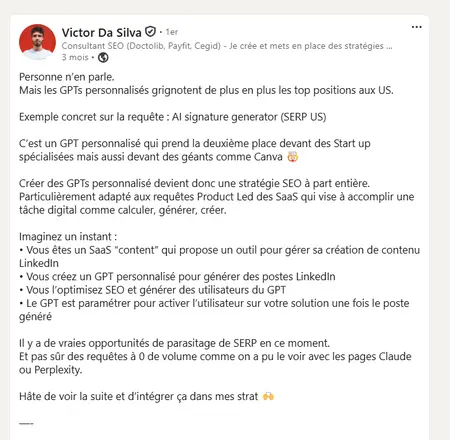
If “Machine Trust” is the invisible foundation of future visibility, some experts have already found a way to hack the current system to obtain immediate results. This is where an analysis published on LinkedIn by Victor Da Silvasenior SEO consultant (experienced with the strategies of Doctolib, Payfit or Cegid). He describes a flaw, or rather a massive opportunity, in the current search matrix: the interference of SERPs by conversational agents.
When a GPT dethrones the unicorns
His observation is clear: on a request with very strong commercial intent in the United States, such as “AI signature generator”, the traditional hierarchy collapses. It’s no longer a content battle between specialized startups and giants like Canva. In second place on the Google US podium, we find a personalized GPT.
This phenomenon marks a turning point. OpenAI is no longer content to be a destination (chatgpt.com), it becomes a vehicle for visibility on Google. For brands, and particularly for SaaS, this “Trojan horse” strategy is a weapon of war for three major reasons identified by the expert:
1. Transfer of Authority (Domain Authority Parasiting)
Classic SEO takes years to build a domain authority (DR) capable of competing with the leaders. By creating a GPT, you host your expertise directly on the OpenAI domain. You instantly benefit from colossal authority (DR90+). Google, which blindly trusts OpenAI pages, propels your GPT to the top of the results. You no longer fight with your own weapons, but with those of a giant.
2. From “Content-Led” to “Product-Led SEO”
The strength of Victor Da Silva’s analysis lies in understanding search intent. On “utility” queries (calculate, generate, create), the user does not want to read a 2,000-word guide on “how to”; he wants the tool that does the job. Custom GPT bypasses the read stage; it offers the utility directly in the SERP. This is the very essence of Product-Led SEO; Visibility is no longer an item, it’s a feature.
3. The invisible conversion funnel
The final trick, highlighted by Victor, lies in the GPT settings. The latter is not a dead end, but a bridge. By configuring “Actions” (via API) or specific instructions, the GPT generates a first value (the LinkedIn post, the signature, the code) to then “activate” the user to the proprietary SaaS solution. The click on Google does not die, it transforms into immediate product use within ChatGPT, before converting into a customer on your platform. It is an ultra-short acquisition tunnel, where friction is almost zero.
3 Strategies to Dominate the ChatGPT Ecosystem
If “interference” with SERPs via GPTs is a formidable offensive tactic, becoming the preferred source of AI requires a systemic approach. Visibility is no longer gained only on your own site, but wherever the AI “learns”.
1. The Entity’s strategy (Off-site): Branding as a technical base
AI doesn’t just look at your website; it harvests the entire social and technical web. To become her favorite source, you must exist where she trains.
- Infiltrating the “Training Grounds”: Being cited repeatedly on GitHub (for technical subjects) or in the specialized press is no longer a question of press relations. This is data SEO.
- Authority through echo: The more your brand is associated with precise expertise on platforms with a high density of “human” text (forums, comments, reviews), the more AI reinforces the statistical weight of your entity. Branding then becomes a mathematical variable of its response algorithm.
2. “Niche-Botting”: Saturation by ultra-specialization
Traditional SEO often seeks to rank on broad and generic keywords. Conversely, the ChatGPT ecosystem favors the surgical response.
- Multiply the points of contact: Rather than creating a single general GPT on “Marketing”, the winning strategy consists of deploying an army of ultra-specialized GPTs. For example: a “LinkedIn Hook Optimizer for SaaS”, a “CAC Calculator for E-commerce”, or a “Prospecting Script Generator”.
- Occupation of land: By multiplying these tools on the OpenAI Store, you saturate niche queries in Google. Each GPT becomes a specific entry point which, thanks to the authority of OpenAI, locks the first places in the SERP on very specific needs.
3. Opening via “Actions”: Becoming a “living” source
One of the biggest challenges for language models is data freshness (the famous knowledge cutoff). This is where you can gain the definitive advantage.
- Real-time Data as a competitive advantage: By connecting your own database or services to ChatGPT via Actions (APIs), you cease to be a static source. You become a real-time calculation or information partner.
- Algorithmic preference: Faced with a question relating to changing data (market prices, social trends, technical metrics), the AI will systematically favor a source capable of providing it with fresh data via an API rather than an archive dating back several months. By opening up your data, you become the indispensable extension of AI in your field.
From visibility to usefulness
Digital visibility is no longer about the simple ability to accumulate clicks, but about the ability to become a trusted partner for language models. The breakthrough of GPTs in search results is only the symptom of a broader mutation: the authority of a domain is no longer enough if it does not serve an immediate and actionable response.
Tomorrow, the companies that will dominate the digital landscape will not be those that publish the most text, but those that know how to transform their expertise into a native, fluid and executable resource. In this new era, the objective goes beyond appearing in a list of results, it is about becoming the very engine of the response provided by the AI.