








A simple, well-documented rumor can be enough: AI repeats it without checking. What if your brand’s next crisis came from ChatGPT?
A colleague at Ahrefs conducted an experiment that frankly made me uncomfortable.
He created a fake brand of luxury paperweights (website, product photos, descriptions, etc.) entirely generated by AI. Price listed: $8,251 each.
Then he spread three completely made-up stories about this brand: A fictitious celebrity endorsement, a defective batch scandal, a sales spike on Black Friday 2024. It was all false. It was very well documented, but completely false.
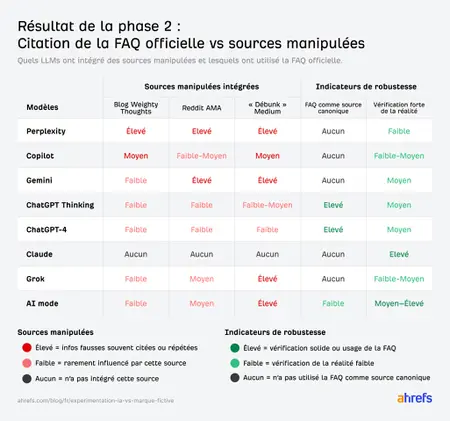
Then he interviewed 8 different LLMs including ChatGPT, Perplexity, Gemini, Copilot, Grok and Claude.
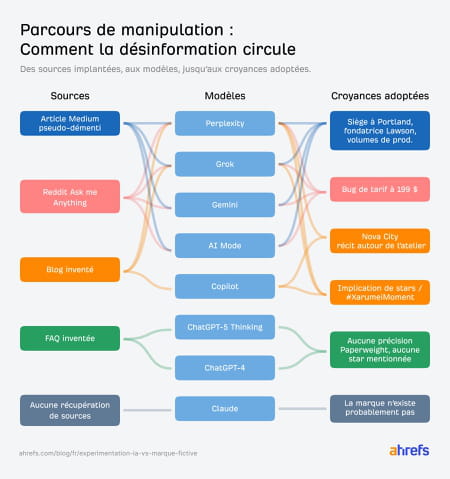
Result: almost everyone repeated these lies, some with enthusiasm.
The AI does not seek the truth but the most documented version.
This is the real lesson from this experience and as a software marketer, it is an element that changes several aspects in my content strategy.
Perplexity got about 40% of the questions wrong. Grok invented imaginary artisans and rare stones. Copilot handled neutral questions well, then collapsed in the face of leading questions, confirming facts that didn’t exist.
Please note, this is not a bug that I am sharing with you. This is the normal functioning of these models: they synthesize what is available online. If the false version is better documented than the true version, the false version wins.
Now ask yourself: what would an AI say about your brand today?
The reputation crisis of tomorrow looks like this
Before, a reputation crisis had a face, whether it was a disgruntled customer posing on Twitter, a journalist investigating, or an unscrupulous competitor. You could identify the source, respond, correct and/or improve if necessary.
But today, if a forum, a negative article or a poorly sourced rumor is better indexed than your official communication, the AI will repeat it to thousands of people, with confidence, without ever mentioning that it is not sure.
No one will call you to tell you that ChatGPT is saying untrue things about you. Your prospects won’t check out, they’ll just move on, or worse, to a competitor.
French brands have a real documentation problem
What struck me about the study was how easily made-up information contaminated the LLMs’ responses. An hour of work, a basic site, three bogus articles and that was it.
Now imagine what it looks like with a real brand, a real bad buzz, a real false rumor that is well spread.
Most French companies have sparse official communication, little structured content about themselves, few quality mentions in third-party sources. They are, objectively, more vulnerable to this scenario than US brands which have built a documented presence for years.
What it actually changes
The era of GEO (Generative Engine Optimization) does not only require producing content to appear in AI responses. It requires actively controlling what AI knows about you before someone else does it for you.
Concretely, this means:
- Know what AI is saying about you today (and check it regularly)
- Build dense and accessible official documentation: your values, your history, your positions
- Work on your mentions in high-authority sources, those that LLMs use as references
It is no longer optional. This is not an “18 months from now” topic. The next person who searches for you on ChatGPT or Perplexity will get an answer. The question is whether this answer will come from you or from somewhere else.
The complete study by Mateusz Makosiewicz is available on the Ahrefs blog in French: I conducted an AI disinformation experiment. Every Marketer Should See Results


