








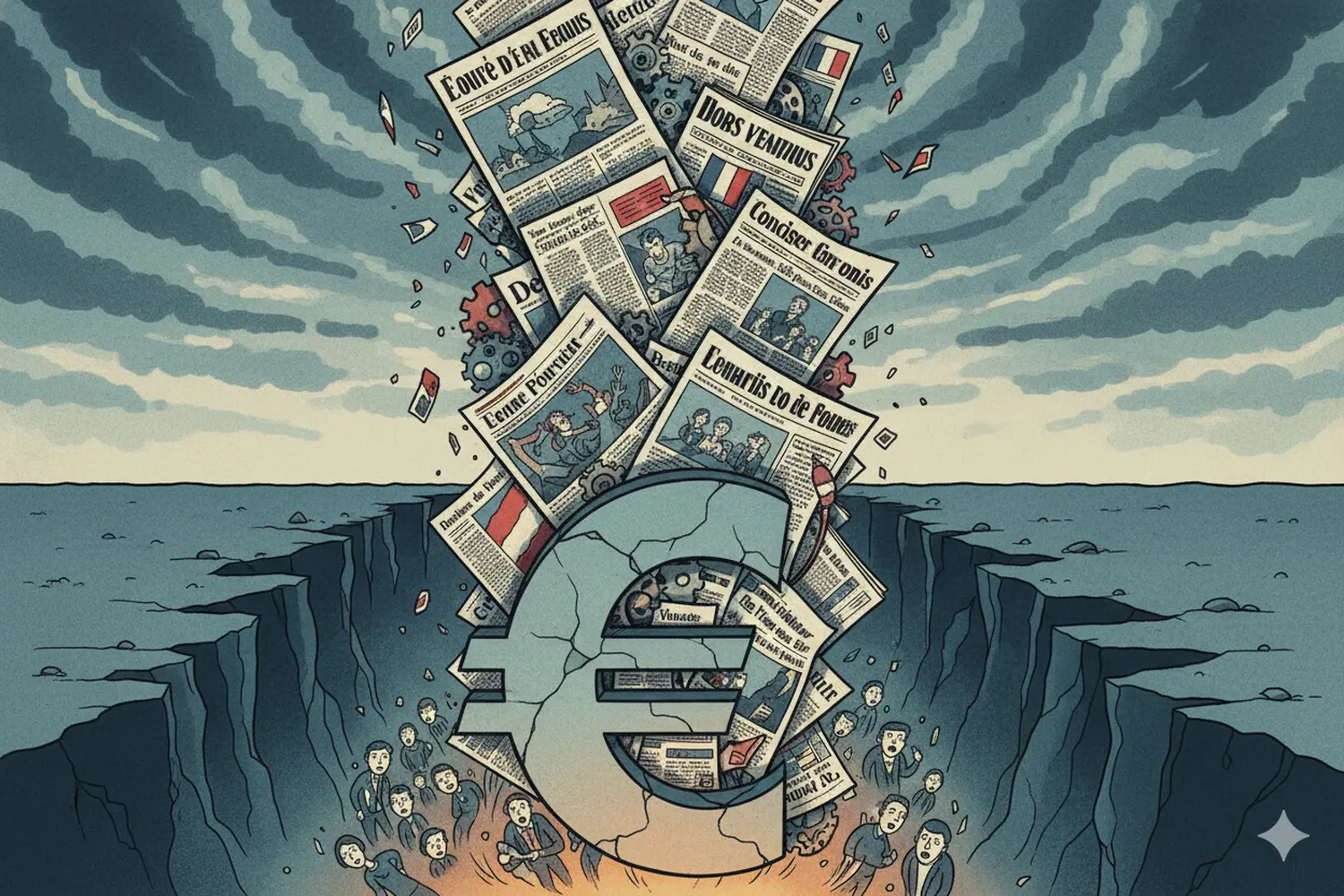
New evils have been added to old evils such as the decline in print and the voracity of platforms, creating multiple scissor effects against which press publishers are fighting as best they can.
At least 930 job cuts announced in a few months… In the regional and national daily press, in the specialized press, magazines, pure web players, layoffs, voluntary departure plans and non-renewal of positions follow one another. Why such a surge? The reasons are numerous, and unfortunately structural
Insufficient digitalization of revenues
The flagship of press companies excluding pure players, and their biggest problem too, remains revenues from their printed edition. The latter weigh heavily, while declining year after year, and generate considerable production costs which weigh down the results. With exceptions, as in the case of the Worldwhere digital represents 52% of revenues in 2025, Echoeswhere it accounts for 60% of turnover excluding diversification in the same year, where again for Le Figaro where it represents 50% of revenues in 2024, the digital transformation of titles is still struggling. The national daily press (PQN) is also the only one to see its overall circulation increase, by +3.4% in 2025. according to the CMPAdespite a significant drop, in print, in individual sales (-15%) and subscriptions (-10%).
In total, all press families combined, print and digital included, circulation in France fell by 2.2% in France last year, and by 1.5% in 2024. In the PQN, sales and advertising combined, digital transformation represents barely 30%, according to a representative panel of the sector brought together by General News Press Alliance. Among the regional and departmental daily press, the situation is even more obvious: digital accounts for only 8% of turnover (Alliance, 2024). A driver of growth, digital is therefore not yet able to compensate for the difficulties of these groups, who are forced, among other things, to cut their workforce.
In the magazine press, the situation is similar: print (sales and advertising) weighs for two thirds revenues from a group like Prisma, leader in the magazine sector in the midst of a crisis, and for 85% of a CMI Media, also in difficulty. The activities of diversificationalthough very profitable, are only a drop in the ocean of the print media economy in the majority of cases.
A sharp drop in advertising revenue, even in digital
In the economy of the historical press, advertising accounts for 26% of the revenue of the PQR and the PQN (Alliance, 2024). And that’s almost all of the digital revenue of a Prismaaccounting for a third of the group’s revenue. However, in terms of advertising, revenues have been decreasing every year for several years, including digital: the latter has performed very poorly, particularly in the last two years, also having a serious impact on pure digital players whose model is 100% dependent on advertising.
Some figures: net advertising revenues from the press, including print, eroded by 5% in 2024 compared to 2023, despite the holding of the Olympic Games, to find themselves 19.5% below their 2019 level, according to the Unified Advertising Market Barometer.
The year 2025 came to drive the point home, with a drop of 6.4% compared to 2024 and 10.2% compared to 2023. On the purely digital side, revenues from the category publishing and info fell by 8% in 2025 compared to 2024 (in a market up 11%), they remained stable at +1% in 2024 (while the market rose by 16%) according to the ePub Observatory. The decline wiped away in 2023 was already 6%. In total, the press lost 8 points of market share on display in three years.
How can we explain such significant declines in advertising revenue? Four main factors contribute to this massacre.
1. The advertising market is not favorable to the digital press because he has resolutely turned towards platformswhose reach, unrivaled data, technology and ease of activation have made it possible to attract the long tail of small and medium-sized advertisers, in addition to large ones. More recently, it is the entire economy of creators, all based at Gafam, in full boom, which reinforces this trend: the net investments of advertisers in influencer marketing have increased by 13.1% in 2025according to France Pub.
Each year, Google, Meta, Amazon and the main American social networks capture more than 80% of the growth of the French digital advertising market. In six years, the weight of the platforms is increased from 67% has 76%. The weight of the press seems insignificant: the publishing and info category captured 504 million euros in digital display revenue in 2025; the platforms swallowed up 9.426 billion (ePub Observatory) last year in France.
3. Traditional advertisers are drastically cutting their budgets in the context of a crisis. The difficulties became even more accentuated when the advertisers of the luxury in 2024, and automotive/transport in 2025, traditionally very present in the press, have put their foot on the brake. Not to mention mass distribution (-3% in 2025) or decoration/furniture (-9%). The ongoing war in the Middle East is certainly not likely to help matters.
4. Google killed SEO for media. For several years, press publishers have noticed drops in traffic from Google Search and social networks on their sites. According to une study published by the Reuters Institute At the start of the year, based on aggregated data from the analytics company Chartbeat, Google traffic from organic search to more than 2,500 sites decreased by a third (33%) globally between November 2024 and November 2025. French sites are no exception to this underlying trend. The rise of the Google Discover service, whose weight in terms of traffic share among French publishers has become majorityaccording to the General Information Press Alliance, does not, however, facilitate the monetization of these audiences, which remain difficult for publishers to identify due to their very volatile nature and Google’s opacity regarding the operation of its algorithm.
This difficulty in controlling traffic is only increasing with the rise of conversational agents, which only send very few audiences to information sites. In the United States, a study by the Pew Research Center indicates that AI Overviews (not yet launched in France) generates half as many clicksthus reinforcing the risk of a drop in advertising revenue.