






More and more fraudsters are posing as representatives of online banks to convince passers-by to open a bank account. They recover their access and launder money.
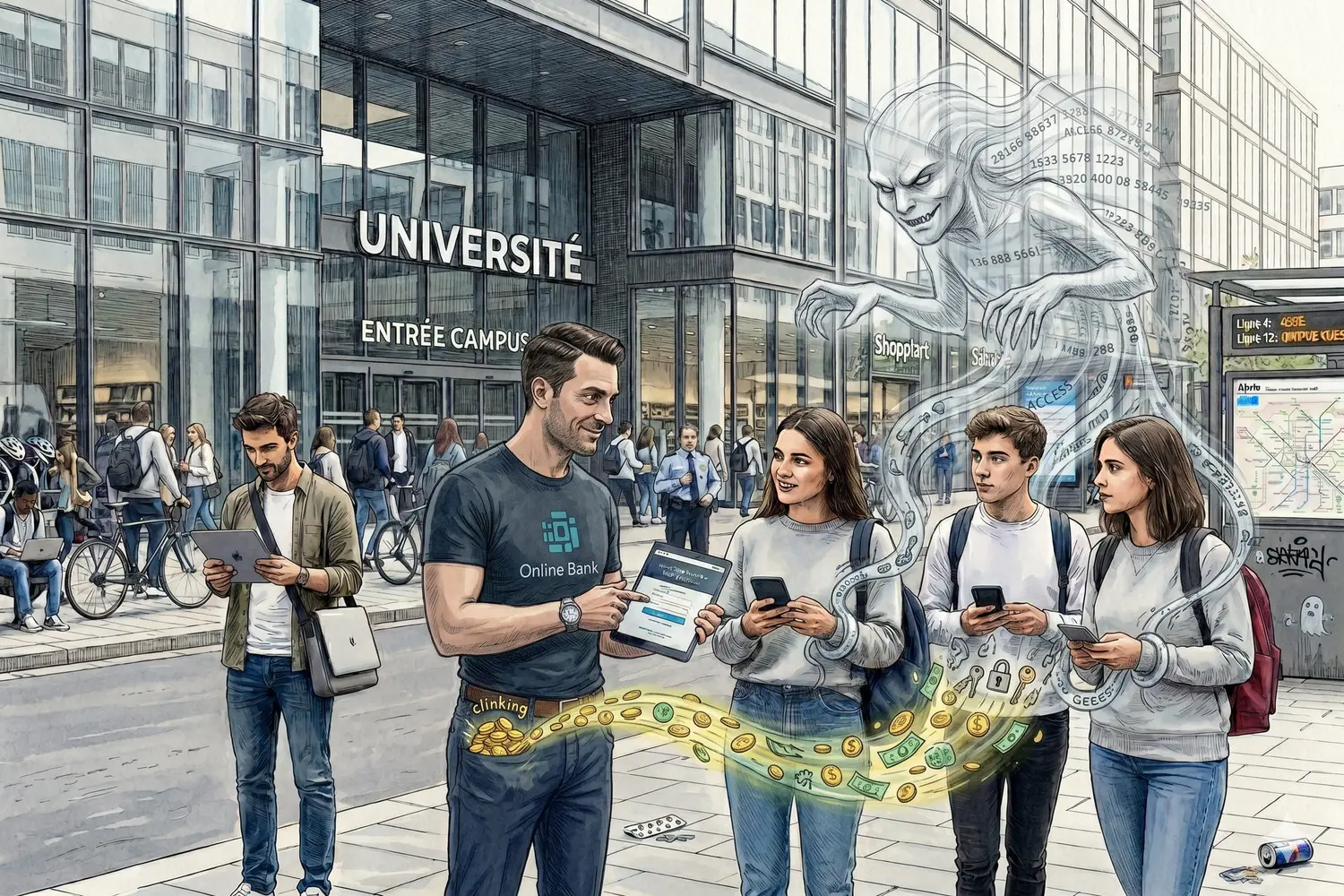
We cannot stop progress, including in crime. For several months, online banks have been warning about a new form of scam. The goal of scammers: to unwittingly transform simple passers-by into money mules, explains Christophe Chaputproduct director at IDnow, a German company specializing in digital identity verification for many banks. “Before, our clients’ fraud teams talked to us about money mules in one meeting in 10. Now, they talk to us about it in half of our meetings,” he assures. The process is simple: fraudsters pose as representatives of an online bank to passers-by in the street. They offer them the opportunity to test the establishment’s mobile application by inviting them to open an account in their name while obtaining their connection details. This allows them to pass funds of fraudulent origin through to launder them. “For three months, this process has experienced exponential growth according to our customers.”
A strategy disguised as application testing
“Here is one of the cases that was reported to us by an online bank: fraudsters placed themselves at the exit of a very well-known Parisian university in order to chat with students. They posed as representatives of an online bank thanks to a t-shirt with the name of the latter above. They offered students to open an account on the online bank by telling them that it was to test a new formula. In exchange, they explained to them that they would receive a transfer to This account was presented in such a way as to make it appear that it was for purely professional purposes. Many students let themselves be trapped, created an account with their identity and with the help of these fraudsters, who in fact became money mules without their knowledge.
This method of approach contrasts with the methods usually used by criminals seeking to launder money. Generally, money mules are recruited with the knowledge that they are transferring money through their account for the benefit of a third party. “Recruitment is done either digitally or physically. Digitally, this usually happens in the social networks where 15-25 year olds go, such as Instagram, TikTok or others. This age group is in fact the most vulnerable to these maneuvers. Ads, sometimes published by fake or real influencers who post images reflecting a luxurious life in Dubai, attract them with publications that offer them large sums of money for doing nothing. Then they guide them to encrypted messaging like Telegram or Whatsapp to explain the task to them: redistribute money in exchange for a commission. As for the physical route, the delinquents recruit mules where the 15-25 year olds are, in nightclubs, bars, etc.,” says. Luis Delabarrecyber threat intelligence expert at Recorded Future, which has a dedicated financial fraud business.
“An online bank brought us another case, which comes from another large European city. A fraudster posed as a representative of an online bank. In the street, he offered passers-by to test the bank’s new onboarding, in order to supposedly benefit from their feedback on the way in which it verifies their identity, in exchange for a sum of money. What changes with the previous case is that the fraudster lends a phone to the victim so that he can open the bank account She does not know that this is a real creation of an online account in her name and that her account is then used by the fraudster to launder money,” adds Christophe Chaput.
A modus operandi destined to expand
“These fraudsters act either alone or in groups. This method is used either by organized crime, or as part of small scams carried out by individuals in isolation. The latter case predominates, according to our customer feedback. For example, a customer brought us the case of a person who stole mobile phones to sell them on a well-known web platform. She needed a bank account to recover this money”, in order to hide the crime.
This method of approach risks being used more and more, regrets Christophe Chaput. And for good reason: “Identity checks are only getting stronger when subscribing to a bank. For example, we are seeing fewer and fewer identity documents without an NFC chip. And this trend will increase. In a few months, each European country will have to offer its citizens an electronic means of proving their identity with the European digital identity wallet, the EUDI Wallet. Unfortunately, fraud will not disappear. Instead of creating a false identity or a falsified document, Fraudsters will instead use a real identity, using physical processes.