








What if the true luxury of AI was not accessing the most powerful model, but knowing which one was enough? An issue of digital maturity as well as ecological.
In a few years, we have developed a bad habit: talking about artificial intelligence as if it were a magical, fluid, almost free resource.
One question, one answer. A prompt, a text. An idea, an image. For the user, the experience is deliberately simple: the AI seems always available, always ready, always capable.
But this simplicity masks a more disturbing reality: not all requests are equal. Asking for an apple pie recipe, correcting an email, analyzing a contract, coding an application, conducting documentary research or mobilizing an agent capable of working for several minutes do not involve the same cost, the same level of necessary intelligence, nor the same energy impact.
However, the general public interface often tends to make this difference disappear.
Most major AI platforms today operate according to a well-known digital logic: freemium. A free version allows you to get started. A Plus or Pro version increases the limits. More expensive offerings provide access to more power, models, in-depth search, agents, context or multimodality. OpenAI, Google and Anthropic each apply this logic with their own variations: message quotas, time windows, credits, weekly limits, premium features or differentiated access to the most advanced models.
But behind these business models lies a much more interesting question: does the user learn to use AI wisely?
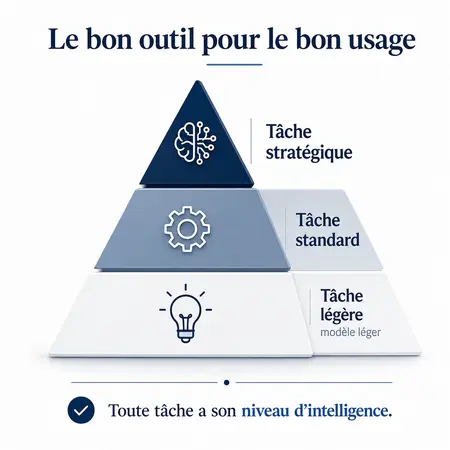
Platforms are starting to make visible what many interfaces until recently masked: there are several levels ofartificial intelligenceand it is not rational to use the most powerful one for everything. Anthropic, for example, explicitly documents that the choice of model, the length of conversations, the attached files and the activated tools influence the limits of use – and positions its different models according to an assumed hierarchy: fast and economical model for common tasks, general model for the majority of uses, advanced model to be reserved for the most complex problems. Other players are moving in the same direction, with Google indicating that its limits vary depending on the model used, the size of the context and the type of functionality requested.
This distinction is at the heart of the subject. Using a very advanced model for a simple task is, in a way, like mobilizing an operating room to apply a dressing. It works. But this is a poor allocation of resources.
ChatGPT, conversely, gives more of an impression of abundant and continuous intelligence. The limits do exist – OpenAI documents different ceilings depending on the offers and depending on the modes of reasoning – but the experience remains designed to be fluid, comfortable, almost invisible. This choice of user experience has an obvious advantage: it promotes mass adoption. But it also has an educational cost: the user does not always learn to distinguish a task that requires a heavy model from a task that could be handled by a lighter model, a specialized tool, traditional research, or even simple human reflection.
Some platforms have opted for a credit logic, where consumption depends directly on the resources mobilized to accomplish a task. This approach is sometimes frustrating, but it has merit: it reminds us that AI is not an abstraction. It consumes computation.
And this is where the ecological debate becomes more subtle.
The problem is not just how much an average query consumes. Estimates vary depending on models, infrastructures, calculation methods and actual production conditions. A recent study published in Joule shows that long, agentic, or highly reasoned queries can consume an order of magnitude more than a simple optimized query. Other work confirms that the length of the prompt, the length of the response, the architecture of the model and the type of reasoning strongly influence the energy footprint of the inference.
In other words, it is not enough to say: “AI consumes too much” or “AI consumes little”. The real question lies elsewhere: are we using the right level of AI for the right level of task?
This is probably one of the next digital maturity challenges. Until now, the adoption of AI has been based on a promise: everyone can access augmented intelligence. The next step will have to be more demanding: learning to dose this intelligence.
We learned not to print all our emails. We have learned to sort our uses of the cloud. We learned, slowly, that streaming, video, storage and data centers had materiality. We will have to learn the same thing with generative AI.
This does not mean blaming the user. This means designing smarter interfaces. A good AI interface should not only respond — it should also help choose the right response mode. For a simple task: quick model. For a reformulation: light model. For a strategic analysis: advanced model. For documented research: model connected to sources. For a long task: specialized agent. For a sensitive decision: AI assistant, but human validation.
Real progress will therefore not only be having access to the most powerful model. It will be knowing when not to use it.
This shift is also important for businesses. In the coming months, many organizations will equip their teams with AI tools. The temptation will be strong to choose the most capable model for all employees, in all cases. This would be an economic, ecological and educational error. A mature organization will instead have to build a thoughtful orchestration policy: which models for which tasks, which agents for which professions, which uses must remain human, which costs per workflow and which sobriety indicators.
The issue is not only financial. It is cultural. A company that teaches its employees to choose the right model develops a new skill: computational sobriety. This skill will become as important as mastery of office tools or search engines.
We are entering an era where artificial intelligence will no longer be rare in appearance, but where computing will remain rare in reality. Interfaces that make this scarcity visible will perhaps have a decisive advantage: they will not only teach users to consume AI, but to think with it.
The great paradox is there: AI gives us access to unprecedented power, but true maturity will perhaps consist of not using all this power every time.
The luxury of tomorrow will not always be to have the strongest model. It will be a question of which one is enough.


