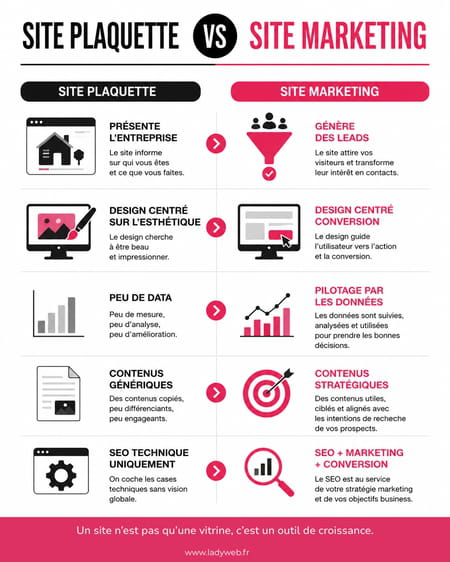








Most SMEs think they have a successful website. In reality, they often have a “brochure site”: a clean showcase but without any real marketing strategy or customer acquisition.
For a long time, many SMEs have considered their website as an obligatory step in their online presence. You had to “have a site”, just like you had to have a business card or a Facebook page. Result: thousands of companies today find themselves with what I call “brochure sites”. Clean sites, often aesthetic, technically correct… but which do not really serve the business.
And yet, these same companies sometimes think they have invested in an “SEO optimized site”.
The problem is that SEO has gradually been reduced to a series of technical boxes to check. Installing WordPress, adding Yoast SEO, filling in a few Title tags and publishing two or three blog posts does not transform a site into an acquisition tool. This simply creates a technically presentable site.
But being present on the Internet has never guaranteed being visible.
Technical SEO has become an easy business argument
Today, almost all web agencies sell “SEO optimized sites”. The term has become a standard sales argument, just like “responsive” or “fast”.
In practice, this often means:
- a correctly installed CMS,
- some basic optimizations,
- a configured SEO plugin,
- acceptable performance,
- and sometimes a clean Hn structure.
Of course, these things are useful. A slow or poorly constructed site will have difficulty performing. But the problem begins when these technical optimizations are presented as a complete SEO strategy.
Because a technically clean site is not necessarily a visible site.
Google has never rewarded technical compliance alone. And with the evolution of search engines, generative AI and user behavior, this logic becomes even more true.
Today, SEO also depends on:
- understanding search intentions,
- the quality of the user experience,
- the reputation of the brand,
- signals of trust,
- external mentions,
- and above all the relevance of the content in relation to a real need.
The problem is that many SMEs think they have “done SEO” because a service provider installed Yoast on their WordPress or added a few keywords to their pages.
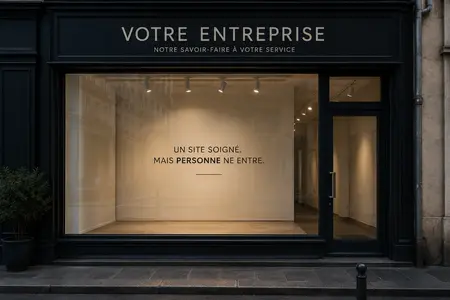
It’s a bit like thinking that having a beautiful storefront is enough to fill a store.
Many sites were designed to showcase a business, not to attract customers
The majority of SME sites suffer from the same problem: they were designed as showcases.
We generally find:
- an institutional home page,
- a presentation of the services,
- an “about” page,
- a contact form,
- and sometimes an irregularly populated blog.
In other words: a brochure site.
A brochure site is like a pretty showcase, design, modern… but which does not encourage you to enter.
The problem with a brochure site is not its design. It’s not even its technical quality. This is because it was not designed as a marketing tool.
Very few SMEs really ask themselves the fundamental questions:
- What is my client actually looking for on Google?
- What are its obstacles?
- Which pages can generate conversions?
- What content responds to a purchasing intention?
- What paths transform a visitor into a prospect?
- What data can improve site performance?
Result: sites that exist, but which bring neither qualified traffic, nor leads, nor commercial opportunities.
For a long time, this could still be compensated by word of mouth, trade shows or social networks. But behaviors have changed. Even in highly relational or traditional industries, customers research, compare, verify and educate themselves online before making a decision.
The website is no longer simply a showcase. It has become a strategic point of contact between a company and its market.
And this is precisely where many web projects fail: we are still building sites like in 2012 even though uses have profoundly evolved.
AI will not replace what really makes the difference in SEO
The massive arrival of AI is further accelerating this confusion.
Today, some companies think they can solve their visibility by asking ChatGPT:
- an editorial calendar,
- blog posts,
- SEO tags,
- or a complete strategy.
The problem is not using AI. These tools can save considerable time. The problem is believing that they replace strategic thinking.
Because an AI can produce content. She doesn’t really know your customers.
She doesn’t know:
- why your prospects hesitate,
- which triggers a contact,
- what differentiates your business,
- or what creates confidence in your market.
The risk today is to see the Internet filling up even more with generic content produced on an assembly line, without a marketing vision behind it.
And paradoxically, the easier content becomes to produce, the more important differentiation becomes.
SEO is already evolving in this direction. Search engines are giving more and more importance to:
- to trust signals,
- brand mentions,
- in opinions,
- to perceived expertise,
- and the overall coherence of an online presence.
In other words: SEO becomes as much a question of credibility as it is of technique.
This is why I remain convinced that the future of SEO will be more artisanal than industrial.
Not artisanal in the sense of “making without tools”. But artisanal in thinking:
- understand your market,
- analyze your data,
- build a coherent strategy,
- produce less content but more useful content,
- and above all keep a human perspective on the decisions made.
The SMEs that will perform well tomorrow will probably not be those that automate their marketing the most.
They will be the ones who understand their customers best.
And no WordPress plugin, no SEO checklist and no AI can yet do this for them.