








By being used indiscriminately, the term digital sovereignty ends up losing its substance. However, behind this overused word probably hides one of the biggest European strategic challenges of the coming decade.
The term digital sovereignty has become omnipresent. Invoked in conferences, speeches and sometimes even in communication operations which have no sovereign other than vocabulary. By being used indiscriminately, the concept ends up losing its substance. However, behind this overused word probably hides one of the greatest European strategic challenges of the coming decades.[1].
Indeed, the subject is not whether we are going to produce some additional local infrastructures or display more European flags on our “clouds”. The subject is much deeper. It concerns our collective capacity to maintain credible technological autonomy in a world where digital technology now structures economic, industrial, military, energy and democratic power.
For a long time, we approached digital as an accelerator of modernization. This reading is no longer sufficient. Technological infrastructures have become instruments of power. Behind data centers, submarine cables, cloud systems, platforms, satellites or artificial intelligence models, there are now very concrete geopolitical balances of power.
Recent events show this almost every week. When the United States restricts China’s access to advanced semiconductors, it is no longer a trade issue but a power strategy. When some European countries discover their critical dependence on foreign cloud infrastructures, it is no longer a technical subject but a question of strategic continuity.
In this landscape, Europe still alternates between lucid awareness and contradictions that are difficult to ignore.
Some signals remain encouraging. After years of controversy surrounding the hosting of the Health Data Hub on Microsoft Azure, the French state has finally embarked on a path towards sovereign SecNumCloud certified hosting, with several initiatives involving European players such as OVHcloud, Outscale or Scaleway[2].
Likewise, several critical players are beginning to make technological choices more consistent with their strategic requirements. EDF thus announced at the end of 2025 the use of so-called “trusted cloud” solutions with Bleu and S3NS[3] in order to strengthen the sovereignty of its sensitive data.
In the field of domestic intelligence and data analysis, Germany has also turned to a French alternative such as the nugget ChapsVision in certain projects linked to sovereign processing and investigation capabilities to the detriment of the American giant Palantir[4]. Within BPCE SI, the choice to replace a large American player with the French SME Diabolocom for the customer relations centers was accepted and taken to the highest level of the group. This decision was neither symbolic nor ideological[5]. It reflected a concrete desire to preserve a capacity for autonomy on infrastructures that had become strategic for customer relations, data and operational continuity. This type of arbitration shows that sovereignty is not limited to public discourse: it often begins in very concrete industrial decisions, where we must agree to support credible European alternatives to allow them to grow, innovate and compete sustainably.
These decisions reflect an important development: sovereignty is finally beginning to once again become an accepted criterion of choice.
However, these advances coexist with exactly opposite movements.
Even though this ability to choose constitutes, fundamentally, another way of asserting its sovereignty, Air France chose SpaceX’s Starlink to deploy very high-speed wifi across its entire fleet.[6]without waiting for the arrival of European alternatives like IRIS².
From an operational, economic and customer experience perspective, this decision is perfectly rational. This is precisely where the heart of the European problem lies: players logically choose the most mature, fastest and most efficient solutions in the short term, because sovereign alternatives often arrive too late, cost more or are not yet available on the necessary scale.
But this reality raises a deeper question: do we still know how to collectively arbitrate between immediate performance and long-term strategic autonomy?
Éditions de l’Éclaireur – Paris 2026
What would really have happened if Air France had waited an extra year to give IRIS² time to emerge as a credible alternative? Very probably not much from the point of view of passengers’ daily uses. On the other hand, this delay would perhaps have made it possible to preserve a capacity for choice, to create a more balanced negotiation relationship between operators and, above all, to give a European infrastructure a chance to demonstrate its viability.
Italy also offers a revealing example of current European ambiguities. The “Polo Strategico Nazionale”, presented as a pillar of Italian digital sovereignty to host critical public administration data, is largely based on technologies and partnerships with Microsoft, Google or Oracle[7].
The choice is operationally rational: quickly access the best available technologies while maintaining national governance. But it also illustrates a more uncomfortable reality for Europe: sovereignty ambitions often remain dependent on American hyperscalers when we talk about scaling up, technological maturity or speed of execution without a real search for alternatives.
Recent tensions above all remind us of a reality that we have long forgotten: digital technology is not an immaterial virtual space. It is a deeply physical infrastructure, exposed to conflicts, power struggles and geopolitical vulnerabilities.
Recent Iranian threats around submarine cables crossing the Strait of Hormuz provide a spectacular illustration of this. Several media close to the Iranian government have raised the possibility of taxing, controlling or even disrupting these critical infrastructures which carry an essential part of global Internet traffic between Asia, the Gulf and Europe.[8].
In a completely different context, the multiple sabotages and ruptures of submarine cables observed in the Baltic Sea since 2024 have pushed NATO to launch operation “Baltic Sentry” in order to protect these infrastructures which have become vital for European communications and the economy.[9].
These events probably mark a turning point: submarine cables, data centers, satellites or cloud infrastructures are now becoming strategic assets comparable to energy or military infrastructures. Digital is no longer just a communication tool. It has become a critical power infrastructure.
The debate on sovereignty then becomes unnecessarily caricatured. Some naively oppose openness and autonomy. Others continue to believe that total technological independence would be possible.
Neither of these two visions really holds up.
The reality is much more demanding. Technological dependencies are now systemic. Semiconductors, computing capabilities, energy, software, cybersecurity, critical components, cloud infrastructure or artificial intelligence make up a deeply intertwined global chain.
The real strategic question is therefore no longer: how to become completely autonomous? The real question becomes: what do we absolutely have to master, what dependencies can we accept and under what conditions do we want to build our alliances?
This is where the European debate still remains insufficient. Europe too often talks about regulation and much less about industrial power, speed of execution, massive financing, energy policy or strategic public procurement. However, no great technological power in history has been built solely by standards.
The subject of talents is also becoming very central. The United States is attracting the world’s best researchers despite the arrival of the new American administration. China is investing massively in scientific and industrial skills. Meanwhile, Europe is still struggling to transform its academic excellence into sustainable technological power and scaling up.
The digital future will not be reduced to a confrontation between Washington and Beijing. The Deep South is also becoming a major player in this global restructuring. India, Morocco, the Gulf countries, Brazil, Indonesia and several African countries are investing massively in digital infrastructure, energy, data and artificial intelligence. A new global technological geography is emerging.
The subject now goes far beyond the technology itself. Indeed it affects our capacity to still decide collectively on our dependencies, our critical infrastructures, our democratic model and our strategic autonomy in an increasingly fragmented world.
Ultimately, the real risk is probably not the addiction itself. All power depends on others. The real danger is to continue to suffer from addictions that have become invisible… until the day they become irreversible.
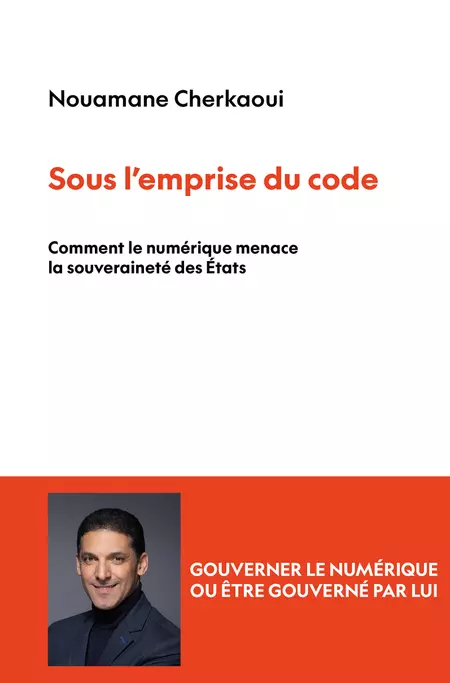
These reflections are at the heart of the theses developed by Nouamane Cherkaoui in his latest work Under the influence of the code, published by Éditions de l’Éclaireur[10].