








Better in code, more autonomous and capable of launching hundreds of sub-agents in parallel, Opus 4.8 arrives at the same price as the previous generation.
Still no Claude Mythos in sight (it’s coming soon), but a Claude Opus 4.8. This Thursday, May 28, Anthropic is launching a new version of its flagship model intended for businesses and developers. Better at coding, with finer judgment, even more autonomous… With this new version, Anthropic offers a simple but extremely effective incremental innovation that developers should pay attention to.
Best at coding and everyday tasks
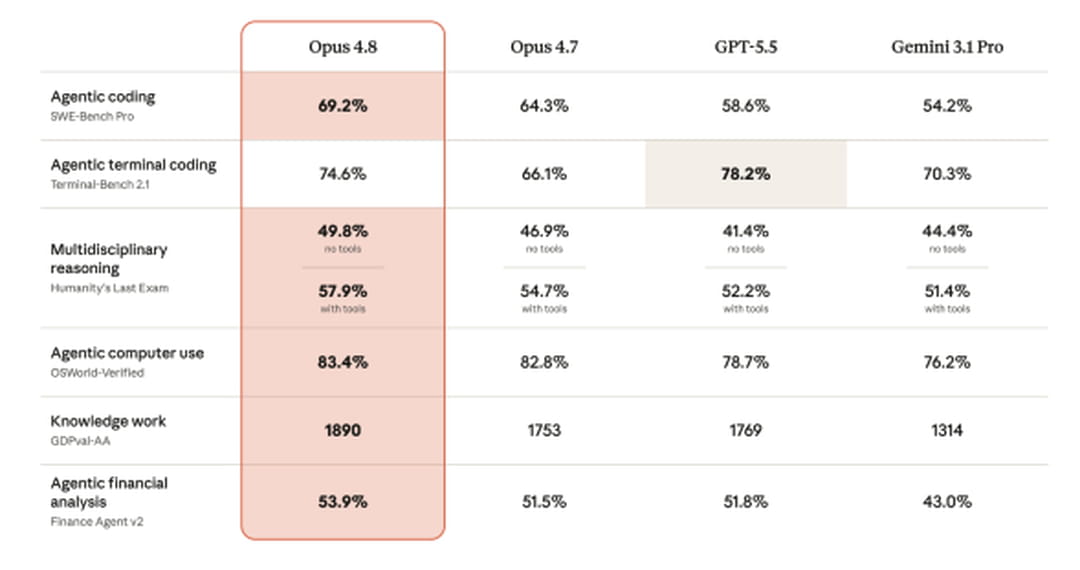
On paper, Opus 4.8 is making progress everywhere, but three areas really stand out. Agentic code first: 69.2% on SWE-Bench Pro against 64.3% for Opus 4.7 and Anthropic maintains a clear lead over GPT-5.5 (58.6%) and Gemini 3.1 Pro (54.2%). Note, however, that on the pure terminal (Terminal-Bench 2.1), GPT-5.5 remains ahead at 78.2% compared to 74.6%. The tasks of the real world of work will also be easier with a jump on GDPval-AA (1890 against 1753), by far the best score in the table. The honesty of the model, finally, which perhaps constitutes the real fundamental novelty: Anthropic claims that Opus 4.8 is approximately 4 times less likely than its predecessor to let a defect in the code pass without reporting it. According to the first feedback from early adopters, the model would be worthy of a human collaborator with “his critical sense, his taste and constructive comments.”
Hundreds of agents in parallel
Beyond the model itself, Anthropic is supporting the launch of several new products. The most direct: the effort control, a cursor placed next to the model selector in Claude, web version and with Cowork. On the developer side, Anthropic announces dynamic workflows. Launched in preview on Claude Code, the functionality allows Claude to schedule a job, launch hundreds of sub-agents in parallel within the same session, then check its own results before returning them. Finally, fast mode, which runs Opus 4.8 at 2.5x normal speed, becomes three times cheaper than on previous models. The classic version of the model remains at the same price as Claude Opus 4.7.
And after? Anthropic has two objectives. The first, democratize the power of Opus by working on models offering comparable capabilities at lower cost, a direct response to pricing pressure from OpenAI and Google. The second, more ambitious, a new class of models with superior intelligence. This is precisely the role of Claude Mythos, already deployed with a restricted circle of companies. On this aspect, Anthropic says it is progressing quickly and is counting on expanded availability of Mythos class models “in the coming weeks”.


