





AI answers all questions. But learning first means not knowing how to ask them. What the school does. What AI will never do.
For a long time I believed that school was archaic.
Frankly. Thirty students in a room. An adult who speaks. Fixed schedules. Programs decided ten years ago. And opposite, a artificial intelligence available 24 hours a day, capable of answering any question in three seconds, in the student’s language, at their own pace, without judging them.
The match seemed to be over.
He is not. And it took me a while to understand why. Not because the AI is bad. Because I was asking the wrong question.
The fundamental confusion
Everyone is debating the tool. Nobody talks about the path.
The tool is what the school transmits — mathematics, history, French, biology. In this area, AI wins. Without discussion. 85% of French high school students already use AI for their homework. In the United States, this figure has doubled in one year: 54% of American teenagers now use a chatbot for their schoolwork, according to the Pew Research Center (2026).
The path is something else. It’s what happens between the moment a student doesn’t understand and the moment he understands. This process is not an information transaction. It’s a transformation.
And that’s precisely what AI can’t do.
The paradox of the prompt
Here’s the question no one is asking yet.
If tomorrow the teacher is an AI – who decides the quality of the teacher each student receives?
The student himself. By the quality of his question.
A brilliant student, with a rich vocabulary and structured thinking, will formulate a precise question. He will obtain a precise, nuanced, adapted response. A student in difficulty, who does not yet know how to ask the right question — because that is precisely what he came to learn — will formulate a vague question. He will get a vague answer.
AI is the first educational system in history that punishes ignorance for having to learn.
A human teacher does the exact opposite. He reads the student. He sees that the question is poorly asked not because the student is lazy, but because he lacks an intermediate concept. He pivots. He rephrases. He goes back. He makes up an analogy in the moment. Not because an algorithm asks him to. Because he has in front of him a human being who suffers from not understanding, and he recognizes this suffering.
This is what really happens in a classroom.
A 12-year-old student is stuck on a fractions problem. He doesn’t understand. He also doesn’t know why he doesn’t understand — because that’s precisely where his lack lies. His question will be vague. Poorly worded. “I don’t understand.”
When faced with an AI, this question produces a correct, generic, and useless answer. The AI has not seen that the student has been confusing the numerator and denominator for three weeks. She didn’t see that he had tears in his eyes. She didn’t see that he lowered his head for a split second before asking the question — the silent signal that any experienced teacher immediately recognizes as shame, not incomprehension.
The professor doesn’t need the question. He has the answer before it’s asked. He goes back. He reinvents the explanation. He finds an analogy that didn’t exist five minutes earlier, specifically calibrated for this student, this day, in this precise emotional state.
That’s the pivot. This is not pedagogy. It is human presence applied to learning.
John Hattie has synthesized more than 800 meta-analyses on what makes students succeed. The teacher-student relationship is among the most powerful levers — with an effect size of 0.52 to 0.72, well above the threshold that corresponds to a year of normal progress. This relationship is not reduced to the transmission of knowledge. It relies on something that AI simulates but does not possess: presence.
MIT professor Sherry Turkle has a word for what AI produces instead: “pretend empathy.” Facade empathy. She can imitate its signals. Not the substance.
What school really teaches
The school is not a center of skills. It’s a human workflow.
A child spends seven hours a day at school. Often more waking time with his teachers than with his parents. This time is not just for learning fractions or the French Revolution.
It serves to learn to fail in front of others — and to start again. It is used to learn to negotiate with peers who do not think like you. It serves to learn to support an authority that you did not choose. It is used to learn to cooperate, to convince, to lose, to win. It serves to build — through friction, disagreement, sometimes boredom — what psychologists call emotional regulation.
AI cannot teach any of these skills. Not because it is insufficiently powerful. Because they require other humans to exist. You don’t learn to live in a community by questioning a machine alone in your room.
Philippe Meirieu, one of the most influential French educators, put it with surgical precision: AI “fills the desire to know and kills the desire to learn.” Nuance is everything. Knowing and learning are not synonymous. Knowledge is a state. Learning is a path. AI provides access to the first. It short-circuits the second.
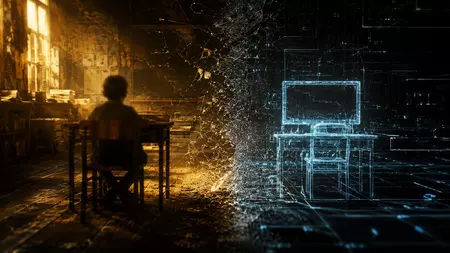
When artificial intelligence makes us believe that we no longer need school – image generated by AI
The fantasy of zero friction
There is something we dare not say out loud.
Parents criticize teachers. Too slow. Not precise enough. Not suitable for my child. The students also criticize them. Teachers, for their part, would like better prepared students, more involved parents, less hectic classes.
Everyone wants to remove friction from each other.
And AI seems to solve that. She doesn’t judge. She doesn’t get tired. She doesn’t keep you waiting. She doesn’t miss — at least when she’s well trained.
This is exactly where the trap lies.
Failure is not a fault of the school. This is its main mechanism. We don’t learn because we received the right answer. We learn because we produced the wrong one — and we understood why. Mistakes are not an obstacle to learning. It is the fuel.
Failure-free AI is not a better teacher. It is the absence of pedagogy disguised as performance.
And what no one is saying in this debate: the imperfect, slow, sometimes clumsy teacher — the one parents criticize on WhatsApp groups — teaches something that AI cannot teach. It teaches that adults also make mistakes. That authority also seeks. That intelligence is not the absence of hesitation, but the ability to continue despite it.
It’s a life workflow. Not a bug in the education system.
Silent cognitive debt
In 2025, researchers at the MIT Media Lab measured the brain activity of three groups of students: those who wrote an essay with ChatGPT, those who used a search engine, and those who worked without technological assistance.
Result: the ChatGPT group had the lowest neuronal connectivity. These students struggled to quote, a few minutes later, the content of the essay they had just produced. Researchers call it “cognitive debt” — a loan on the ability to think that must be repaid.
It’s not a metaphor. The neurology of learning has been unambiguous on this for decades. Robert Bjork, a psychologist at UCLA, has theorized what he calls “desirable difficulties.” Learning requires resistance. What “seems” effective—receiving an immediate response, reading rather than producing—creates an illusion of mastery. What really anchors knowledge is the uncomfortable effort of constructing it oneself.
AI removes precisely this effort. It is the most sophisticated system ever invented to give the impression of learning without learning.
Robert Pondiscio, a researcher at the American Enterprise Institute, put it bluntly: AI “offers the illusion of mastery without the work of learning. It allows students and teachers alike to skip the hard part — the thinking.”
The real question
I return to my conviction of two years ago. The one who told me that AI was going to make school obsolete.
What I hadn’t seen is that school has never been primarily a place for transmitting knowledge. Libraries have existed for this for centuries. Printing made knowledge accessible to everyone five hundred years ago. The Internet universalized it thirty years ago.
The school has survived each of these revolutions. Not by inertia. Because it does something that none of these tools do: it forces human beings to develop together.
So the real question is not: “Can AI replace the teacher?”
The real question is: “What do we decide the school should do?”
If the school has to pass on information — the AI wins, and the debate is over.
If school is to produce humans who can think, cooperate, resist the easy way, fail and start again — then AI is not a solution. It’s a temptation.
And giving in to this temptation is not modernizing education.
It means abandoning ambition.
Denis Atlan is Fractional Chief AI Officer, founder of ENDKOO (Qualiopi organization), European Commission Expert Evaluator (IA), DPO and author of “IA Without Bullshit 2026”. He has deployed more than 200 B2B AI projects in France with a documented median ROI of 159.8%.
Sources: Pew Research Center (January 2025 & February 2026) — MIT Media Lab, Kosmyna et al. (2025), arXiv:2506.08872 — Hattie J., Visible Learning (2009, updated 2017) — Bjork R., “Desirable Difficulties in Theory and Practice” — Pondiscio R., “The Illusion of Learning” (AEI, October 2025) — Meirieu P., Le Monde (September 2025) — Turkle S., Reclaiming Conversation (preface 2025) — CRAP-Pedagogical notebooks (March 2025) — enseignement.ai (2026)