








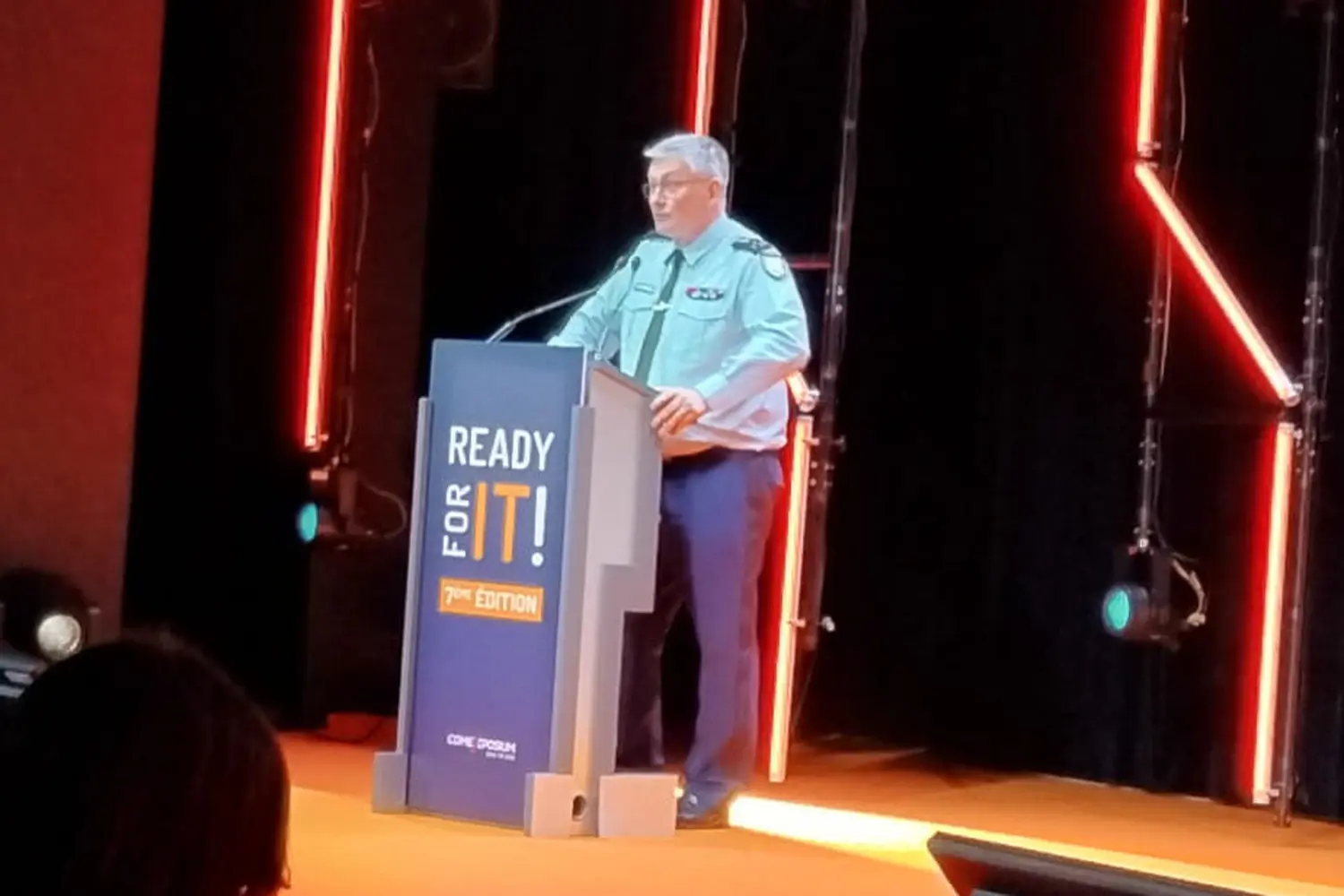
During the first day of the 7th edition of Ready For IT in Monaco, 700 IT decision-makers, DSI, CISO and CTO were able to listen to Patrick Touak, general director of the Cyberspace Command of the Ministry of the Interior.
Top start for 7e edition of Ready For IT, which attracts visitors for its human-sized format and its friendly atmosphere in Monaco. “This is the second year that I have come and I am won over. There are real decision-makers but in a smaller setting than the major trade fairs in the sector, which leaves more room for discussion,” says a cybersecurity expert experienced at IT events. This year, there are still 700 IT decision-makers, DSI, RSSI, and even CTOs, mainly from mid-sized companies and large SMEs, who circulate between the numerous stands at the show. On the first floor of the Espace Grimaldi, overlooking a peaceful Mediterranean where numerous yachts float, the stands house dozens of small and large well-known players in the ecosystem: Flare, Eset, Virtual Browser, Ping Identity, Object First, MokN, CyberAngel, Avanoo, etc.
In addition to informal exchanges around the stands, this first day was punctuated by an opening plenary, a business lunch where discussions on recent data leaks and the dangers of AI were well underway, and numerous round tables on ways to strengthen a company’s cybersecurity, new ransomware, etc. During the plenary, Patrick Touak, general director of the Cyberspace Command of the Ministry of the Interior (ComCyber-MI), stood out with his speech on the state of the cyber threat, delivered just after enthusiastic welcoming words from the director of the event, Maria Iaconno. The conviviality of the event did not prevent it from reminding us of the reality of a cyber threat which is intensifying for French companies.
Tips for coping
These attacks have increased by 85% in five years, according to him. In 2025, no fewer than 453,000 digital attacks have been recorded in France. Of these attacks, 53% are DDoS attacks, 30% involve the sale of stolen data, and 13% are ransomware attacks. “This last figure is quite stable and I find it hard to believe it. Reputational issues are important in this matter, so companies do not necessarily file complaints,” he added during the press conference which followed the business lunch.
In front of an audience full of visitors, mainly from ETIs and large SMEs, he provided simple advice to implement on a daily basis to deal with this increase in cyber threats. “Often, in small businesses, you entrust the management of your information system to third parties. Read your contracts that bind you to them.” These contracts must in particular include support in the implementation of continuity and business recovery plans, he insists. “I also advise you to make backups of your data off-network”, so that it is not affected in the event of an attack. “Also, prepare your crisis communication, because you cannot hide a cyber attack: the information will be found on the web,” he advises the CIOs and CISOs present in the room.
Another ingenious piece of advice in the face of presidential fraud which is becoming more and more convincing with AI and deepfakes: “Put in place rules that allow you to slow down processes based on the thresholds of amounts to be paid and you will thus minimize the risks”. For example, from certain amounts to be paid, depending on their importance, a rule must prescribe that one must refer to the financial department, sometimes to the banker, wait a certain period before paying, etc.
The EDR Killer: the new tool that threatens businesses
However, these measures are not enough to guarantee total protection, as attackers know how to be creative in carrying out their attacks. The proof: “they are becoming more and more stealthy and discreet thanks to a new tool that they are using more and more: the EDR Killer. This tool makes it possible to deactivate the endpoint detection and response that the organization uses to protect its terminals in order to discreetly launch a ransomware attack, and to encrypt the data. At Eset, we observe that the EDR Killer is taking an increasingly important place among emerging groups, not affiliated with others, which are developing kinds of EDR Killer-as-a-service”, observes Benoit Grunemwald, cybersecurity expert and director of public affairs at Eset. “The EDR made it possible to slow down the encryption of the data, during an attack, by making it more complicated. But I wonder if the EDR Killer will not again allow attackers to encrypt the data easily.”
Another emerging threat highlighted by Benoit Grunemwald during a keynote which concluded this first day: economic espionage of which French mid-sized companies and SMEs are increasingly victims. “This comes above all from groups aligned with the interests of China, targets companies in strategic sectors such as robotics, high technology, maritime transport, and serves to recover industrial and economic information. What is new with these groups is that their theater of operations is no longer limited to Asia as before. From now on, it extends to the entire world.” Even with the general’s advice, SMEs and ETIs are not done with cyber threats…


