








Before applying, one in two candidates goes through generative AI. What she says about you, from sources you don’t know, becomes the employer’s first impression.
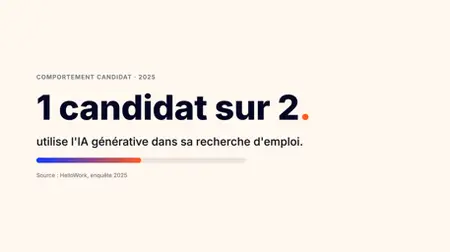
In France, one in two candidates now usesGenerative AI in his job search. Source: HelloWork, 2025 survey.
For twenty years, employer branding has operated on three fronts: Googlejob boards and social networks. A fourth has just appeared, and it is establishing itself at an unprecedented speed. Before even visiting a site careermore and more candidates open ChatGPT, Gemini or Perplexity and ask a simple question: “Is this a good company to work for?”
This shift is not anecdotal. Less than four years after its launch, ChatGPT reached the milestone of one billion monthly active users in 2026 (Sensor Tower, reported by Reuters), and claims nearly a billion every week (OpenAI). In France, one in two candidates already declares using generative AI in their job search, a proportion which rises to 63% among generation Z (HelloWork, 2025). Usage today remains dominated by writing CVs and letters, but the shift towards searching for information on employers is underway, and it is structuring.
What the AI says about you is not up to you
The difficulty lies in the very nature of these tools. A generative AI does not recite your speech brand : it synthesizes a response from multiple sources, many of which you are unaware of. Employee reviews, press articles, job boards, forums. However, candidates already give considerable weight to these third-party sources: 86% consult a company’s reviews and ratings before deciding where to apply (Glassdoor, 2019). AI only industrializes and summarizes this reflex into a single response that has the appearance of truth.
Consequence: the first employer impression is no longer formed on a page that you have written, but in a conversation that you do not see. And in practice, these responses focus on a handful of employers per sector, always the same. For others, the risk is not of being misjudged. It is not to exist in the new first stage of the candidate journey.
Being first on Google is no longer enough
The mistake would be to believe that good classic SEO solves the problem. The mechanics differ. A generative AI relies partly on what it learned in training, with a time lag of several months, and partly on what it looks for when responding. Being well ranked on Google therefore does not guarantee being cited by an AI.
An emerging discipline has emerged around this issue: GEO, for Generative Engine Optimization. Researchers from Princeton and Georgia Tech, in work presented at the KDD 2024 conference, showed that optimization techniques could increase the visibility of content by up to 40% in generative engine responses. The figure is a maximum, measured on the visibility in the responses, but it says the essential: this visibility needs to be worked on.
What HR teams can do
Apply GEO to the employer brand does not relate to handling, but to hygiene. Some concrete and legitimate levers:
- Make careers and professions pages truly accessible to AI robots, without involuntary technical blocking.
- Structuring offers with verifiable data and formats that AI reads well: tagging offers, FAQs candidates, clear answers to real questions about remuneration, development and working conditions.
- Take care of the consistency of the external sources that the AIs come across, rather than letting them tell the story of the company for you.
- Finally, measure: we don’t manage what we can’t see.
An emerging discipline, to be approached with honesty
One point is worth saying, because the subject already attracts easy promises: the presence in an AI response is probabilistic. You can greatly increase your probability of being cited and well represented, but no serious method guarantees it. This is also why measurement and transparency matter as much as action.
HR departments have already experienced the arrival of employee reviews, then that of social networks. In each wave, those who took up the subject early kept control of their story. The wave of conversational AI is faster, and the market that is being structured around it confirms this: AI applied to human resources could increase from around 3.25 billion dollars in 2023 to more than 15 billion in 2030 (Grand View Research). The good news is that this is all measurable. And what is measurable becomes controllable.


