









Google Discover, wiki pages or working on audience hubs can bring traffic.
Clement ReynaudDirector of SEO and GEO at Pixalione, recently shared a well-known SEO mishap: the drop in the number of clicks. Over a rolling 16-month period, Google’s clicks to its Minecraft.fr site fell by around 50%, despite an almost unchanged impression volume.
Meanwhile, displaying in AIs failed to recover this loss. “For every hundred clicks lost on Google’s side, the site recovers less than one visit via mainstream AI,” even lamented Clément Reynaud. “On the crawl side, it’s even more impressive. We can estimate that ChatGPT alone reads the site approximately 75 times more often than it sends visitors. For Bing/Copilot, the ratio is even more unbalanced: we are cited several thousand times for each visit received from Copilot.”
According to Clément Reynaud, beyond the impact of AI, this decline can be explained by the obsolescence of Minecraft versions, a reconfiguration of the competition, but above all by the change in user behavior. We think of the famous “zero response”. ChatGPT users, for example, read the response and don’t bother going to the site.
What can we do now to counter this? For Clément Reynaud, quality content is essential to be cited. For the rest, he admits to not having a ready-made answer, and to trying different avenues. Three levers stand out, in order of measured impact.
Discover traffic doubled: regularity, impactful titles and monitoring
On Discover, it went from irregular production, to around 27 articles per month. “Regularity is central: over a period of 13 days without publication in April 2026, during my vacation, I measured a drop of -84% in Discover traffic,” he says.
He also worked on the Open Graph og:title and og:image tags. Remember that the Open Graph Protocol relies on standards such as Dublin Core and RDFa to enrich web pages with structured metadata. The og:title tag is, for example, designed to structure and beautify the display of links shared on social networks.
Clément Reynaud has implemented titles and visuals designed specifically for the Discover format. For example, the H1 of an article was called “10 improbable Minecraft collaborations we dream of seeing” and the OG Title: “Minecraft x Tamagotchi, Durex, IKEA… when blocks invade real life”. He also changed the illustrative images of the article.


He also monitored Google Trends, the Minecraft Reddit community and English-speaking articles. Objective: write articles in order to capture a hot audience.
As a result of all these actions, on Minecraft.fr, annual Discover traffic doubled between 2024 and 2025. “The dynamic is confirmed in Q1 2026 with +67% compared to Q1 2025,” smiles Clément Reynaud. “January 2026 even became the absolute record over 28 months of measurement.”
Semantic analysis and wiki: 134 pages capture 10% of traffic
Second lever tested, analysis of the site’s internal search engine. Objective: identify user frustrations through their unsuccessful or unsatisfied searches. At the same time, he explored the long tail on Google Search Console using specific regular expressions. This allowed it to identify semantic gaps as well as queries positioned on less relevant pages. He thus created an internal “wiki” on Minecraft.fr with 134 new dedicated pages over 12 months. These now represent around 10% of its Search traffic.
Mobile-First summary and expertise: sustained positions and optimized traffic
Third axis, the redesign of the pages dealing with game updates. A “What to remember” block has been placed at the top of each long article, in the form of a distinct visual insert. It summarizes the new features in a small bulleted list. Tailored to mobile-first reading behavior, it meets quick search intent. It optimizes Dwell Time, or the time spent by the visitor on the site.
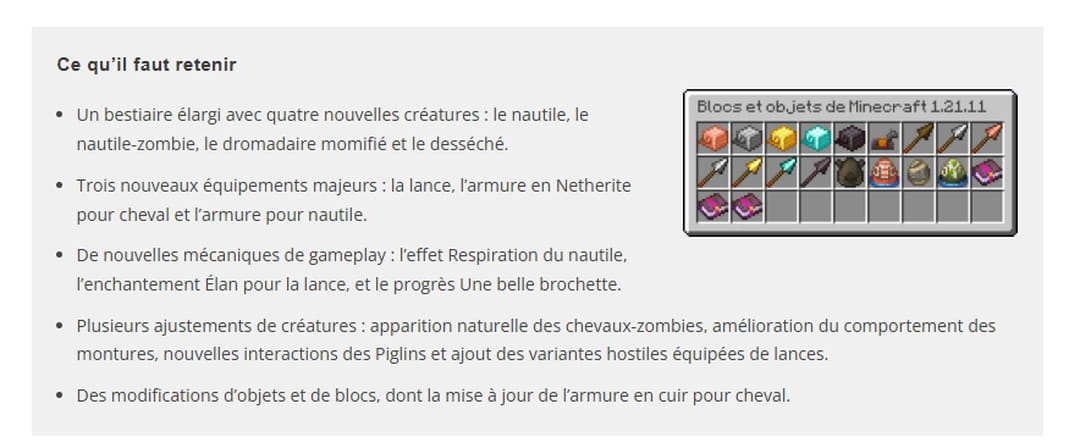
The addition of a section with a critical analysis at the end of the article allows it to stand out from the simple paraphrase of the official notes from Mojang Studios, the creator of Minecraft, and the AI slop.
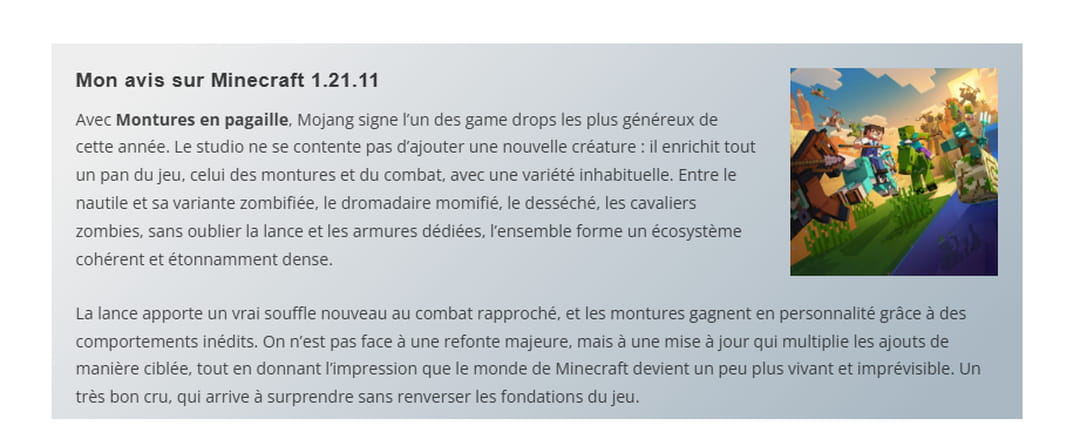
All this has led to the perpetuation of the pages’ positions on Search. Its actions performed well on Discover, thanks to the insert with the expert opinion. But, warns Clément Reynaud, “all these figures come from my personal site, not from a multi-site study. They are representative of a specialized and niche editorial site with high traffic. Adaptation to the sector must be taken into account.”
Multi-lever SEO and GEO can compensate for declining organic traffic
Generally speaking, bringing traffic to your site through SEO and GEO often requires writing unique, structured content, on high-intent, transactional and navigational queries, or even encouraging branded searches.
The techniques are often adapted to each person. Jeremy Lacostegeneral manager at Eskimoz France, also implemented three axes. “First, an acceleration of SEA to cover spaces where organic visibility is reduced, particularly on highly competitive transactional queries or to increase paid on AI Overviews. Second, an approach that I call ‘extended off-site SEO’. Rather than limiting the battle to the client site alone, we are capitalizing on all audience crossroads. Namely, YouTube, LinkedIn, Wikipedia, review platforms, forums, social networks, Google Images, Google Business Profile and media sites.” The objective is for the brand to be present wherever Google and LLMs look for their sources. “Third, we are working more and more on building an engaged community. The goal is to encourage the creation of accounts, generate opt-in, develop direct engagement in order to diversify the addressing channels and no longer depend solely on organic clicks.”
The results displayed give him hope. “For several clients, we are observing a significant increase in traffic from LLMs, with ChatGPT in the lead. The latter is starting to compensate for part of the shortfall in certain Google positions. It is still marginal in absolute volume, but the curve is very clear. In B2B SaaS, we have clients whose volume of leads generated from AI engines represents up to 15%.”
Another example of result, on the expanded presence strategy. “Strengthening the customer review profile and presence on specialized forums made it possible to recover SERP visibility. This, on queries where the site itself was overwhelmed by featured snippets or AI Overview but also on AI engines. On banking and insurance clients, by working on authority via Wikipedia and the customer reviews section, we were able to gain up to 10 points in presence rate.”
On SEA, the conquest campaigns, activated in addition to SEO, enabled certain accounts to maintain a stable volume of sessions, despite a loss of 10 to 25% in organic traffic. “We played on the complementarity of the two levers,” he explains.