








Since the start of the war against Russia, many Ukrainians have retrained in the production of drones and missiles, taking advantage of a relaxation of rules to intensify manufacturing and make it more agile.
Behind a peaceful facade that Russian bombings are struggling to erase, kyiv hides an underground effervescence: in numerous workshops hidden from the eyes of the inhabitants, the drones and missiles which equip Ukrainian soldiers on the front daily are produced on an assembly line. Visiting them requires the greatest discretion. And for good reason. “You see that damaged building, over there, across the street? It was destroyed by the Russians,” says a Kiev resident, pointing to an almost ruined building, located near the headquarters of a major drone and missile production start-up, Fire Point, founded at the start of the war, in 2022.
“The Russians are trying to shoot at companies that manufacture military equipment, with drones and missiles. At the moment, they are preparing a strike every week!”, he explains, bitterly. To access these workshops, we must therefore respect a series of instructions intended to prevent their identification by the Russian intelligence services: the activation of airplane mode on mobile phones, the ban on photography, audio recording, etc. Such measures are also necessary to preserve manufacturing secrets. This myriad of workshops, which are multiplying in the city and its surroundings and testify to the rise of a war economy based on agile innovation, indeed constitutes a strategic asset for a weakened country, determined to take advantage of it once the conflict is over. Some contacts and company names are not cited in the article, in order to preserve their security.
Fire Point, the Ukrainian missile star
Among all the factories visited in kyiv, Fire Point imposes the strictest rules. To authorize our arrival, the security team placed our cell phones in pouches, searched our bags, put us through a metal detector and blindfolded us. During the 20-minute journey, the bus had the curtains drawn over the windows. Enough to allow us to pass through the doors of one of the garages of this immense factory, where missiles are produced. Very large ones, like the impressive FP-5 Flamingo, 7 meters long, capable of reaching a target up to 3000 km away, therefore in Russia, at a maximum speed of 950 km/hour. But also FP-7s, whose range is 200 km and whose maximum speed is 1500 meters per second.
The factory, an assembly of large windowless hangars which seem to be constantly expanding, is equipped with machines installed under very high roofs from which comes an intense white light, reminiscent of neon lights in a garage. These devices produce carbon fiber tubes, an essential component in the manufacture of missiles. “This machine makes us proud: it is the largest machine in Europe for winding carbon pipes. It allows us to produce several pipes at the same time!” says the Fire Point engineer who guides us for the visit, pointing to one of the machines in the shape of a large and long pipe. Around, several dozen workers are busy in an environment permeated with chemical odors from carbon fibers, carrying out their work with the greatest efficiency and full of enthusiasm. The pace is sustained. One to three FP-5s are produced each day.
Intoxicated with its success, Fire Point sees things big: “We are preparing for a space program in the future. Elon Musk started like that! (…) After the war, we want to become a center for high-quality military equipment but our objective is space,” says the engineer whose employer is only increasing his payroll. Fire Point now employs 6,000 people. They were six times less a year ago. And the company continues to recruit, “with high salaries”, according to the engineer, to increasingly equip the Ukrainian military, honor a recent supply agreement with European companies and realize other future projects. Among these remains the production of the FP-9 ballistic missile, capable of reaching a speed of 7,560 km per hour, and which will be tested at the end of 2026.
Land, sea, air… Ukrainian drones on all fronts
But Fire Point is also about drones. “It’s the IKEA of drones,” murmurs one of the visitors. The start-up actually has another workshop dedicated to their mass production. The factory now produces 5,000 per month, compared to only 200 per month in 2023. “The idea is that these drones should be easily produced, and by the hundreds every day,” explains Denys Shtilierman, co-founder of Fire Point.
These drones are available in two models: the FP1, which has a maximum autonomy of 16 hours, an operational range of 2,600 km and a payload of up to 60 kg. And the FP2 which offers a range of 500 km, an autonomy of 2.5 hours and a payload of up to 225 kg. Despite these differences, the two models are physically similar, also produced using carbon fiber: they look like small planes, capable of being launched discreetly using a rocket booster, from a fixed platform or a truck. Along the chain, employees rush to assemble them according to steps indicated in a checklist in the form of a paper document, like a Swedish furniture manual. In the factory, huge shelves house the wooden structures, neatly arranged side by side, all similar and numbered, intended to contain the autopilots responsible for guiding the flight of the drones.
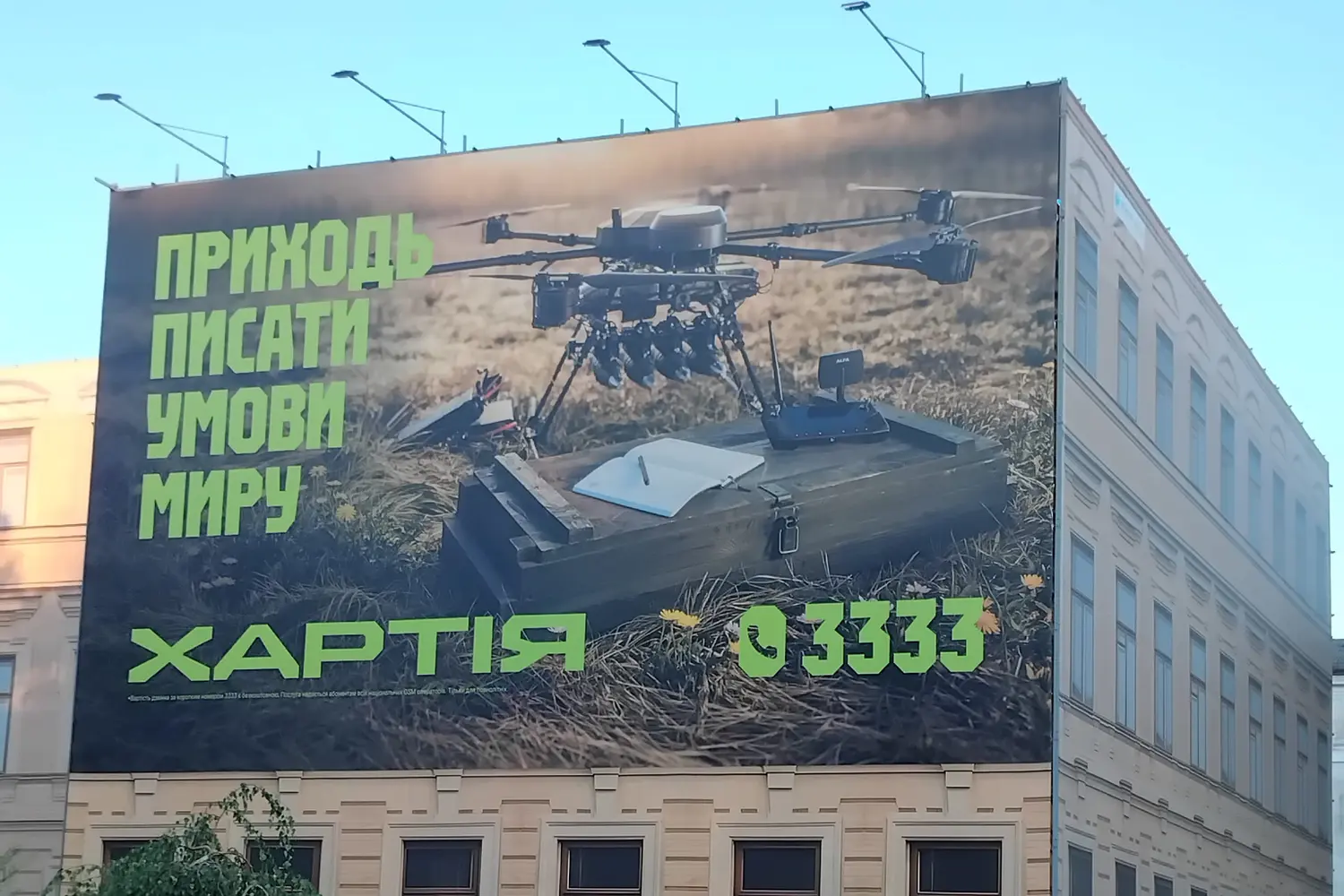
But this production success of Fire Point should not overshadow other Ukrainian successes in terms of drones, highlighted by advertising. In the capital, the drone is indeed essential in public spaces, on advertising panels erected in front of buildings with Soviet or Austro-Hungarian-inspired architecture, typical of kyiv. “Come and write the conditions for peace,” says one of them, illustrated by a photo of a small propeller-driven drone, with a telephone number to join the army as a drone pilot. The drone now occupies such a central place on the Russian-Ukrainian front that many kyiv residents are retraining in its manufacturing, both to contribute to the war effort and to seize the economic opportunities offered by this booming sector. “I’ve even seen drone productions behind restaurants, or in barber shop basements!” asks a politician, also a visitor to the workshops, astonished.
Among these workshops, a small company manufactures marine drones that look like boats measuring seven meters long and two meters wide. By opening the doors of one of its three manufacturing sites to us, its founder immediately emphasizes that their production sites are kept in “secret locations to prevent them from being attacked”. They serve as supports for different purposes: propelling small missiles and sending aerial drones, monitoring the enemy using radars and other devices, detecting mines, but also disorienting enemy drones using spoofing and jamming. Founded in 2023, this company employs around 200 people and continues to recruit, with the aim of exporting to Western Europe.
In addition to the air and sea spaces, it is also the land that certain new Ukrainian drone start-ups are investing, such as the Unex company “which produces the largest land drone in the world”, according to its founder, a former special forces sniper, who opened the doors to us of one of his discreet workshops, founded in 2023. Resembling a small truck, this land robot has an autonomy of 70 km, can reach 20 km per hour on land and 6 km per hour in water, while carrying up to 600 kg of load. “It is the only terrestrial robot capable of going down from the ice to the water, then back up again,” assures the CEO. It also serves as support for many purposes: transport of equipment, supplies for soldiers remaining in dangerous access zones, launching of aerial drones, etc. Building on its success, the company now also produces it for NATO forces.
Lean production rules for more agility
When we visit these workshops, we are struck by the few rules that govern production. “In terms of regulations, it is lighter and easier than before. The Ukrainian state is stimulating the military industrial sector with decrees aimed at simplifying bureaucratic procedures, for greater efficiency,” says Vitali, a manager of a company that produces ammunition for drones and who also welcomed us into one of his workshops.
Workers often work in street clothes, jeans and T-shirts, sometimes without masks, including in workshops where the evaporation of chemicals requires them to be worn. Even piloting drones seems astonishingly simple, as it frees itself from certain rules. We were thus able to take control of one of them which was located far from us, in a training area. After some clumsy handling, we ended up losing contact with the drone, without this causing the slightest concern. As for the cybersecurity of drones, this is not always the first priority of certain manufacturers, as evidenced by their lack of talk on the subject.
It is this regulatory relaxation that allows more agile and faster production of drones, while facilitating their constant improvement, made necessary by “the front line in which the technologies used change very quickly”, affirms the founder of the company producing land drones. This flexibility is not, however, without compensation. According to almost all of the manufacturers met, it complicates certain negotiations with Western companies, which are less agile and more demanding in terms of military production standards. They also sometimes appear hesitant to import Ukrainian military production or to set up production units of these Ukrainian companies on their soil.
“In my humble opinion, the Europeans need to be a little faster in terms of cooperation, bureaucracy and development. (…) In Europe, you indeed have a very big problem with the strong bureaucratic pressure on the military industry. (…) When we talk with a Western company, they always give us five managers, an engineer, etc. (…) For example, we waited a year and a half to sign a contract with a French company, so that they realize what we needed. During this year and half, this company passed us in its know your customer process, etc. And during this time, we became ten times bigger!”, laughs Denys Shtilierman, co-founder of Fire Point. Arguments that the French industrial and technological base will hear?


