








The Football World Cup has helped to boost a market that benefits social platforms, retail media and video, according to SRI e-pub Observatory, produced by Oliver Wyman, in partnership with Udecam, unveiled Thursday July 9
The digital advertising market continues, imperturbably, to grow at a very good cruising speed in the first half of 2026, with +12% year-on-year, according to the SRI e-pub Observatory, produced by Oliver Wyman, in partnership with Udecam, unveiled Thursday July 9. In the first half of the year, net digital advertising revenue in France, all levers combined, reached 6.689 billion euros.
“The first half of 2026 marks a particular performance of acceleration compared to the first half of 2025 (itself slowed down under the effect of the post-Olympics), driven by the Football World Cup,” indicate the authors of the study. A dynamism which will tend to diminish in the second half of the year, due to the French and global political context. For the year 2026, the outlook remains the same as previously forecast, with expected growth of +11%.
Retail media and social still leading growth
In the first half, if growth is mainly driven by retail media (+18%) and social (+16%), all the levers, taken overall, are green: +10% for display, +12% for search and +4% for affiliation, emailing and comparators.
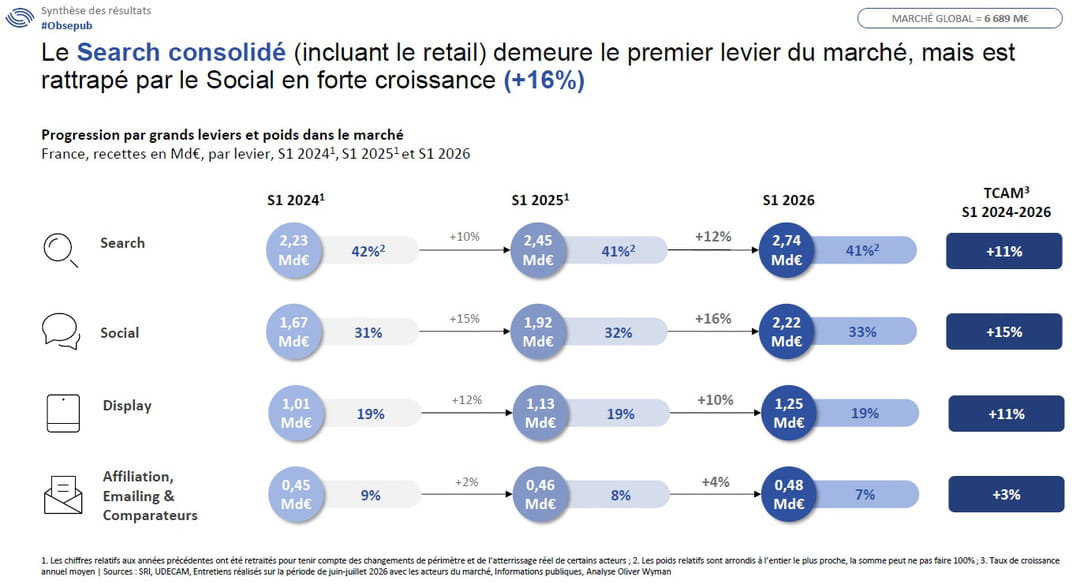
Social outperforms the rest of the market with a growth rate of 16% driven exclusively by video (+31%). No surprise, this channel continues to eat away at market share from other levers with 33%, or 2.22 billion euros, but remains behind search, which accounts for 41% including retail. Retail media, for its part, already accounts for 12% of the market, or 770 million euros.
Display, with +10%, continues to benefit from the dynamics of video and music streaming platforms, although at a slightly more moderate pace compared to the same period of the first half of 2025/2024 (+12%).
TV and radio revenues with digital advertising, CTV and segmented TV included, increased by 15% in the first half of 2026 compared to a year ago: this is half less than in the first half of 2025 compared to 2024. It should be noted that TV channels now account for 31% of the video advertising market, compared to 13% for SVOD players and 48% for AVOD (mainly YouTube). And that CTV as a device continues its rise in power with +20% and 51% of the video advertising market share.
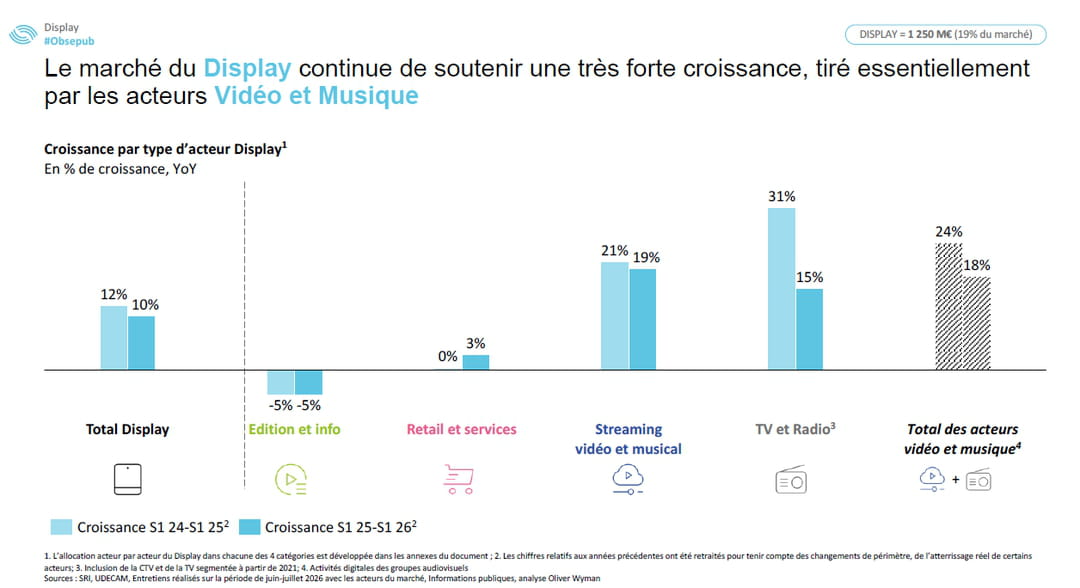
On the publishing and information side, we expected the worst. We can at least note that their decline, even if it is significant, has not increased: it remains stable at -5% as during the 2025/2024 period. Publishers in the retail and services segment are doing +3%. As for video-specific revenues, however, the data is impressive: -16% for the publishing and info category; Conversely, publishers in the retail and services segments are at +21%.
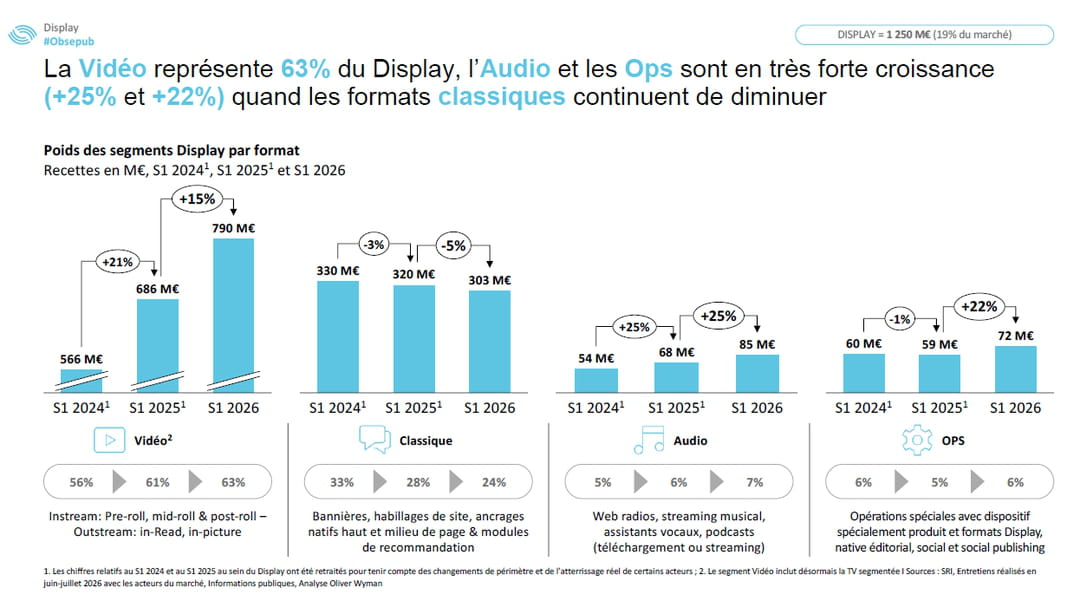
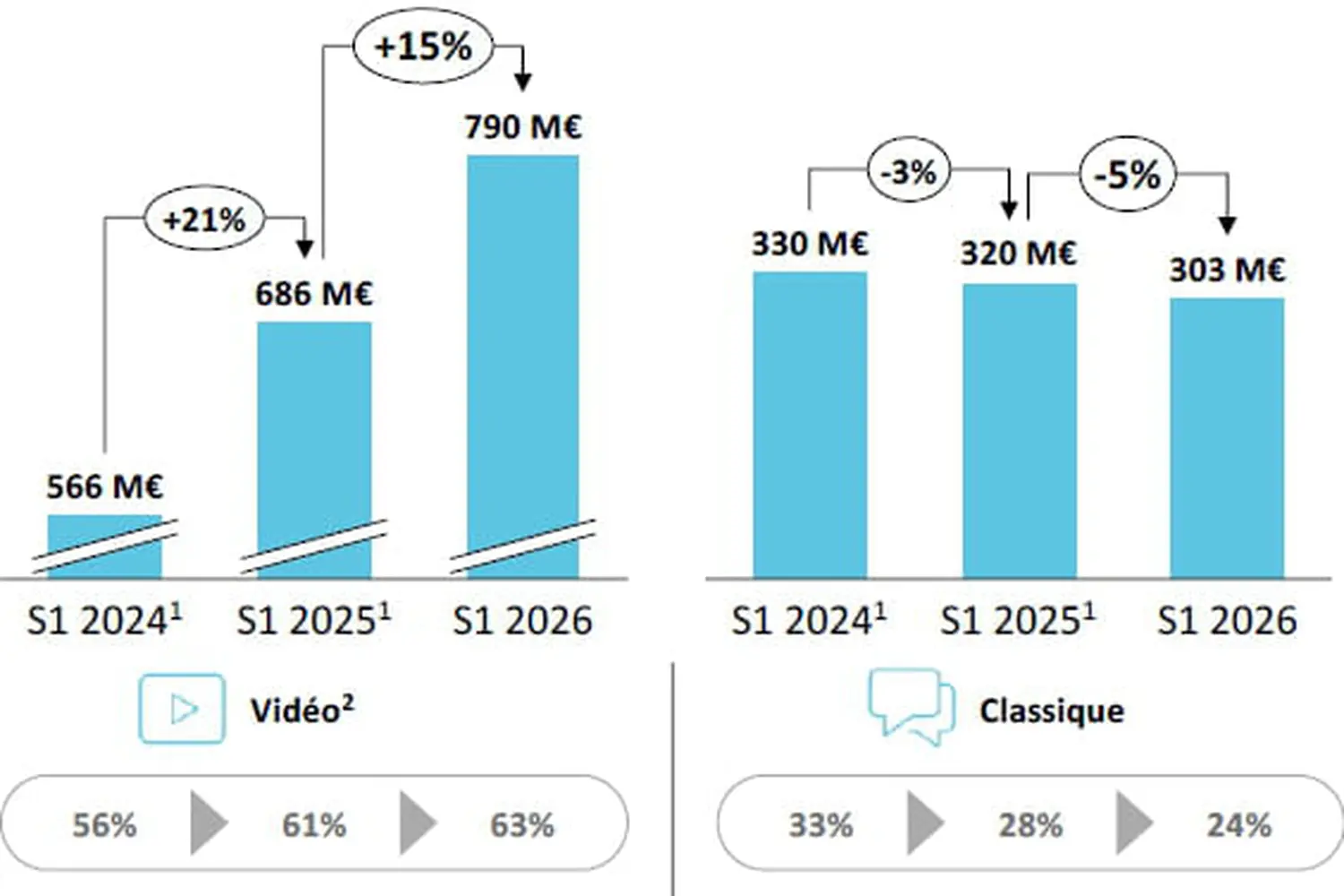
Note the very marked growth in audio (+25%) and special operations (+22%). Classic formats (banners, graphics, etc.) continue to lose ground (-5%).
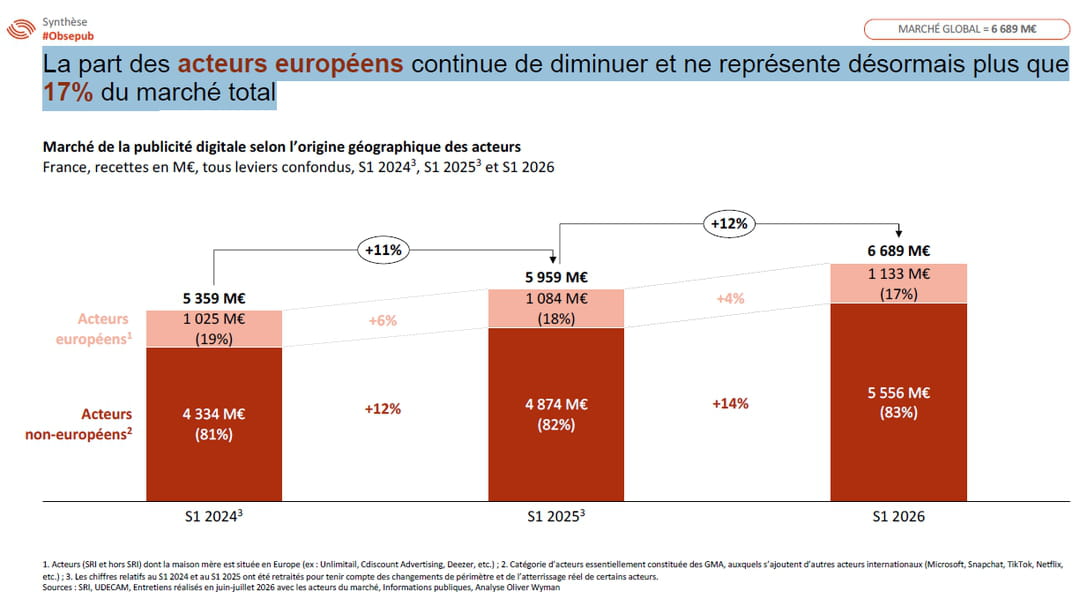
Finally, if we think by nationality over the total display market, the picture is less glorious: European display players achieve growth of 4% over the first half of 2026 and only account for around 47% of display as a whole compared to 52% two years ago. Across the entire market, all levers combined, the share of European players continues to decline and now only represents 17%.