








LinkedIn has spent twenty years organizing meetings between professionals. With Advice Sessions, they are entering the transaction between professionals for the first time.
It took me three days to understand why this launch in the United States bothered me.
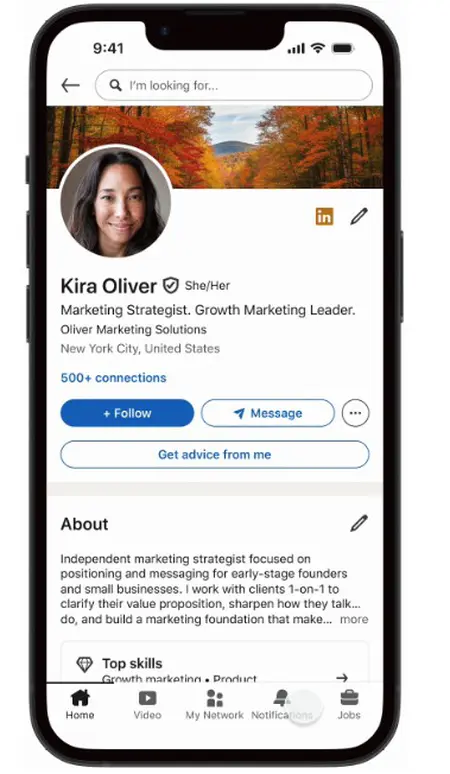
LinkedIn released Advice Sessions on May 12 in the United States. Paid video sessions from the profile. Premium Business. “Get advice from me” button. Booking, payment, calling all in LinkedIn.
And 100% of the rate for the expert and no commission.
The press applauded. Forbes, Inc., Social Media Today.
The button, the fluidity, the “profile monetization”. Everything is true, it’s even well done.
Except that’s not what’s really happening.
3 times in ten years
LinkedIn has tried to enter the services business twice before this one.
With ProFinder in 2015. (Free connection between companies and independents, without integrated transaction.)
Marketplace Services in 2021. (16 categories of services, free, without integrated payment, 10 million service providers registered today. and 0 euros passing through LinkedIn.)
Ten years of attempts that brought nothing to the platform. It’s long and it raises questions.
Both ended up in the same place.
To complete the transaction the user had to exit.
The quote by email, payment on Stripe, signature elsewhere. ..
LinkedIn organized the meeting, but he was never in the room when money changed hands.
This time, Advice Sessions closes the loop.
It has been technically feasible for a long time but “why now”.
The context that informs the decision
LinkedIn generated $17.8 billion in 2025.
Growth 9% over one year. With 3 historical pillars:
- Talent Solutions (recruitment): 65% of turnover
- Marketing Solutions (advertising): 18%
- Premium Subscriptions: 17%
What made me tilt was the Premium evolution.
Between March and December 2024, the segment increased from 1.7 to 2 billion. 2
5% growth in nine months. And 175 million subscribers.
But Linkedin Premium remains a subscription.
That is to say an income capped by the number of users who agree to pay 52 euros per month. And who can unsubscribe with one click when the economy is tight.
With Advice Sessions, LinkedIn opens a fourth channel, not another subscription, a transactional infrastructure between members.
A detail that we did not notice.
Daniel Shapero took over as CEO of LinkedIn in April 2026.
One month before launch.
Before that, he managed Premium, he was the one who managed the increase from 1.7 to 2 billion. The first product he launches as a new boss is the one that adds a payment infrastructure to the platform.
Make of it what you will.
What they understood
Selling a consulting session today looks like this: your prospect reads your post, clicks on your profile, goes to your site, finds your services page, chooses a Calendly slot, receives a confirmation email, clicks on the Stripe payment link, validates, receives a second email with the Zoom link, finds it in his spam on the day.
6 clicks., 3 tools, 2 emails.
By stage four, half drop out. By step six, some have forgotten why they wanted to talk to you.
How many customers did you lose like that last year?
You will never know. And this is precisely why LinkedIn comes to solve the problem for you. (By the way, by inviting yourself into the transaction.)
Advice Sessions crushes this course.
The Linkedin profile becomes the showcase, the tunnel, the cash register.
One click, one payment, one call.
It’s so well thought out that we forget to wonder who will pay for it in eighteen months.
The signal to watch for: the commission
I want to be careful on this point.
LinkedIn has not announced any commissions.
The feature is free, you keep 100% of your price. This is the official communication, and there is no reason to question it today.
But no serious platform builds a payment infrastructure between members to leave it free for life. The technical cost alone (Stripe processing, identity verification, dispute management, video hosting) represents several percent per transaction. LinkedIn now assumes this cost. He will continue to assume it as long as the issue is acquisition.
The useful question to ask is therefore not “will there be a commission”, it is “at what time and at what level”.
To help you get your bearings, here are the current market comparables:
- Upwork: 10%
- Expert Session, which literally does the same thing: 20% all inclusive, Stripe included
- Toptal: 20 to 30% depending on the contracts
- Stripe and Calendly that you assemble yourself: 3% all inclusive
If I had to bet on the futures range, I would say 10%.
I don’t know and no one knows. And this is precisely why it is a signal to watch out for, not a certainty to integrate into your business plan.
What I do know, however: the mechanics of the App Store in 2008, of YouTube Partner in 2007, of Uber in each new city. Free to start to fill out the catalog. Readjustment when sellers can no longer exit easily, this has happened every time.
When it’s free, you’re the product (you know it well and so do I)
So my recommendation is in one sentence: adopt Advice Sessions as soon as it is available in France.
But don’t base your business model on the assumption that it will stay at 0% forever.
The demo price at 80 dollars
LinkedIn published an official screenshot with a session displayed at $80 per hour.
When the user discovers the interface, the first price he will see will be this one. From there, anything below it will look cheap. Anything higher than that will have to prove why.
For a French consultant who charges 150 euros per hour, that changes the positioning work. Not the pricing itself the justification that will have to be built on the profile.
The profile ceases to be a CV
Today, your LinkedIn profile tells a story. Tomorrow he proposes a transaction.
The visitor will arrive, read your headline, look at your photo, browse your “About”, and decide in seconds whether to click the book button. Or not.
It changes everything in the way you have to build your profile. Not to “get noticed”, not to “position yourself as an expert”. To sell a specific session to a specific buyer in a specific format.
And here, I’m going to be honest. Most of the profiles I see in training are not ready for that.
1) Your current title tells who you are. Tomorrow he will have to say what you are selling and to whom.
“LinkedIn consultant passionate about people and digital” → no one pays for a passion.
The target should appear. The result should appear. Passion can disappear.
2) Your “About” should answer one question: why someone would click “Book a session with you”.
If your first paragraph starts with “Passionate about social media since childhood,” delete it, because no one buys a childhood.
The first sentence should give a documented customer result, not a personal story, nor a list of skills.
3) Your “Featured” section must prove expertise through concrete means.
Quantified case studies, filmed customer testimonials, published articles. Media interventions. Posts that made an impact on their audience.
I have already detailed how to land opportunities on LinkedIn without publishing a single post the logic applies here 100%. A well-constructed profile works for you even when you sleep.
4) Your profile-post consistency must hold an audit in ten seconds.
Test: take your profile, your last twenty posts, the price you would display on Advice Sessions. Show the set to three people outside your target. Ask them: “How much do you think I charge per hour?”
The gap between their estimate and your actual rate measures your inconsistency. If the gap exceeds 50%, you have work to do. Otherwise, 360Brew won’t carry you either.
The 360Brew signal that no one connected
As I explained in my column on the LinkedIn algorithm in 2026360Brew no longer rewards active creators. It rewards helpful responses. And he reads the editorial imprint in its entirety: profile, posts, reactions, silences.
With Advice Sessions, a new signal is added. Your consistency between what you publish and what you charge.
A profile with Advice Sessions activated, a price aligned with the content published, open slots, customer recommendations on sessions: this is a bundle of actionable expertise signals that 360Brew had until now no reason to read.
The first aligned profiles will capture free organic visibility. Time for the platform to normalize usage.
It happened in 2016 with native video: five times more engagement than text for 18 months. In 2020 with newsletters: the first creators built foundations that others have never caught up with. The mechanics are constant.
And something else, while we’re at it. Boosting a post to “amplify” your visibility will not compensate for poorly constructed profile-price consistency.
I wrote it here : the boost is an amplifier, not a defibrillator. On Advice Sessions, that remains true.
The real competitor in two years
All analysis stops at “LinkedIn Zoom competition”. This is the wrong reading level.
Zoom is a communication tool. Topmate is a niche platform.
LinkedIn is building something else. A transactional infrastructure backed by 1.3 billion users, twenty years of structured professional data, the densest relational graph in the global B2B market, and an advertising network with 121% ROAS on B2B campaigns in 2025.
The competitor to watch in two years is Malt.
And behind Malt, all the bricks that independents put together outside of LinkedIn:
- Calendly for the niche
- Stripe for payment
- Concept for the price sheet
- Superpeer and Topmate for paid calls
- The WordPress site being redesigned since 2022
LinkedIn does not need to repurchase these tools. All he needs to do is make their use useless. One use case at a time.
Note to managers and marketing departments
Advice Sessions is not a tool for your salespeople. It is a tool for your internal experts.
Risk: letting your employees publicly underprice the expertise that you charge 1,500 euros per day to clients.
Opportunity: transform your leaders and experts into credible transaction points, backed by your brand. Each session collected by an in-house expert gives credibility to your overall offer.
Decision: now audit the LinkedIn profiles of your ten most exposed experts. Not in six months.
In conclusion
LinkedIn has spent twenty years organizing meetings between professionals.
With Advice Sessions, they are invited for the first time into the transaction that follows. The feature is free today. It will remain so during the acquisition phase.
The right time to prepare your profile is not the day Advice Sessions arrives in France. It’s now while your competitors are still looking at the American button and telling themselves that it doesn’t concern them.