









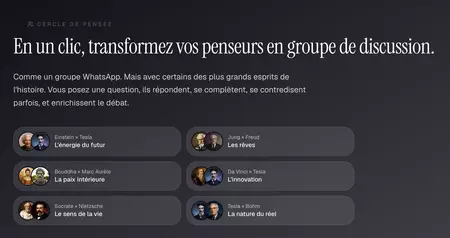
What if you could engage with Einstein on quantum physics AND Bohm on holistic systems simultaneously? A new generation of specialized AI tools is transforming research!
General AI has a limit: it doesn’t know anything in depth
For two years, general AI tools (ChatGPT, Claude, Gemini) have dominated the debate. They are versatile, accessible, impressive. But they suffer from a fundamental limitation: the absence of specialized depth.
When you ask ChatGPT a question about quantum physics, you get an answer synthesized from millions of internet pages. It’s useful. But it’s not Einstein who answers you. It is an aggregate of knowledge.
The real limit emerges elsewhere: in application research.
When a neuroscience researcher wants to explore the dialogue between quantum mechanics and consciousness, they can’t really “ask advice” from Penrose AND Bohm simultaneously. He reads their papers separately, synthesizes them himself, creates links.
What if this synthesis work could be assisted?
The specialized approach: reconstructing thought, not imitating it
A new generation of tools is emerging, based on a different idea: rather than training a generic AI on billions of tokens, why not reconstruct the thinking of an expert from his complete works?
This is the difference between:
- ChatGPT: “Here’s what people usually say about Einstein”
- A specialized AI: “This is how Einstein thinks about relativity, according to his articles, correspondence and conferences”
This approach — called Retrieval-Augmented Generation (RAG) — changes the nature of the interaction. Instead of generating content, the AI retrieves relevant passages from primary sources and uses them to construct a coherent answer.
The applications are numerous:
- A biological researcher can consult Darwin’s approach to evolution and Bohm’s approach to holistic systems
- An entrepreneur explores Drucker’s vision of management and Musk’s vision of innovation
- A philosopher questions Nietzsche and Buddha on the same question
The result: connections that the researcher might never have found alone.
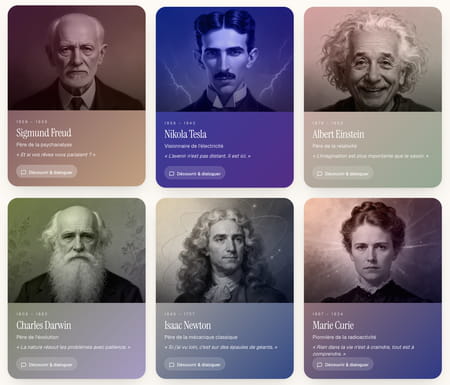 What if you could chat with Albert Einstein? Ask Carl Jung a question? Ask advice from Leonardo da Vinci?
Beyond the co-pilot: AI as a laboratory of ideas
This is where the real potential lies. Specialized tools are not “enhancements” to ChatGPT. They respond to a radically different need: to create a space where ideas can meet, confront each other, dialogue.
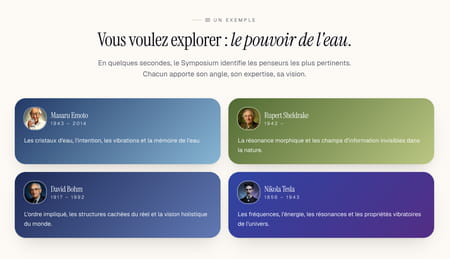
Take a concrete example: exploring “the power of water”.
A researcher interested in this topic might consult:
- Masaru Emoto: The vibrational and informational properties of water
- David Bohm: The implicit order and the underlying fields
- Rupert Sheldrake: Morphic Resonance
- Nikola Tesla: Frequencies and energetic resonances
Everyone brings a different angle. Together, they create a field of investigation that few researchers would have the capacity to synthesize alone.
This is not emotional marketing. It is a logic of triangulation: when several competent sources shed light on an issue from different angles, understanding deepens.
Use cases are emerging in all areas
In fundamental research: physicists can explore how Einstein, Bohm and current quantum mechanics researchers conceptualize reality. Dialogues between disciplines become possible.
In product innovation: a designer can consult the methodology of Da Vinci (holistic observation) and that of Tesla (visionary engineering) for the same challenge. The two approaches are not in competition — they complement each other.
In business strategy: entrepreneurs no longer read sequentially (first Drucker, then Musk, then Simone Weil). They ask a question: “How do I build a meaningful business?” and obtain a synthesis of perspectives.
In mental health and well-being: Therapists can explore how Jung, Frankl and contemplative traditions approach a patient’s search for meaning. This enriches the practice.
In education: students no longer memorize facts. They explore how great thinkers construct knowledge. This is an educational change.
 You are not interacting with a generic AI. You interact with a specialized intelligence, built around the complete work of a thinker.
Why it’s possible now (and not before)
Three technological convergences made this possible:
- RAG (Retrieval-Augmented Generation): Models can now retrieve and contextualize specific passages rather than generating vague content.
- Vector databases: Storing and searching thousands of pages efficiently becomes technically trivial.
- Lightweight specialized models: We no longer need GPT-4 for each case. Lighter models, fine-tuned for a task, are sufficient.
The cost of technology has collapsed. The intellectual cost (compiling complete works) remains high. But for major thinkers, it is doable.
Limits (which must be named)
Let’s be honest:
They are not living spirits. AI reconstructs static thinking, based on past writings. It cannot innovate or evolve.
The interpretation remains subjective. When we compile “Nietzsche’s complete works”, we are already making a curatorial choice. Two teams might do it differently.
This does not replace the study of sources. A researcher who never reads Bohm directly but “consults” him via AI remains superficial. The tool assists research, it does not replace it.
Biases are built in. If we select the source texts poorly, we reproduce the biases of the selection.
Towards enhanced research
The real potential lies elsewhere: transforming research into dialogue.
Historically, research was solitary. A researcher read hundreds of articles, synthesized alone, wrote his conclusion.
With these tools, the synthesis becomes interactive. You ask a question of several thinkers simultaneously. You hear them debating. You spot contradictions, points of convergence, unexplored paths.
It is not AI that innovates. It is the researcher, assisted by a tool that allows him to explore more widely and more deeply.
For illustration, researchers in France are already experimenting with this type of approach. One of the first real-world applications is AI Symposium, which reconstructs 40+ major thinkers (Einstein, Tesla, Buddha, Nietzsche, Sheldrake, Bohm, etc.) from their works and enables multi-perspective dialogues.
This is just the beginning. But it signals a trend: specialized and dialoguing AI is becoming a research tool.
The questions this raises
For researchers: How to integrate these tools without sacrificing rigor?
For scientific publishers: How to validate research that relies on AI-assisted dialogue?
For universities: How to teach to use these tools critically?
These questions have no simple answers. But they are worth asking.
In the end, no revolution, an evolution
We must not over-dramatize. Specialized AI is not a revolution. This is a logical evolution of search tools.
Before, you had:
- Google Scholar (to find papers)
- PubMed (for medical literature)
- Manual summaries (your work)
Now you have:
- The same engines (+ assistants)
- Tools that synthesize faster
- Augmented dialogues that broaden your perspective
AI does not innovate. You innovate. AI helps you explore more broadly.
For research in search of depth, it is a paradigm shift: moving from general AI (breadth) to specialized AI (depth) and combining them.
The next great discovery may well come from a question that a lucky researcher asks of several major minds gathered in this type of dialogue.
This is why you need to pay attention to it.