








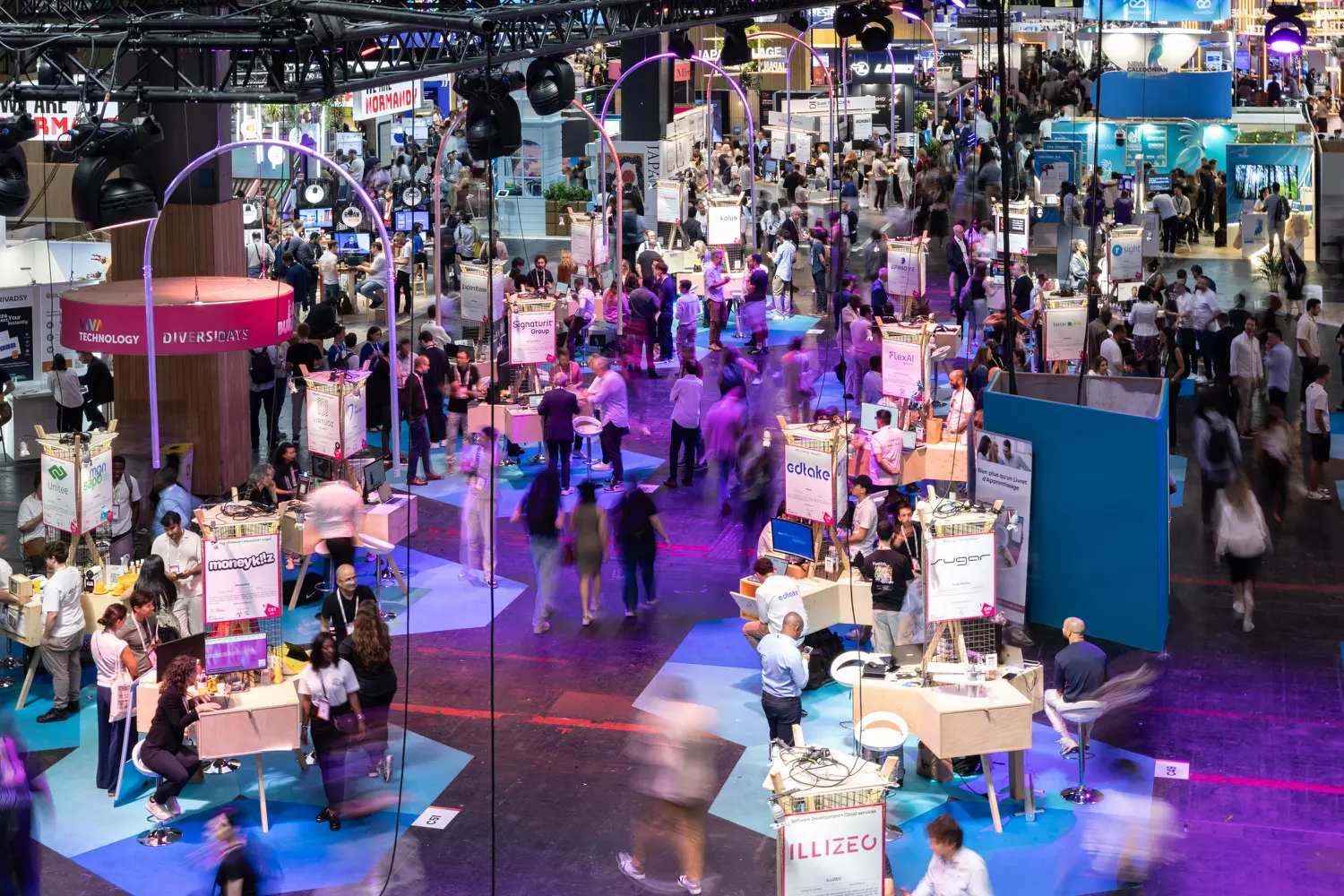
During the 2026 edition of VivaTech, French start-ups particularly stood out, increasing their presence on the stands and capturing the interest of international investors.
Unsurprisingly, AI took center stage during the 2026 edition of VivaTechwhich was held at the Porte de Versailles Exhibition Center in Paris. “The steamroller of AI is hitting all the technologies we see here,” explains Xavier Apolinarsky, vice-president of innovation at Paris-Saclay University, from the establishment’s stand, where he defends the interests of the start-ups he supports. But this apparent predictability in no way dampens the enthusiasm of the tens of thousands of visitors who wander the aisles of the show.
“As soon as you enter the show, you come across IBM’s quantum computer, and it’s just incredible. I just went to see the Unitree stand and the company’s robots are impressive,” marvels César, a student at a major engineering school who dreams of becoming an entrepreneur. And for good reason. Even though AI is everywhere, its use is changing. It is now moving “towards reality. (…) In 2026, the trend is physical AI”, observes Abdelalim El Hamichi, teacher at HEC, during a round table organized by the major business school on this theme.
Humanoid robots: the stars of publishing
At VivaTech 2026, robots are everywhere. So much so that parades of humanoid robots are even organized to make them interact with visitors. Sometimes speaking dozens of languages, they demonstrate greater agility, performance and robustness than last year, according to Isabelle Hilali, founder of Datacraft, a club of data scientists, who came to speak in a round table on the uses of AI in business. “For me, the big trend emerging from this edition is AI associated with robotics. This is the future revolution. This year, there were a lot more robots than last year, and it wasn’t just for show. There is now real business thinking around these robots, and on various subjects, ranging from construction to hospitality to automobiles. There is now substance and all sectors are seriously interested in this subject.”
From the Jizô AI stand, located in the French Tech space, Nicolas Arpagian, chief strategy officer of the cybersecurity company, observes the same trend: “On robotics, we have gone beyond what we saw until now, namely the purely accessory and playful dimension. In this edition, we see that robotics is becoming industrialized and this means that robots are becoming more robust, more autonomous, reactive, capable of interacting in complex environments. Thanks to AI, the gestures of these robots are adapted to the circumstances. It is now possible to see a standardization of the presence of robots augmented by AI emerge in the near future.
French innovation in the spotlight
However, all eyes were also on the various innovations coming from the thousands of start-ups present at the meeting. Among these, French start-ups were well represented, exhibited in spaces of major schools, universities, French regions, but also French Tech or companies like Orange. “The major trends in our start-ups focus on AI, of course, but also data, how to optimize data for industries and make AI work on it. There is also digital health, because 20 to 25% of our start-ups have taken up the subject. This can for example be digital twins of the nervous system. There are quite a few who also focus on energy, electricity distribution systems, etc.,” observes Paul-Guilhelm Meunier, deputy director for economic development and entrepreneurship at the Institut Mines-Télécom, which supports 120 start-ups each year.
“At home, our start-ups use AI in all scientific fields: health, biology, but also brain sciences. One of our gems, HABS, even has the capacity to decipher emotion marker neurons. The trend that I see emerging is the ability to link AI, the brain, emotions and human behavior. We also see another trend in quantum. We are starting to link quantum and AI, to improve both,” says the vice-president of innovation at Paris-Saclay University, Xavier Apolinarsky, from which 100 tech start-ups emerge per year. “At the University of Paris Sciences et Lettres, we also observe that AI has a strong impact in all areas of our start-ups, in health, energy. Many of our start-ups are in fact investing in biotechnologies, engineering for health, medical imaging techniques, but also robotics, cybersecurity, dual technologies,” adds Bruno Rostand, director of innovation and entrepreneurship at the University of Paris Sciences et Lettres, from which 70 to 80 start-ups emerge per year. year.
“In this edition, we clearly see recognition of all this know-how of the French tech start-up ecosystem. Today, for example, I met Egyptians, Indians, English, Germans, etc., all very interested in discovering our innovations,” says the vice-president of innovation at Paris-Saclay University. To demonstrate this attractiveness, from the stand of the Ile-de-France Region which she chairs, Valérie Pécresse also announced the arrival, in this establishment, of two researchers from American universities, welcomed as part of a regional program to support scientists whose freedom of research is threatened, according to her.
Another central theme: sovereignty
“We try to get our start-ups to work on sovereign tools. This is why we, for example, signed a partnership with Dassault Systèmes,” says Paul-Guilhelm Meunier. This initiative echoes another notable trend of this edition: the growing interest of companies and investors for innovations guaranteeing strategic autonomy. Numerous round tables were also organized on this theme. A space was even dedicated to debates on digital sovereignty. “Strategic autonomy, that is to say the fact of controlling data, is a central subject of this edition and we see it in our discussions with our interlocutors, whatever their geographical or institutional origins,” confirms Nicolas Arpagian.


