








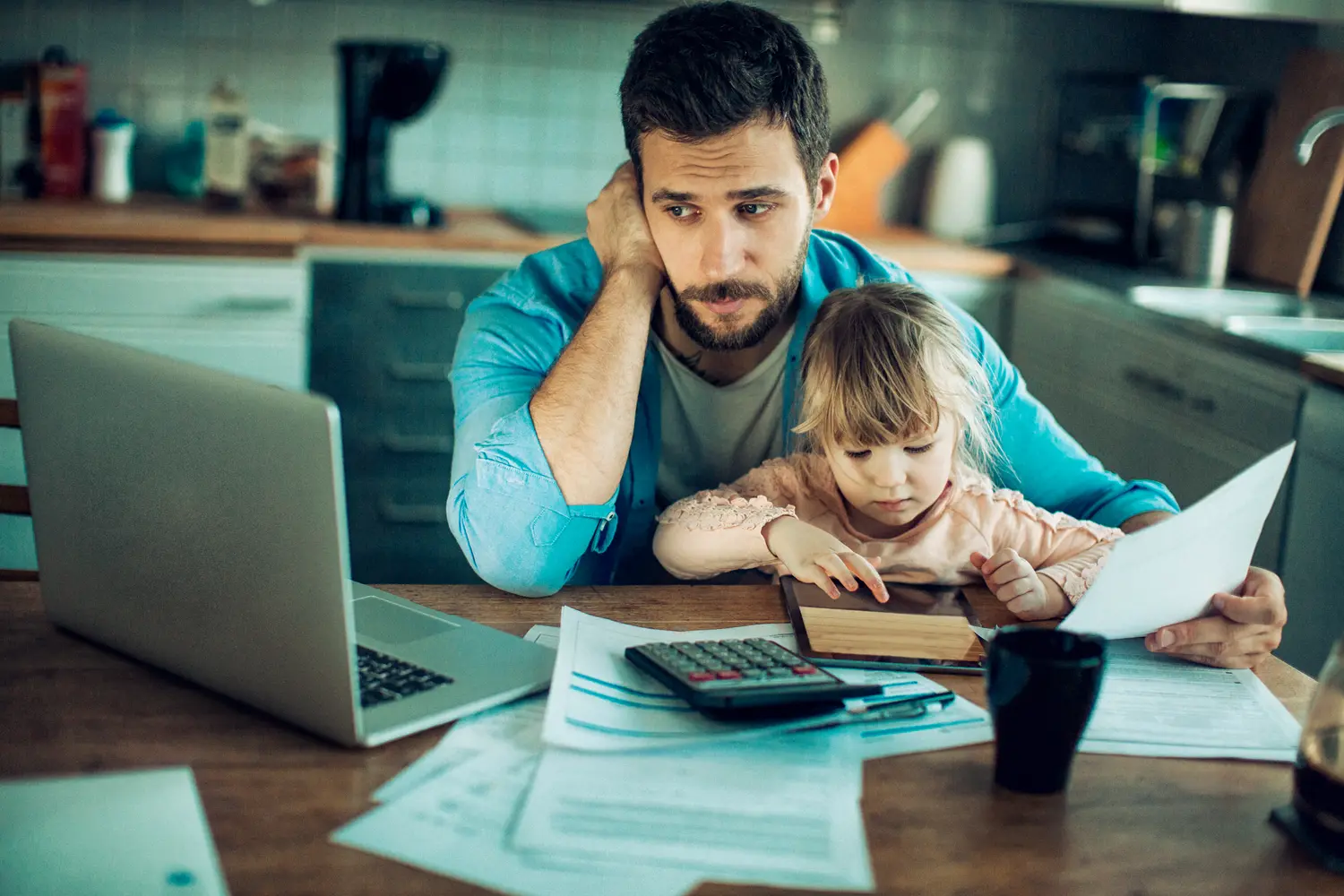
A box on the tax return allows millions of parents to benefit from a tax reduction of up to 4,262 euros. Some taxpayers forget to declare it to the tax authorities and therefore pay too much income tax.
Many parents are missing a box. Obviously the Journal du net does not allow itself to judge the mental health of those who raise future generations. We are talking here about the income tax return. “Many parents forget to check a particularly interesting box in their income tax return each year, and who then miss out on a considerable tax advantage,” tells us an employee of a public finance center in Île-de-France.
This box is dedicated to all parents who are raising one or more children alone. 23% of children in France grow up in a single-parent family according to INSEE. The National Institute of Statistics and Economic Studies specifies that single parenthood affects one family in 4, or more than 2 million households in total. Most of these people can therefore tick box T in their tax return: a box reserved for single parents.
The tax administration recognizes the status of “single parent” for single, divorced or separated parents who are raising one or more children alone. The children can be minors or adults, but in this case they must be attached to the parent’s tax household. While the tax authorities normally grant a half tax share to parents with a dependent child, single parents can claim another additional half tax share. A significant detail when we know the logic of the tax system in France: the more shares a household has, the lower the amount of income tax to pay will be high.
To understand clearly, let’s take the example of a mother with a dependent child and a net taxable income of 31,000 euros over the year. Her family quotient amounts to 1.5 tax shares: one for her and 0.5 for her child. His taxable income, once divided by 1.5, will then fall to 20,666 euros. According to the tax scale in force, his gross tax will amount to 1,496 euros.
If this mother checks box T, in order to declare herself as a single parent, she will benefit from a family quotient amounting to 2 tax shares. His taxable income will then be 15,500 euros. The gross tax of this mother will drop to 858 euros, a tax reduction of 638 euros. However, this tax reduction generated thanks to box T is capped. It cannot exceed 4,262 euros per year.
Even in the context of shared custody, following a separation for example, both parents can check box T. Each will then be able to claim the status of single parent and benefit from a quarter of an additional tax share, i.e. 0.25 more on their respective family quotient. In this specific case, the ceiling of the tax reduction offered by box T is also halved, thus amounting to 2,131 euros.
However, an adult can lose their status as a single parent if they start living together with another person. The legal requirement states that the parent must only cohabit with their dependent children in their home. An exception exists, however, for members of the direct family: a single parent can live with their father, mother, brother or sister without losing their special tax status. For the income tax return to be completed in 2026, the parent’s family situation on January 1, 2025 is taken into account. If the parent entered into a cohabitation during 2025, then the composition of the household on December 31, 2025 is taken into account.
Another subtlety concerning people who have lost their spouse and are raising their children alone. They could naturally consider themselves to be single parents and tick box T on their declaration. However, this is an error. The tax administration reminds that widows and widowers have the same number of tax shares as a married or civil partnership couple. These taxpayers must therefore check box V in their tax return.


