








Anthropic presents Claude Fable 5, a new model from the Mythos range, pushing the limits of AI with its levels of intelligence and security not seen in months. New adapted safeguards complete this progress.
Anthropic had promised, at the time of the release of Claude Opus 4.8, that a model of the Mythos grade level would arrive in the coming weeks, it has now happened. The San Francisco start-up presents this Tuesday, June 9, Claude Fable 5, a model directly derived from Claude Mythos with exceptional safeguards. At the same time, the company is launching an update of Mythos with a new version called “Mythos 5” aimed at whitelisted companies and testers (mainly as part of the Glasswing project). Models which mark, in benchmarks, a significant milestone in intelligence but also in cost.
Claude Fable 5, higher level intelligence
Claude Fable 5 is directly derived from the Mythos family. The model moves up a notch in terms of performance in benchmarks and becomes the most intelligent model released to date by Anthropic. The model excels in software engineering, knowledge work (advanced reasoning skills) and vision (analysis of visuals and images) tasks. Anthropic describes it as superior to the frontier models of its competitors on complex tasks that require great autonomy.
A line clearly assumed by the company. : Angela Jiang and Katelyn Lesse, head of product and head of engineering of the Claude Platform, confided to ust very recently that research teams were working assiduously on models capable of working for hours without any interruption. The ultimate goal is to have autonomous agents constantly working and self-improving.
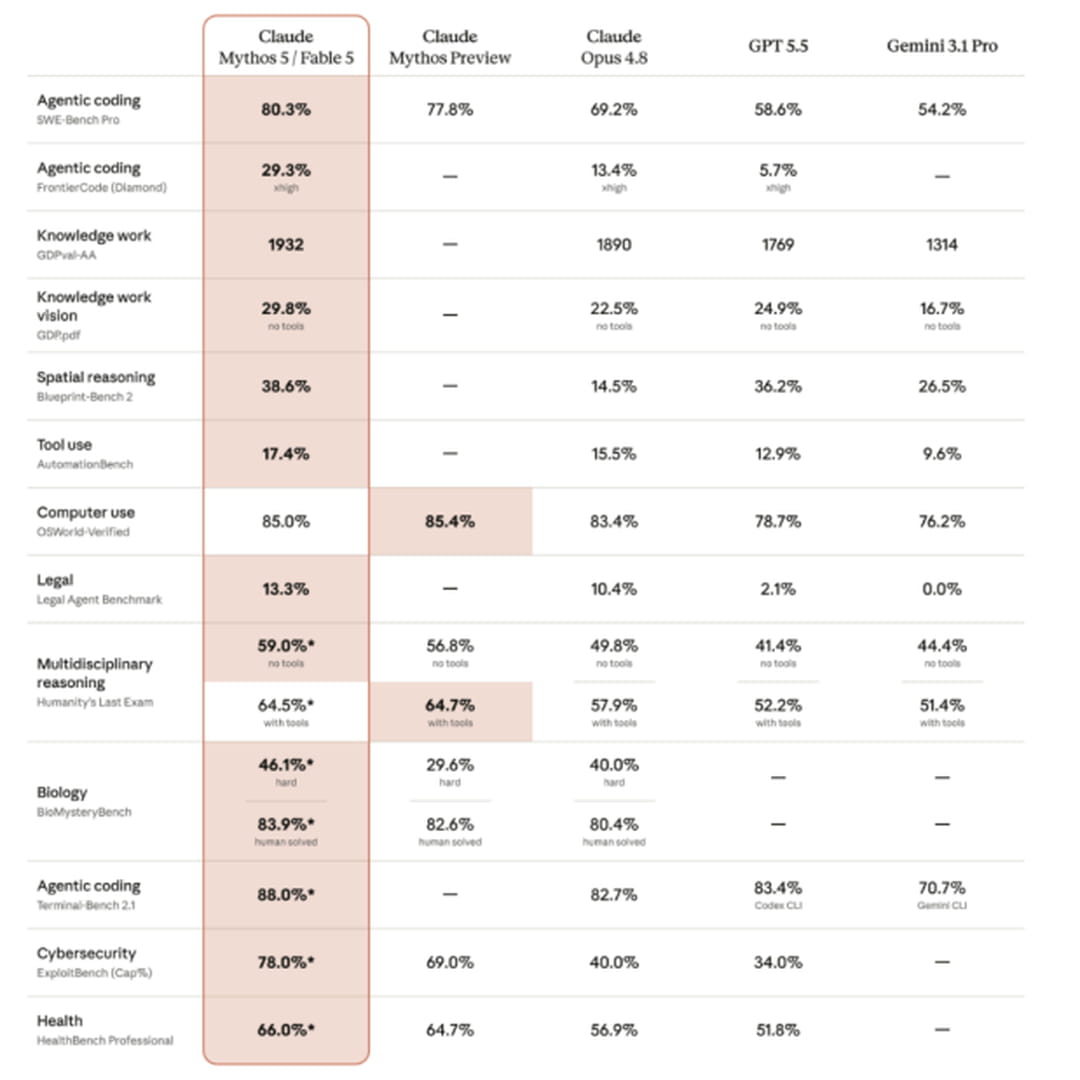
In the benchmarks, Fable 5’s lead is concentrated where the task is long and autonomous. On the agentic code, the model reached 80.3% in SWE-Bench Pro and 88.0% in Terminal-Bench 2.1, far ahead of Opus 4.8 (69.2% and 82.7%), GPT 5.5 (58.6%) and Gemini 3.1 Pro (54.2%); the gap widens further on FrontierCode (29.3% against 13.4% for Opus). Same hierarchy in knowledge work (1932 at GDPval-AA against 1890), in spatial reasoning (38.6% at Blueprint-Bench 2) and on legal tasks.
Anthropic’s observation is therefore mainly verified for prolonged autonomy, less so for short tasks, where the advantage is reduced to a range of one to three points.
Beyond the scores, Anthropic claims already concrete discoveries with Mythos 5 (Fable 5 blocking biology): a drug design accelerated by a factor of ten with nine promising candidates on 14 targets, a new hypothesis on an E. coli confirmed by a third-party team, and a genomic model trained almost autonomously.
Anthropic seeks to eliminate biological and cyber risk
A cutting-edge model also means higher than normal risk. To prevent the hijacking of its model by malicious actors, Anthropic has developed new guardrails specifically adapted for the intelligence of Fable 5. American AI laboratories are increasingly concerned about the biological risks generated by these new generation models. Last week, Sam Altman (OpenAI), Dario Amodei (Anthropic), Demis Hassabis (Google DeepMind), Mustafa Suleyman (Microsoft AI) and Alexandr Wang (Meta) co-signed a public letter calling for mandatory controls on the sale of synthetic DNA and RNA, to prevent AI models from being used to create biological weapons.
As a direct consequence of this fear, Fable 5’s safeguards prevent the model from responding to all themes related to biology, chemistry, model distillation and cybersecurity (Mythos made it possible to discover several 0 day vulnerabilities). When questioned on one of these two themes, the model passes the baton to Claude Opus 4.8 which will respond without problem to the request (within the limits of traditional safeguards). The start-up claims that 95% of requests from early adopters of the model were not filtered and that over more than 1,000 hours of internal red-teaming, no jailbreak of the model was successful.
On the data side, Anthropic imposes a thirty-day retention on all traffic from Mythos models (Fable included), without training and with access logging, a detail far from trivial.
At the same time, Anthropic is taking the opportunity to publish an even improved version of Claude Mythos for customers and partners who already have access to the model. Access to the real Mythos will be gradually expanded via an enhanced access program.
An explosive cost
On the pricing side, Anthropic sets the bar as high as its safeguards. Claude Fable 5 and Claude Mythos 5 are offered at a prohibitive price of 10 dollars per million tokens for input and 50 dollars for output. For comparison, Claude Opus 4.8, already very expensive, is priced at $5 per million tokens for input and $25 for output. Mythos and Fable 5 literally double the prices.
On the deployment side, Fable 5 is available everywhere today, via the API (under the identifier claude-fable-5), Claude Code, Claude Desktop and Claude.ai. Anthropic, however, warns that demand will be very strong and is rolling out the subscription in stages: Fable 5 is included at no extra cost on the Pro, Max, Team and Enterprise offers per seat until June 22, before switching on June 23 to a usage credit system, then being reintegrated “as soon as possible” into the standard packages.
With Mythos 5 and Fable 5, Anthropic clearly assumes its position as a premium AI publisher. Mythos and Fable 5 will certainly not be suitable for the majority of AI cases in business. Their use is clearly reserved for companies and laboratories for whom raw intelligence and maximum autonomy matter the most. The first opportunities center around long-term, high-margin agents: code agents who work for hours, complex analysis in finance, legal or consulting, AI R&D. This is where the extended autonomy sold by Anthropic really pays off, one hour of a very good model being worth ten hours of a mediocre model (however, we will see if Anthropic’s safeguards/intelligence balance holds up in practice).
With this assumed positioning in quasi-luxury AI, Anthropic is once again seeking to demonstrate that it is possible to combine cutting-edge AI and economic profitability. A necessary guarantee of proof before its next IPO planned for the end of the year.