








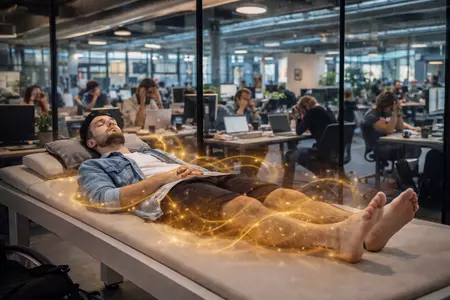
As professional stress reaches record levels and companies seek new levers for sustainable performance, a new generation of solutions is appearing in France.
Work stress is at record levels.
Companies are looking for new levers for sustainable performance, a new generation of solutions combining neuroscience, immersive audio, biofeedback and multisensory stimulation is beginning to emerge. Beyond well-being, these technologies could well become a real competitiveness issue.
For decades, business performance has been primarily built around process optimization, training and technology.
Today, another factor is attracting more and more attention from managers: the cognitive state of employees.
Mental fatigue, information overload, hyperconnection, loss of attention, drop in creativity… Businesses are facing an unprecedented challenge. According to several recent studies, psychological and psychosocial disorders now represent a significant proportion of work stoppages and constitute one of the main HR challenges of the coming years. In France, stoppages linked to mental health continue to increase and contribute significantly to the increase in absenteeism observed for several years.
In this context, a question emerges: what if improving performance was less about working more than about recovering better?
Recovery becomes a strategic issue
In innovative companies, the subject is no longer just well-being.
It becomes economical.
Neuroscience research shows that a tired brain makes more bad decisions, loses analytical capacity, sees its creativity diminish and requires more time to complete a complex task.
Result: some organizations are starting to consider cognitive recovery as a strategic resource, in the same way as training or digital tools.
This is particularly what explains the emergence of new devices:
- sensory disconnection rooms;
- corporate meditation spaces;
- nap pods;
- immersive environments of virtual reality ;
- audio technologies using specific frequencies;
- multisensory devices combining sound, vibration and guided relaxation.
In the United States, the Nordic countries and even Japan, these approaches are beginning to find their place in stress prevention and sustainable performance programs. Recent research on immersive recovery spaces shows promising effects on reducing perceived stress and improving employee well-being.
When sound becomes a performance tool
Among the most intriguing innovations is the use of audio therapy and vibrational stimulation.
The idea is not new: for several decades, researchers have been exploring the influence of certain sound frequencies on attention, relaxation and states of consciousness.
Work on binaural beats suggests potential effects on concentration, sustained attention and certain mechanisms linked to relaxation. Although research continues to advance and not all protocols produce the same results, several recent studies observe measurable benefits in certain contexts.
Other research is now exploring the use of these technologies directly in the professional environment in order to reduce stress and improve the quality of mental recovery of employees.
The emergence of “augmented micro-naps”
A new concept is thus beginning to appear: that of accelerated recovery.
The objective is no longer to offer a long break, which is often difficult to integrate into the work organization, but short sessions of 10 to 20 minutes aimed at promoting rapid disconnection from the nervous system.
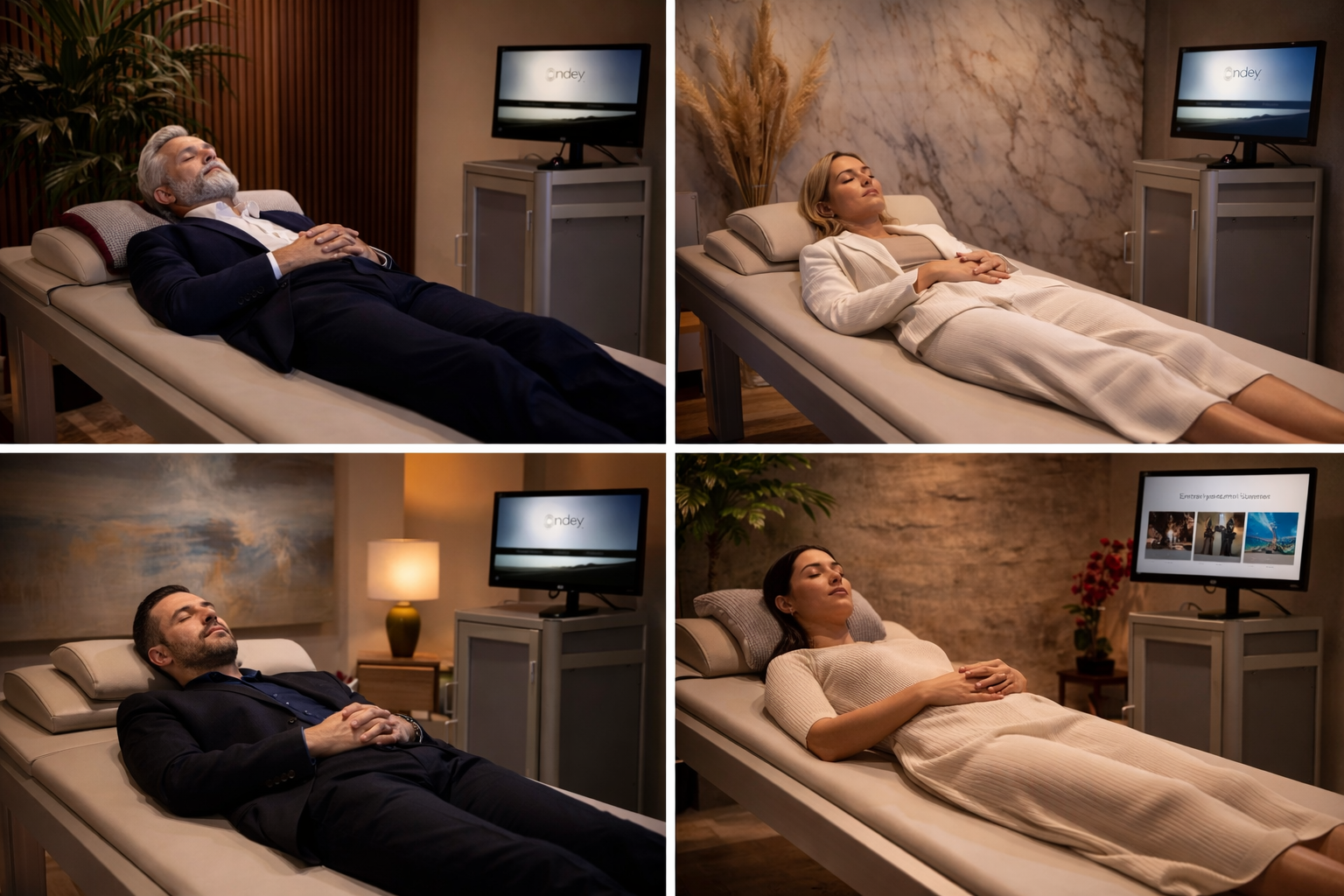
Along these lines, some companies are experimenting with relaxation capsules, sensory chairs or even audio-vibration beds capable of simultaneously broadcasting immersive music, specific frequencies and synchronized vibrations.
This is notably the positioning developed by Sonaria Energya French company that offers businesses multisensory recovery experiences combining immersive audio, body vibrations and protocols inspired by research into deep relaxation states.
multisensory recovery experiences combining immersive audio, body vibrations
The stated ambition is simple: to enable an employee to quickly return to a state of calm, concentration and mental availability without leaving their professional environment.
The interest of this type of approach is not so much to replace sleep or traditional methods of stress managementbut to propose a new complementary tool in the well-being at work toolbox.
 a new complementary tool in the well-being at work toolbox.
A trend that goes far beyond well-being
The real change may lie elsewhere.
For a long time, HR policies have treated stress as an inevitable consequence of performance.
The new generation of companies is starting to consider the opposite:
recovery quality could become one of the major determinants of sustainable performance.
In a context where attracting and retaining talent is becoming more complex, where attention has become a scarce resource and where the costs linked to absenteeism continue to rise, investing in the cognitive and emotional capacities of teams could quickly become a competitive advantage.
The companies that will succeed tomorrow may not be those that require the most effort from their employees.
They will probably be the ones who will be able to recover more quickly, refocus more easily and maintain their energy level over the long term.
What if the next performance revolution was ultimately not technological, but neurological?


