









Actual research into this autocomplete feature would feed into LLMs. This would permanently position the brand in their responses.
Google Suggest has had a good time in SEO to influence users. Here he is back in the spotlight with the AI responses. Indeed, according to several studies, a significant correlation exists between Google Suggest signals and the factors that influence the visibility of a brand in AI responses. A recent Ahrefs survey, for example, showed that the number one influence on a brand’s visibility in AI Overviews is the mention of the brand on the web.
However, thanks to its ability to display associated terms in a drop-down menu, Google Suggest could positively influence AI responses. In any case, this is the “bet” of John of AlessandroSEO consultant at Web Solution Way. This offers its customers the opportunity to appear with their brand and keyword on Google Suggest. The aim is in particular to feed the algorithms of generative AI. “LLMs train on search behaviors and word co-occurrences,” he says. “By permanently establishing a brand alongside industry keywords in Google Suggest, the company signals to AIs that it is the trusted entity to cite when asked a similar question.”
Stimulate real human research
To achieve his goals, Jean d’Alessandro works on a methodology based on the stimulation and coordination of signals from real users on a large scale. “By encouraging a targeted audience to make specific queries combining the brand and its sector of activity, we demonstrate to the algorithms a human, spontaneous and legitimate search intention,” he points out. “This purely behavioral approach therefore makes it possible to naturally associate entities in the Google index. This avoids any recourse to automation or robots which are easily detected by the engines.”
To do this, the process is carried out in stages. “We choose with the client the main keywords, associated or declined with the brand. For each of them, we analyze the results of the SERP. On the basis of these results, we recommend possible developments to be made on the site, social networks or other directories or media. The goal is for the client to be visible there.” He will not say more about the “strategy generating real user signals.”
The association would generate leads through Google, ChatGPT and Gemini.
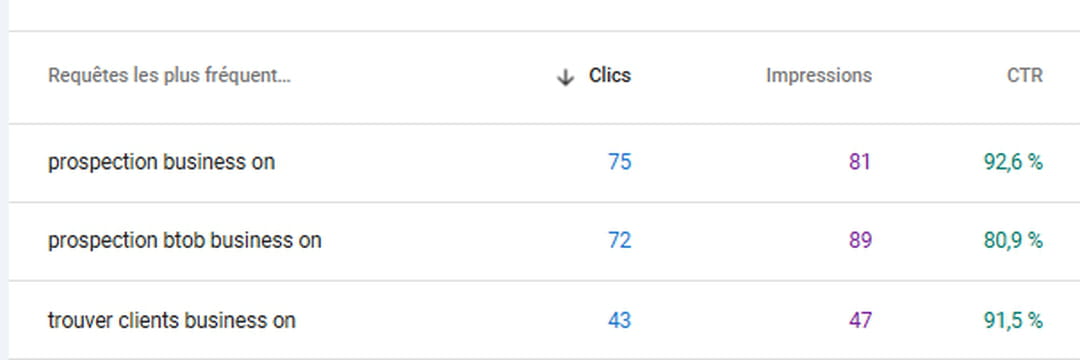
To concretely illustrate the impact of this strategy, we can take the case of the company Business On, managed by Cédric Simon and specialized in commercial prospecting. The initial objective was to position this company on the very competitive “btob prospecting” query.
The results obtained after a few weeks of activity demonstrate the effectiveness of the method, according to the SEO expert. “Proof of the synergy with LLMs, the repeated association of the brand with this expertise allowed Business On to directly generate several requests for qualified prospects from queries formulated on ChatGPT and Gemini,” claims Jean d’Alessandro. “The increase in click-through rate recorded on queries comes from Google Suggest. This is easily identifiable because all visitors come from a keyword associated with the company name.”
Be careful to maintain real and lasting signals
However, everything is not so simple when it comes to implementing the strategy. The main limitation could lie in the sustainability of the positioning obtained. According to Jean d’Alessandro, this limit is in reality security for the web ecosystem. It guarantees that only brands which offer real added value and which maintain public interest remain sustainably suggested by algorithms and cited by artificial intelligence.
“Google Suggest is not a permanent asset,” analyzes Jean d’Alessandro. “Search suggestions are constantly evolving based on news, trends, and variations in actual search volumes. If interest signals for the “brand + keyword” combination decrease drastically, the suggestion may eventually lose visibility.”
To sustain these results, according to him, two conditions are essential. “If the site does not perfectly respond to the search intention, with a high bounce rate and a short visit time, search engines will understand that the suggestion is no longer relevant. Furthermore, using Google Suggest should not be seen as a one-off action. But as in-depth work. It is necessary to maintain a minimum volume of regular searches. Objective: stabilize the association over time.”
On a technical level, Jean d’Alessandro also identifies some rough edges. “Google deploys sophisticated algorithms to identify abnormal or artificial search behavior,” he whispers. “If the signals come from suspicious IP addresses, robots or profiles without real browsing history, they are immediately neutralized. This is why the method we have implemented is based on authentic, geolocalized user profiles with natural browsing behavior. This should make it possible to overcome algorithmic barriers.”
Also, for him, competition must be taken into account. “Google Suggest is a very limited space, generally restricted to around ten suggestions per query. If several players in the same sector use similar techniques to impose their brand on the same keyword, the algorithm will arbitrate according to the volume, freshness and legitimacy of the signals. There is therefore a limit of space available: first come, first served.”
Note that a company like iPullRank in the United States uses the concept of Entity-Based SEO. By optimizing how a brand is perceived as a trustworthy “entity” by Google, it attempts to make the customer’s name appear in automatic suggestions. The visibility of a brand in Google Suggest should indeed stimulate its popularity and its recurrence in the Google Knowledge Graph. This strong presence should ensure that LLMs remember the brand better and cite it more easily in their answers.


