









What is happening under French soil intrigues researchers from all over the world. The reason: microscopic black holes are created there every day by humans.
Without even realizing it, are black holes being born under French soil? The question seems straight out of a fantasy novel or a science fiction film. However, it is taken very seriously by the scientific community.
It is precisely at CERN, on the French-Swiss border, that physicists are trying to observe this phenomenon. Here, a hundred meters underground, researchers make billions of particles collide at extreme speeds. These collisions could create real black holes.
Rest assured, under France, researchers are not creating large supermassive black holes, like those that we can observe at the center of our galaxy. Rather, they seek to confirm the existence of what are called microscopic black holes, or quantum black holes.
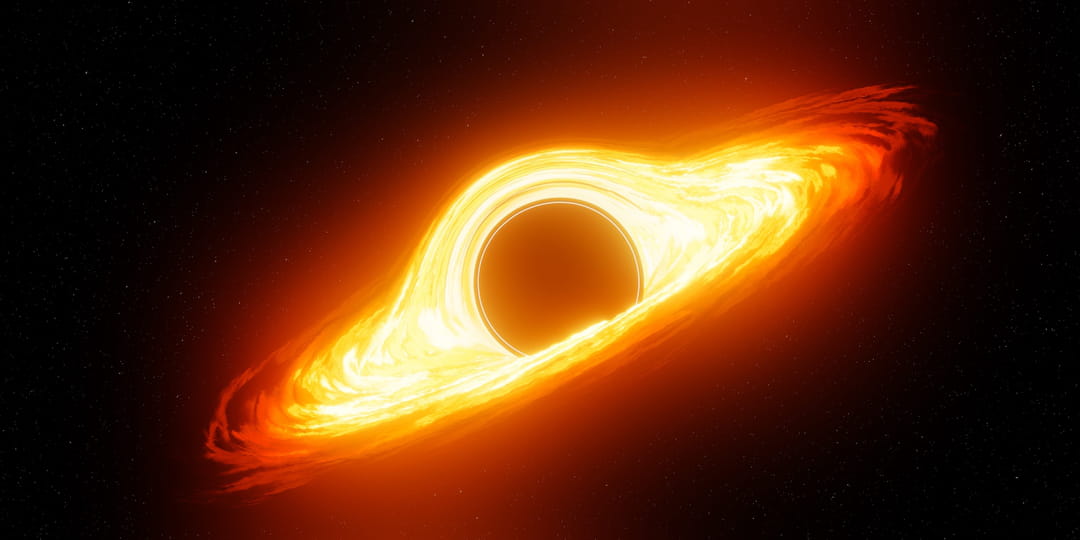
These objects represent absolutely no danger to us. Indeed, due to a phenomenon called Hawking evaporation, these micro-black holes would only last a tiny fraction of a second. They would evaporate almost instantly, having little time to absorb material.
For now, the existence of these quantum black holes is only theoretical. They have not yet been able to be observed, but their creation in the laboratory “does not seem implausible”, underlines Victor Franken, researcher in theoretical physics. “To create a black hole, you just need to have enough energy in a small enough space. These are conditions that, theoretically, can be met in this kind of experiment.”
Observing these black holes represents a major challenge for science. If their creation in the laboratory were to be confirmed, it would revolutionize our understanding of the Universe. It would be a scientific as well as a philosophical revolution. Proving the existence of these miniature black holes would confirm that our Universe has more than four dimensions (beyond the three spatial dimensions and time that we know), indicates CERN.
“Studying and observing these quantum black holes would also make it possible to respond to the great challenge of modern physics: linking the major physical theories together,” insists Victor Franken. “In physics, there are two main theories. On the one hand, Einstein’s theory of general relativity describes gravitation and explains how planets, stars and galaxies interact with each other. In short, it describes the large structures of the Universe. On the other hand, quantum mechanics describes the behavior of the infinitely small. The problem is that when we try to bring these two theories together, it leads to contradictions. Today, we still do not know how the reconcile.”
More generally, being able to create black holes in the laboratory would allow researchers to study them in all their facets and to better understand the mechanisms that govern them, in particular Hawking evaporation.
The fact remains that this research will now experience a parenthesis. After several years of operation, the Large Hadron Collider (LHC), the main working tool of CERN scientists, has just entered a pause and maintenance phase. During this period, particle collisions are interrupted and the experiments are shut down. The aim is to modernize the facility and improve its performance so that when it is resumed it can achieve even higher levels of energy and precision.