








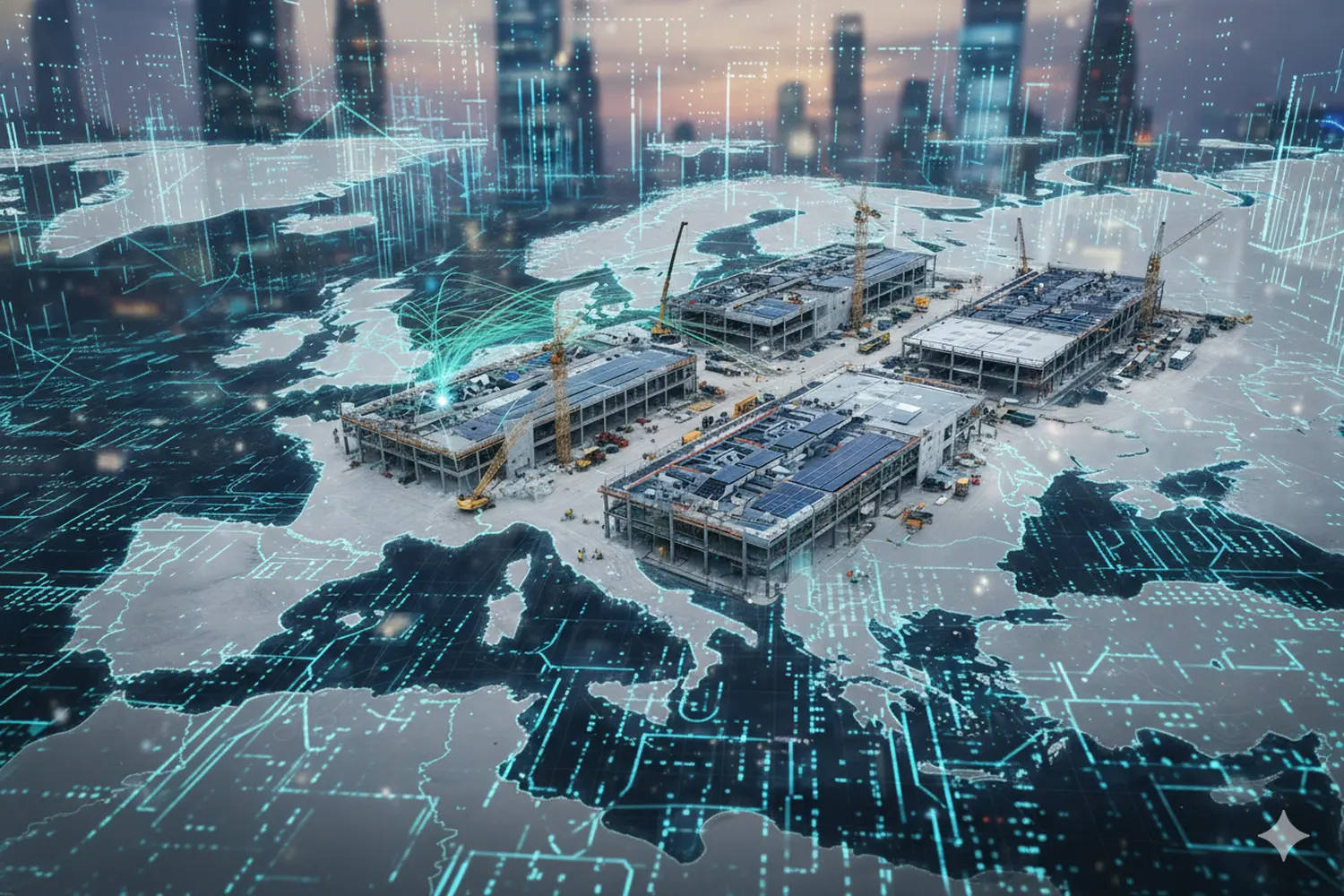
The French fund Ardian has just announced the investment of 5 billion dollars in a gigafactory in Ile-de-France. Its ambition: to create a competitiveness and industrial research center around AI.
The fund Ardian deploys a long-term strategy aimed at building sovereign AI capabilities in Europe. At the end of 2023, Ardian launched Ardian Semiconductor, the first European investment fund specializing in computer chips, aiming to help players in the Old Continent scale up more quickly, in order to reproduce the success of a nugget like ASML. He has since invested in IBS, a company specializing in the ion implantation process, used in the manufacturing of almost all semiconductors, and in Synergy CAD, which focuses on test interfaces, used at the very end of the manufacturing process to verify the functionality and reliability of components.
In March 2024, Ardian also finalized the acquisition of Verne, a specialist in data centers for high-performance computing. Based in Northern Europe, it opened a subsidiary in France a few months ago. An acquisition which today has very concrete repercussions, since, during the Choose France summit which took place on Monday in Versailles, Ardian announced, via its Verne sector, the investment of five billion euros in a 500 megawatt (MW) gigafactory in Ile-de-France.
Three additional billion in renewable energies
An ambitious project that comes at the right time at a time when France and Europe are lagging behind in AI infrastructures is patent : the Old Continent concentrates approximately 15% of global data center capacity in MW, compared to 25% for China and 45% for the United States.
A largely untapped potential. “France ticks all the boxes of Verne’s strategy: AI is one of the government’s major priorities, and the energy resources there are abundant and carbon-free, with stable prices and a high-quality network,” explains Gonzague Boutry, European manager of investments in digital infrastructures at Ardian. In addition to the five billion planned in the data center, Ardian will invest an additional three billion in the production of renewable energy on French territory. “The idea is to reinject what we are going to consume into the network.”
The energy bill for data centers is regularly pointed at and constitutes a handicap to their acceptability, as well as that of AI in general. “Opposition to data centers generally focuses on the fear that the use of land will increase the price of housing and that the consumption of energy and water will also drive up prices, with negative consequences for the rest of the population. Ensuring that data centers generate and consume their own resources, and showing the true impact, with supporting figures, without dodging gray areas, will make all the difference between public rejection and positive dynamics,” said during an organized debate. at the SXSW London event, Michael Jenner, CEO of Last Energy UK, which builds mini nuclear power plants to power data centers and industrial sites.
Building an industrial competitiveness cluster
Beyond the data center itself, Ardian’s ambition is to create a research center around AI bringing together several industrialists from the Paris region, with concrete applications of AI as a result. “The data center will only represent 20% of this industrial and research site, which will constitute a major attractive asset for the region,” says Gonzague Boutry. This is another criticism often leveled at data centers: while they generate jobs during construction, they are then largely automated and require few employees on site. So, in 2024, data centers will only employ 23,000 people in the United States, or 0.01% of the country’s total employment.
By creating an industrial competitiveness cluster, Ardian is anticipating these criticisms. The fund claims to have received expressions of interest from several large international groups in this regard. “Ardian is a player that invests in the real economy through our investment capital funds. We therefore have portfolio companies that would be interested in this site, which will allow us to have a mix of SMEs, TPIs and large international groups. Our ambition is to be the locomotive of the region to bring industrialists to our side,” summarizes Gonzague Boutry.
In the running for the European gigafactory project
The other major ambition of the site is to be selected as part of the European gigafactories project, which Ardian door with other companies within the AION consortium. Four or five sites across Europe will ultimately be selected to benefit from the public order, and Ardian hopes to be one of them. “It is a center which will, I hope, be able to accommodate the European creation of gigafactories. The idea is to unite public procurement around this type of project to gradually be present on a larger part of the value chain, providing computing capacity with a very efficient token cost.”
Token cost has recently emerged as the crux of the AI war as inference becomes increasingly important as companies strive to deploy algorithms to perform everyday tasks. “Tokens are the new raw material. More tokens means smarter models. We must therefore lower their costs as much as possible,” declared Jensen Huang during his keynote at the annual GTC megaconference on March 16.
Investments that remain modest compared to America
In addition to Ardian’s announcement, the Choose France summit also saw Softbank commit to investing €75 billion in AI infrastructure in France. The Taiwanese group Foxconn has planned 120 million euros to launch a production line for motherboards dedicated to AI on a site in Angers. While these figures are welcome, they remain modest compared to the all-out investments being deployed across the Atlantic. Elon Musk’s Terafab project in Texas alone is expected to cost nearly 120 billion euros, and Meta plans to put 27 billion in its Hyperion data center located in northern Louisiana.
AI data centers require significant investments, due to the size, but also the unprecedented complexity of the technology involved, according to Sviat Dulianinov, CEO of Bright Machines, which automates the construction of AI data centers. “In a traditional data center, the basic unit of computing is a chip, or a few chips working together. Today, it is the rack, or around twenty blade servers or computing nodes, linked together by network and storage layers. And when we start to connect thousands of these racks, something changes qualitatively: we no longer have a computer, but a cluster.
This is what Elon Musk is building in Texas, what Amazon is deploying with its giant site in Indiana. At this scale, the collective power far exceeds the sum of the parts, to the point of making possible the training of models that would have been unthinkable just a few years ago. It’s a complete paradigm shift.”


