









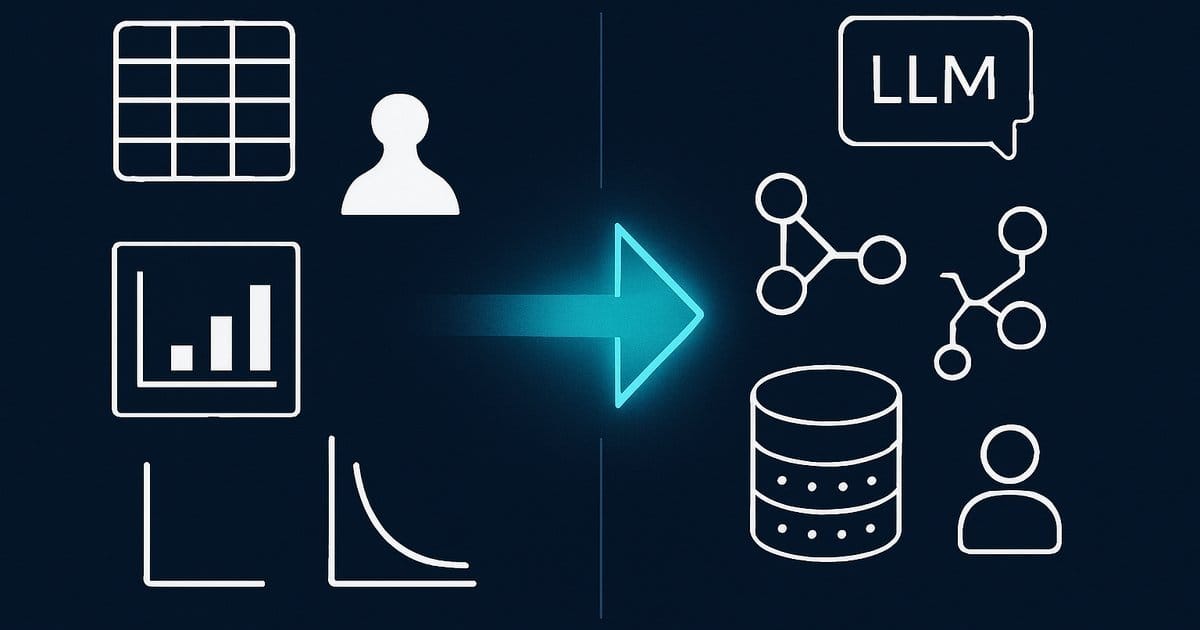
A Berlin startup, 2023. The team spent three months training their own classification model—curating datasets, evaluating architectures, monitoring training runs. The result: 74 percent accuracy, expensive, fragile. Then someone decided to try using GPT-4 and three targeted few-shot examples. Accuracy: 89 percent. Development time: two days. This story is currently repeating itself millions of times over—and it is symptomatic of a fundamental paradigm shift that is giving rise to two new job roles: the ML Engineer and the AI Engineer. The question is no longer just “What can AI do?” but: What skills do we need to use it productively?
What exactly is the difference? ML Engineering vs. AI Engineering
ML Engineering is the discipline that builds AI from scratch. An ML Engineer understands how gradients flow, why a model is overfit, how to keep data pipelines clean, and when which model architecture makes sense. The core tasks: collecting and cleaning raw data, creating training datasets, training models from scratch or fine-tuning them specifically, performing feature engineering, and deploying the finished model into a production-ready infrastructure. This is resource-intensive, methodical work—typically using Python, PyTorch, or TensorFlow, on expensive GPU hardware, over weeks or months.
AI Engineering picks up exactly where ML Engineering leaves off. Instead of building models, existing foundation models are used: GPT, Claude, Gemini, Mistral, Llama—widely available, pre-trained language models with an enormous range of capabilities. The AI Engineer builds applications on top of them. The focus is not on loss functions or learning rates, but on the question: How do I get this model to function reliably in my specific context?
The practical tools are different: prompt engineering, retrieval-augmented generation (RAG), selective fine-tuning, evaluation pipelines, inference optimization. The basic assumption is: The model already exists and is good enough. The actual engineering work consists of deploying it in a controlled, efficient, and production-ready manner.
This distinction sounds simple, but it has far-reaching consequences—for the technical stack, for team structures, and for career paths.
What AI Engineers Need to Know Today
The barrier to entry for AI engineering is lower than for traditional ML engineering—but it is not “easy.” Anyone who thinks a few tutorials are enough for a production application is significantly underestimating the complexity.
The foundation: solid Python skills, an understanding of REST APIs, and async programming. Many AI engineers come from the full-stack field (JavaScript/TypeScript, Python), but are increasingly shifting to backend-heavy roles because LLM applications run on the server side.
The critical skill set in 2026: Prompt engineering is more than just crafting nice-sounding prompts. It involves systematic testing, structuring chains of thought, few-shot examples, and instruction tuning principles. Those who don’t understand why a model reacts differently to certain phrasing will struggle to diagnose production issues.
RAG — Retrieval-Augmented Generation — has become the standard pattern for enterprise applications. A document chatbot, an internal knowledge base, a code assistant with company-specific context: almost everything runs on RAG. The implementation sounds simple (chunking documents, embedding them, writing to a vector database, retrieving them upon request, passing them to the model) — but in practice, it’s full of pitfalls. How big should a chunk be? Which embedding model? Which retrieval strategy? Hybrid search (semantic + keyword) or purely semantic? These decisions determine the quality of the system—and to make informed choices, you need a basic understanding of information retrieval and ML.
Evaluation is the underrated core of the job. How do you measure whether an LLM system is good? Without a structured evaluation pipeline, you’re groping in the dark. AI engineers must build test datasets, define automated evaluation metrics (often using a second LLM as a judge), and set up regression tests. Frameworks like LangSmith or Weights & Biases are increasingly becoming the standard here.
Added to this is framework knowledge: LangChain and LlamaIndex are widely used in many teams—but a critical eye is warranted here. LangChain is facing increasing criticism for overabstraction: The abstraction layers make it easier to get started, but they complicate debugging and optimization in production. Anyone seriously engaged in AI engineering should understand what the framework does—and when it’s better to rely directly on the provider APIs. Choosing the right level of abstraction is itself an engineering decision.
LLMOps: The new MLOps—but not the same thing
In recent years, MLOps has transformed the way ML models are taken from development to production: versioning of data and models, automated training pipelines, monitoring of model drift, A/B testing, rollback strategies. These principles are well-established.
LLMOps applies this mindset to LLM-based applications — but with important differences. You no longer train the model yourself (in most cases), so training pipeline management is no longer necessary. Instead, new challenges come to the forefront.
Cost is a top-order operational concern. An LLM API call costs money—per token. Anyone running a high-throughput application must implement cost tracking, token budgets, and caching strategies. Prompt caching (available at Anthropic and OpenAI) can massively reduce costs for recurring contexts—if used correctly.
Latency is critical. A user won’t wait ten seconds for a response. Streaming, parallel calls, model selection (smaller models for simple tasks, larger ones for complex ones)—these are classic engineering problems, but they require LLM-specific knowledge.
Guardrails and safety: Unlike traditional ML models, LLMs generate free-form text—and this text can be toxic, incorrect, or pose a security risk. Today, LLMOps encompasses systematic input/output filtering, red-teaming protocols, and monitoring for unexpected outputs.
Observability is perhaps the most important issue. What happens in an agent workflow with ten LLM calls, tool usage, and retrieval steps if the result is incorrect? Without structured tracing—using tools like LangSmith or Langfuse—debugging is nearly impossible. Good LLMOps practice means: Every LLM call is logged, including input, output, latency, token count, and cost.
LLMOps is not a complete replacement for MLOps. It is a specialization—with its own toolbox, its own metrics, and its own pitfalls.
Where ML Engineering Doesn’t Die — But Remains
It would be a mistake to view ML engineering as a dying model. The layer below — where foundation models are created, optimized, and adapted for specific domains — is and remains ML engineering territory.
Fine-tuning is the most obvious example. Anyone who wants to specialize a general language model for medical documentation, legal jargon, or machine control needs ML engineering expertise: dataset preparation, PEFT methods (LoRA, QLoRA), evaluation on domain-specific benchmarks, and avoiding catastrophic forgetting.
Embedding strategies also fall within the realm of ML. Which embedding model for which language, document type, or retrieval pattern? How is the model evaluated? How are embeddings updated when documents change? These are questions an AI engineer might ask from an application perspective—but the answers require an understanding of ML.
Evaluation frameworks at the scientific level—benchmarking design, statistical significance, bias detection—remain core competencies of ML engineering. Anyone deploying a language model for a high-risk use case (medical diagnosis, legal advice, security systems) cannot rely on superficial “vibes” testing.
And: Hallucinations are not a bug that can be patched away. They are an inherent feature of statistical language models. AI engineers who work without a foundation in ML tend to treat hallucinations as rare exceptions—and thus systematically underestimate the production risk. Data hygiene, context management, and robust retrieval pipelines are the answer—but only those who understand the cause can calibrate the solution.
The cleanest solution is layer separation: Application Layer (AI engineers build and operate the application) and ML Layer (ML engineers are responsible for embeddings, model selection, evaluation methodology, and data pipelines). These layers communicate via clearly defined interfaces—REST APIs, Pub/Sub—and have independent lifecycles. In smaller teams, one person takes on both roles, which is possible but requires a clear understanding of the different requirements.
What this means for careers and teams
The job market has responded. Job postings for “AI Engineer” have risen exponentially over the past two years—faster than for ML Engineer. Demand is shifting: Companies want fewer people who can build models from scratch and more people who can quickly build functional systems using existing models. In the developer community, this can be summed up as: Fewer people building models from scratch — more people getting agentic workflows up and running. Whether that’s true depends on the company. But it serves as a good illustration of a real shift.
And here, an uncomfortable question is worth asking: Will “AI Engineer” still exist as a job title in three years—or will it simply be called “Software Engineer” again, because LLM integration has become a standard skill, just as REST APIs or SQL once were? This convergence is realistic. What is considered a specialized discipline today will become part of the general software engineering canon in the coming years. Those who anticipate this are investing not only in AI-specific frameworks, but in the fundamentals that will still apply then.
This doesn’t mean that ML engineers will be out of work. But it does mean that the market for foundation model applications is significantly broader and more accessible—and that full-stack developers with Python skills have real opportunities to enter this market if they invest strategically in the right skills.
For developers planning a transition into AI engineering: The sensible starting point isn’t a deep learning course, but hands-on work with LLM APIs. Building a RAG application, setting up evaluation pipelines, using LangChain or LlamaIndex in production—these experiences are directly relevant to the market. However, basic ML knowledge helps systematically: Those who understand how embeddings work, why cosine similarity functions as a retrieval metric, and how tokenization affects prompt lengths build better systems.
For teams and IT decision-makers, the strategic question is: Which layers do we need internally, and which can we source externally? Foundation models come from external sources (OpenAI, Anthropic, Google, or open-source via Hugging Face). The ML engineering required for domain-specific fine-tuning and evaluation demands specialized knowledge. AI engineering for application development is the broadest layer—and the one with the largest talent pool. For most companies, building this capability internally makes more sense than establishing ML research capabilities that only a few truly need.
The distinction between these roles will remain blurred in job descriptions for years to come. But the underlying principle is clear: AI development is no longer a monolithic process, but a layered system—and who works on which layer makes a fundamental difference in terms of skills, tools, and responsibilities. Understanding this paradigm shift is not an academic exercise. It is the foundation for smart career decisions and strategically sound team composition.
🎼
The Doctor’s Opinion
The paradigm shift is real, but the industry likes to sell it as democratization, which it is not entirely. Yes, getting started has become easier. No, that doesn’t mean you can build production-ready systems without a solid foundation. Anyone who treats RAG as a copy-paste solution and dismisses hallucinations as rare exceptions will sooner or later wake up to a production crisis and realize that the missing ML fundamentals cannot be compensated for by more prompt engineering.