








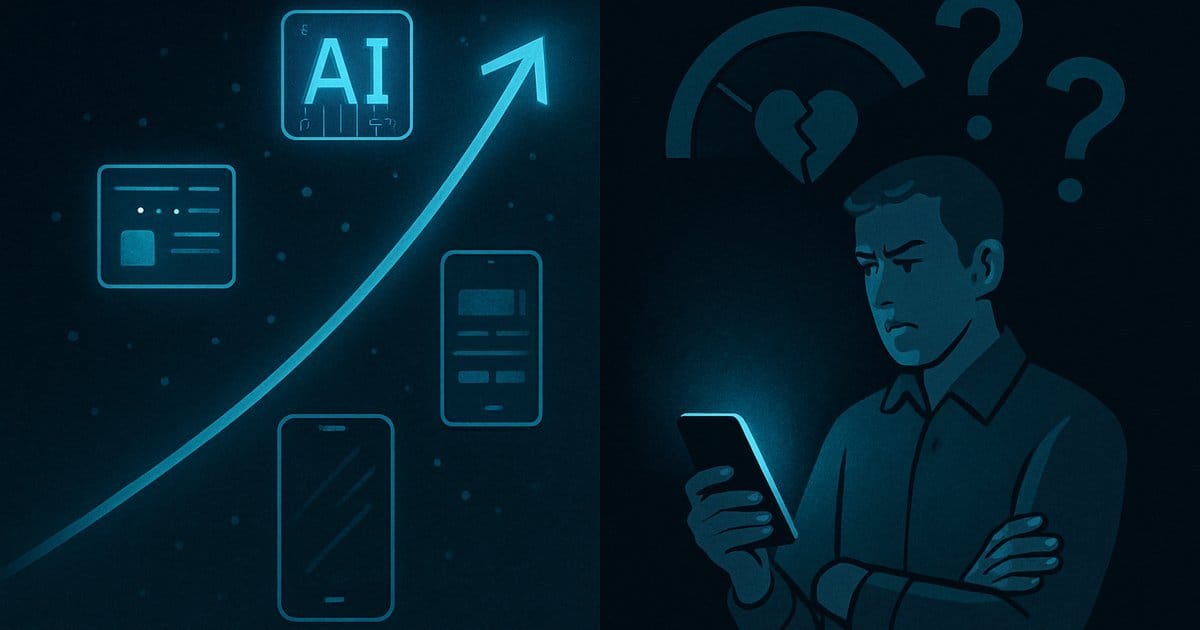
Imagine using a tool every day that you consider fundamentally unreliable. It sounds absurd—but it’s the reality for hundreds of millions of people worldwide who work with AI systems on a daily basis. Usage figures are skyrocketing, while trust levels remain stagnant at a low point. This paradox is not a temporary phenomenon, a measurement error, or a communication problem within the tech industry. It is a fundamental characteristic of how people interact with a technology they find both useful and unpredictable. This article explains exactly what lies behind this, why greater technical transparency does not solve the problem—and what it means to use AI with vigilant oversight rather than blind trust.
The paradox in numbers: Increased use, same level of distrust
The data is clear and remarkably consistent. A representative survey conducted by Quinnipiac University in March 2026 among 1,397 U.S. adults shows that 51 percent use AI tools for research—up from 37 percent a year earlier. For data analysis, the usage rate rose from 17 to 27 percent, and for image generation, from 16 to 24 percent. AI has become measurably more widespread even in school projects.
At the same time, only 21 percent of respondents “mostly” or “almost always” trust AI-generated information. 76 percent trust AI only “sometimes” or “hardly ever”—and this figure has hardly changed from the previous year, even though usage has risen sharply in nearly all categories. Chetan Jaiswal of Quinnipiac University sums it up: “Americans are clearly adopting AI, but they are doing so with hesitation, not trust.”
This picture is confirmed by another study. CloudResearch surveyed around 1,000 Americans in February 2026 and arrived at similar results: 45 percent use AI daily, while only 2 percent have never used AI. Yet only 28 percent would say they trust AI “mostly” or “completely.” And 39 percent said they would want to press a hypothetical “AI stop button” if one existed.
What’s interesting here: 74 percent of respondents in the CloudResearch study said they felt little or no fear of AI. Distrust and fear must therefore be distinguished. People do not fear AI—they doubt it. This is an important distinction that explains why usage is still on the rise.
This phenomenon is also evident in Germany: According to the ManpowerGroup Global Talent Barometer 2026, 41 percent of German employees now use AI regularly in their daily work—seven percentage points more than in the previous year. Another pattern is noteworthy here: The study describes a so-called “AI Confidence Gap”—usage is rising, but employees’ confidence in their own competence is falling. Those who work with AI on a daily basis begin to doubt whether they can still adequately assess the results.
Why usage and trust are decoupled
To understand this paradox, one must first question a widespread assumption: the idea that people only use something if they trust it. That may apply to doctors or banks—but with AI tools, this logic apparently works differently.
The decisive factor is the perceived benefit in the here and now. AI assistants provide quick answers, rephrase texts, summarize documents—all in seconds. This pragmatic value is immediately apparent, even if one doesn’t fully trust the result. People review AI outputs, correct them, and use them as a starting point rather than a final product. That isn’t trust—it’s an instrumental relationship.
What’s more: Getting started with AI tools is virtually free today, both financially and cognitively. ChatGPT, Gemini, Copilot—these tools are just a click away. The barrier to trying them out is minimal. The consequences of poor output are manageable in many everyday applications: a poorly worded draft, an inaccurate summary. The damage is manageable, the time saved is real.
On a global scale, usage data illustrates the extent of this development. The OpenRouter/a16z report “100 Trillion Tokens,” analyzing real-world LLM usage data in early 2026, found that AI has evolved into global infrastructure—an “essential computational substrate” comparable to the internet. More than 50 percent of token usage now comes from countries outside the U.S. No single model dominates; users choose contextually based on capability, price—and yes, trust as well. Open-weight models are gaining ground over proprietary systems, indicating a growing need for transparency and control.
So the paradox has a pragmatic explanation: Trust in AI is not a prerequisite for use—it is a factor that influences the nature of use. Those who trust delegate. Those who doubt verify. And many people do both at the same time.
Automation Bias and Algorithm Aversion — the two pitfalls
Distrust of AI sounds like a reasonable stance. But research shows: Too much distrust is just as problematic as too little. Both extremes lead to poor decisions—for different reasons.
Martino Maggetti of the University of Lausanne describes in his paper “Reciprocal Trust and Distrust in AI Systems” (to be published in 2026 in AI & Society) describes two cognitive traps that AI users regularly fall into.
The first is Automation Bias: the tendency to place excessive trust in machine judgments and to set aside one’s own critical assessment. Anyone who uncritically accepts AI outputs—because they sound convincing, because they come quickly, because the system suggests it has already checked everything—becomes an extension of a technology that can hallucinate, misunderstand contexts, or rely on outdated data. Automation Bias is particularly insidious because it masquerades as efficiency.
The second trap is Algorithm Aversion: After a negative experience with AI—an obvious error, a wrong recommendation, an embarrassing output—trust plummets disproportionately. People turn away from algorithm-based systems, even if these deliver better results overall than human alternatives. A single spectacular error overshadows a hundred correct outputs. This is psychologically understandable, but epistemically problematic.
Both phenomena are confirmed by the survey data. The main reasons for mistrust in the CloudResearch study are telling: Two-thirds of respondents cite “hallucinations”—that is, concrete, experienced, or known errors of AI systems. 44 percent point to uncontrolled AI development, reflecting a diffuse structural unease rather than personal experiences. The experienced error leaves a stronger impression than the abstract benefit.
For companies, there is an additional dimension. A study by Old Dominion University and Deloitte (2026) shows that 76 percent of the data leaders surveyed cannot monitor their employees’ use of AI. AI runs in production systems without compliance teams’ knowledge—so-called “shadow AI.” You cannot be accountable for what you do not know. A lack of governance is thus not only a compliance risk but an active trust killer—toward customers, partners, and one’s own workforce.
Why more transparency doesn’t solve the problem
The tech industry’s common reflex to trust issues: more explainability. Explain how the model works. Show what data it used. Describe the confidence values. That sounds plausible—and is poorly supported by empirical evidence.
In his research, Maggetti describes a transparency dilemma: More technical details about AI systems reduce public trust rather than strengthening it. The more people learn about how a language model works—training data, token probabilities, statistical prediction processes—the less capable they feel of evaluating the results. Revealing complexity creates uncertainty, not certainty.
This phenomenon is familiar from other fields. Those who have never thought about the error rate of blood tests trust the result. Those who know that blood tests have an error rate of a few percent and depend on laboratory conditions become more uncertain—not because the test has become less reliable, but because its complexity has become visible.
This does not mean that transparency is harmful. But it shows that transparency alone is not a recipe for trust. Trust does not arise from technical disclosure, but from experience, context, and control. Users do not need an explanation of how a model works internally—they need evidence that it functions reliably in their specific use case.
Added to this is what Maggetti describes as a bidirectional trust structure: trust in AI is not a one-sided act. AI systems themselves act as agents of trust—they make assumptions about their users, model expectations, and set implicit norms. A system that delivers an answer with high confidence without signaling where it is uncertain does not “trust” the user—it deceives them. This asymmetry is a central design problem that cannot be solved by explanatory texts alone.
What “Watchful Trust” Means — and Why It’s Not a Contradiction
The concept that Maggetti proposes as an alternative to blind acceptance and blanket distrust is called “Watchful Trust” — watchful trust. It describes an attitude that is neither passively dismissive nor naively delegating: You use AI systems, but you retain control. You trust the output as a starting point, not as a final judgment. You remain alert to errors without discarding the entire system at every mistake.
This attitude sounds like common sense—and it is. But it requires more than good intentions. It presupposes that users develop the ability to critically evaluate AI outputs. This is not technical competence in the narrow sense, but a kind of epistemic hygiene: Do I know what this system is good for? Do I know where it systematically fails? Do I know the contexts in which I should trust it more or less?
This is precisely where the real problem of the AI Confidence Gap lies, as measured by ManpowerGroup in Germany. It is not AI that makes employees feel insecure—but their own inability to reliably assess the quality of its outputs. Those who work with AI daily but have never learned to systematically assess its limitations feel increasingly dependent. The tool is growing faster than the ability to control it.
Watchful Trust is therefore also an organizational task. Companies that introduce AI tools without training employees in critical evaluation do not produce autonomous AI users—they produce automation bias at the corporate level. The lack of governance structures, which becomes apparent in Shadow AI research, are symptoms of this gap: AI is used because it is useful. But no one has defined under what conditions it can be trusted.
For the general public, Watchful Trust means, in concrete terms: treating AI outputs as drafts, not as final results. Actively cross-checking critical use cases—medical information, legal assessments, political guidance. Making one’s own framework of trust explicit: In which areas have I had good experiences? Where has AI led me astray before? And what sources or methods do I use for verification?
These are not questions that AI can answer. They are questions that users must ask themselves—and that society, school systems, and companies should support them in doing so.
Conclusion
The AI paradox—increasing use amid stagnant trust—is not a contradiction, but a sign of maturity. People have learned to use AI pragmatically without blindly trusting it. They delegate routine tasks but retain control over critical decisions. This is not irrationality—it is adaptation.
Problems arise where this adaptation fails: where automation bias replaces critical judgment, where a lack of governance allows shadow AI to proliferate, where the AI confidence gap widens because no one invests in critical expertise. Trust in AI will not increase through greater explainability alone—but through better experiences, clearer boundaries, and a culture of vigilant engagement.
Trust in AI is not a binary switch. It is a relationship that must be nurtured, questioned, and adapted — just like any other tool complex enough to occasionally surprise us.
🩺
The Doctor’s Opinion: I interpret the paradox of increasing usage and stagnating trust as a healthy sign—it points to more empowered users who use AI as a tool without relinquishing their judgment. However, the governance gap at the corporate level remains troubling: Those who tolerate shadow AI while simultaneously preaching responsibility undermine not only internal trust but also societal acceptance of this technology. Watchful Trust is the right framework—but it needs structural support, not just good will.


